
We read your photo as:
Explain social justice promotion and analyze population growth in Africa, including its causes and effects.
ScanSolve AI Answer
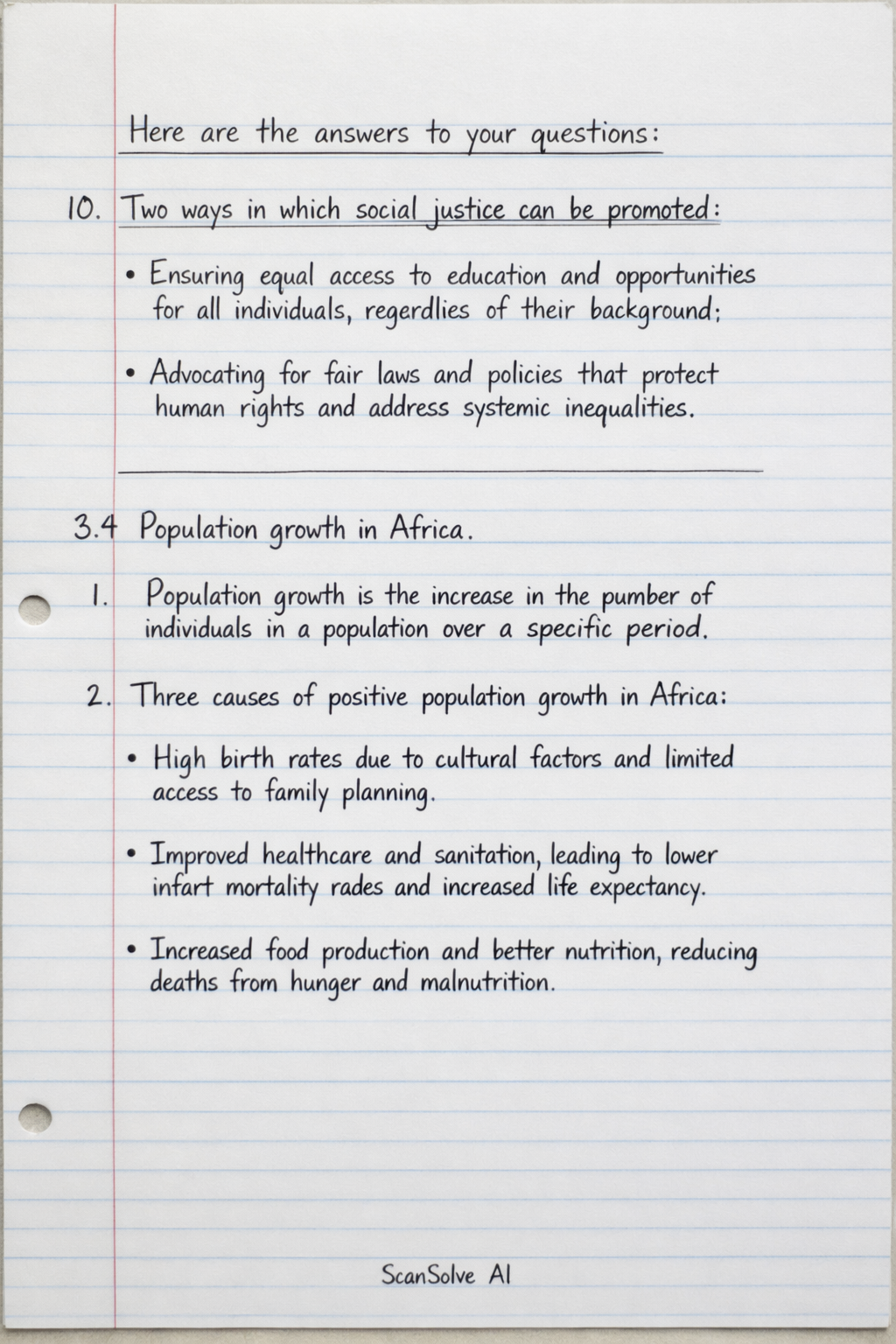
Here are the answers to your questions:
- Two ways in which social justice can be promoted:
- Ensuring equal access to education and opportunities for all individuals, regardless of their background.
- Advocating for fair laws and policies that protect human rights and address systemic inequalities.
3.4 Population growth in Africa.
-
Population growth is the increase in the number of individuals in a population over a specific period.
-
Three causes of positive population growth in Africa:
- High birth rates due to cultural factors and limited access to family planning.
- Improved healthcare and sanitation, leading to lower infant mortality rates and increased life expectancy.
- Increased food production and better nutrition, reducing deaths from hunger and malnutrition.
-
Three causes of population decrease in Africa:
- High mortality rates due to diseases like HIV/AIDS, malaria, and tuberculosis.
- Emigration of people seeking better economic opportunities or fleeing conflict.
- Conflicts, wars, and natural disasters leading to significant loss of life and displacement.
-
Three negative effects of population increase:
- Increased pressure on natural resources such as water, land, and forests.
- Strain on social services like education, healthcare, and housing.
- Higher rates of unemployment and poverty due to a larger workforce competing for limited jobs.
-
Migration is the movement of people from one place to another with the intention of settling temporarily or permanently in a new location.
-
Three effects of migration in Africa:
- Brain drain, where skilled professionals leave their home countries, leading to a loss of human capital.
- Remittances, which are funds sent by migrants back to their home countries, supporting families and local economies.
- Cultural exchange and diversity in both host and origin communities.
-
Four examples of internal migration:
- Rural-to-urban migration (people moving from villages to cities for work).
- Seasonal migration (e.g., agricultural workers moving during harvest seasons).
- Migration due to natural disasters (people relocating after floods or droughts).
- Migration for education or employment within different regions of a country.
-
Two forms of external migration:
- Emigration (leaving one's country to settle in another).
- Immigration (entering a new country to settle there).
-
Mortality in relation to population growth refers to the death rate within a population, which is a key factor in determining how a population changes over time.
-
Demography is the statistical study of human populations, including their size, structure, distribution, and how these change over time due to births, deaths, migration, and aging.
Still stuck on this one?
Ask a follow-up, and the answer starts from this question.
More Geography Questions
Handwritten Step-by-Step Solution
Get this as a handwritten image on WhatsApp — like a tutor wrote it for you.
Try on WhatsApp