
We read your photo as:
Explain the summer solstice, including Earth's position and its effect on the Northern Hemisphere.
ScanSolve AI Answer
Step-by-step solution
3 stepsHere's the explanation for question 3:
Define Summer Solstice.
The summer solstice is the day of the year when one of Earth's hemispheres experiences its longest period of daylight and the Sun reaches its highest point in the sky.
Describe Earth's position during Summer Solstice.
During the summer solstice in the Northern Hemisphere (around June 21), the Earth's axis is tilted 23.5 degrees towards the Sun. This means the Northern Hemisphere is maximally tilted towards the Sun, receiving direct sunlight.
Explain the effect on the Northern Hemisphere.
Due to this tilt, the Sun's rays hit the Tropic of Cancer directly, leading to longer days and warmer temperatures in the Northern Hemisphere. Conversely, the Southern Hemisphere is tilted away from the Sun, experiencing its winter solstice.
Still stuck on this one?
Ask a follow-up, and the answer starts from this question.
More Geography Questions
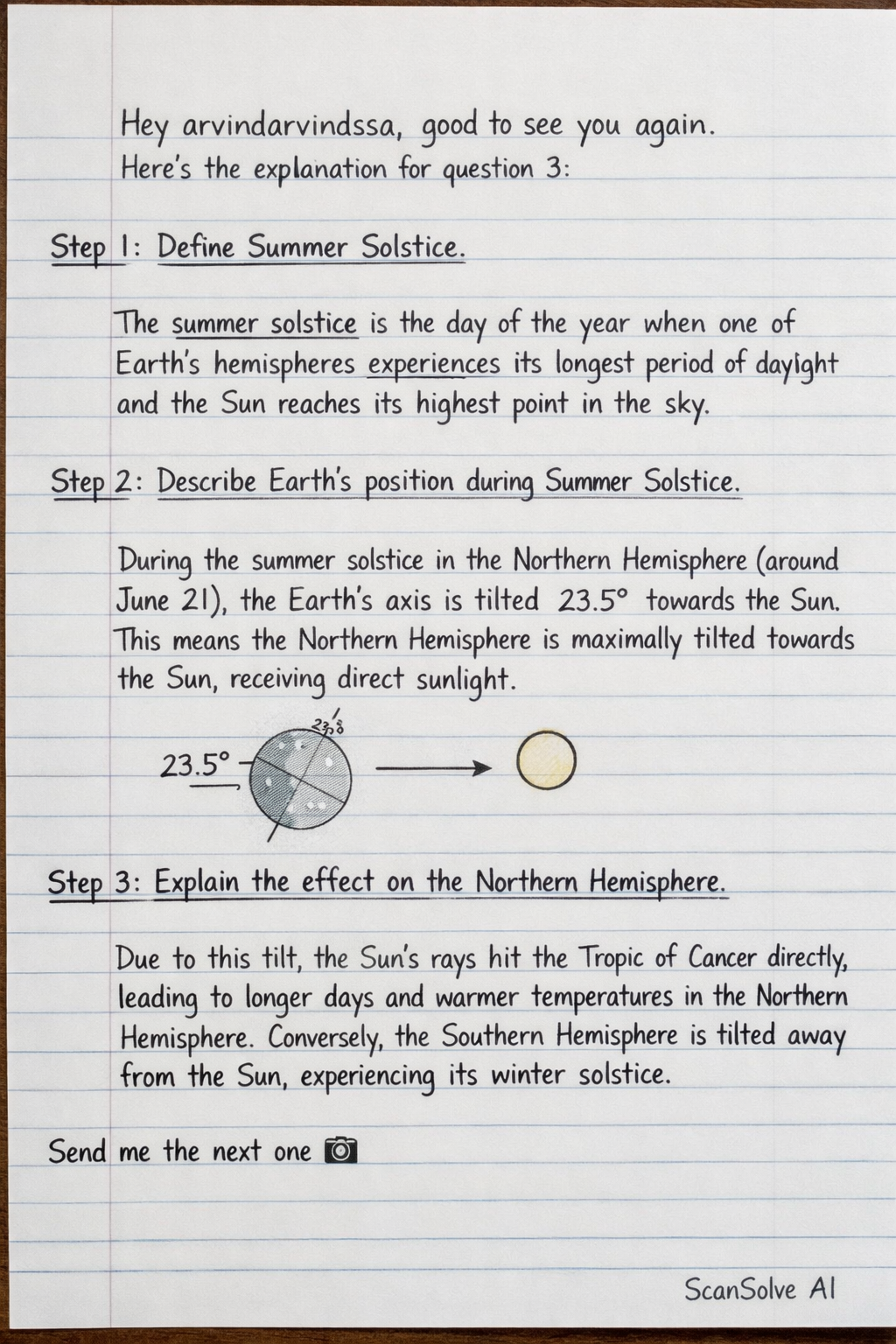
Handwritten Step-by-Step Solution
Get this as a handwritten image on WhatsApp — like a tutor wrote it for you.
Try on WhatsApp