

This geography problem is solved step by step below, with detailed explanations to help you understand the method and arrive at the correct answer.
ScanSolve AI Answer
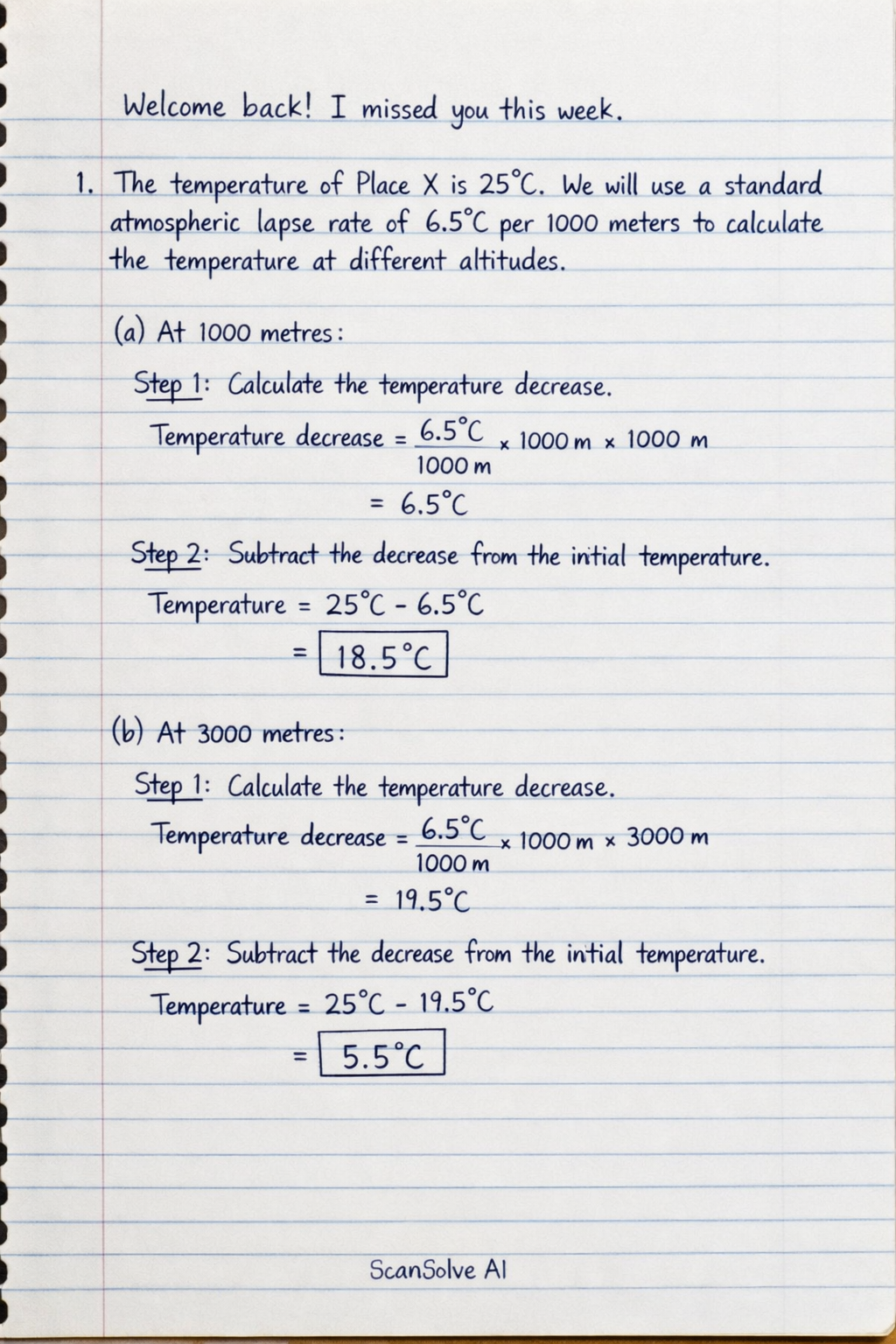
Welcome back In — missed you this week. 1. The temperature of Place X is 25^. We will use a standard atmospheric lapse rate of 6.5^ per 1000 meters to calculate the temperature at different altitudes. a) At 1000 metres: Step 1: Calculate the temperature decrease. Temperature decrease = 6.5^1000 m × 1000 m = 6.5^ Step 2: Subtract the decrease from the initial temperature. Temperature = 25^ - 6.5^ = 18.5^ b) At 3000 metres: Step 1: Calculate the temperature decrease. Temperature decrease = 6.5^1000 m × 3000 m = 19.5^ Step 2: Subtract the decrease from the initial temperature. Temperature = 25^ - 19.5^ = 5.5^ c) At 5000 metres: Step 1: Calculate the temperature decrease. Temperature decrease = 6.5^1000 m × 5000 m = 32.5^ Step 2: Subtract the decrease from the initial temperature. Temperature = 25^ - 32.5^ = -7.5^ 2. Two reasons why temperatures are cooler at higher altitudes than at sea level are: • Less atmospheric density: At higher altitudes, the air is thinner with fewer molecules to absorb and retain heat radiated from the Earth's surface. • Adiabatic cooling: As air rises, it expands due to lower atmospheric pressure. This expansion causes the air to cool as its internal energy is used to do work. 3. Altitude and temperature significantly influence where people live. Most human populations reside at lower to moderate altitudes where temperatures are milder and oxygen levels are sufficient for comfortable breathing and agriculture. Extreme cold at high altitudes and extreme heat in some low-lying areas limit habitability, making these regions less densely populated due to challenges in survival, resource availability, and farming. Send me the next one 📸