
We read your photo as:
How does atmospheric pressure decrease with altitude? Also, solve for pressure given force and area.
ScanSolve AI Answer
This answer stops before the end.
It was cut off when it was first written. Ask ScanSolve this question again for the full working.
foot}} = 180 cm^2$$
Step 2: Calculate the total area of contact when standing on two feet.
Step 3: Convert the total area to square meters (m).
Step 4: Calculate the pressure using the formula .
The pressure exerted on the ground is .
7. Calculate the pressure if a force of 23 N is applied over an area of 46 m.
Step 1: Identify the given values.
Step 2: Calculate the pressure using the formula .
The pressure is .
8. How atmospheric pressure decrease with altitude?
Atmospheric pressure decreases with altitude because there is a shorter column of air above you at higher elevations. This means there is less air pressing down, and the air itself is less dense at higher altitudes, resulting in lower pressure.
Still stuck on this one?
Ask a follow-up, and the answer starts from this question.
More Physics Questions
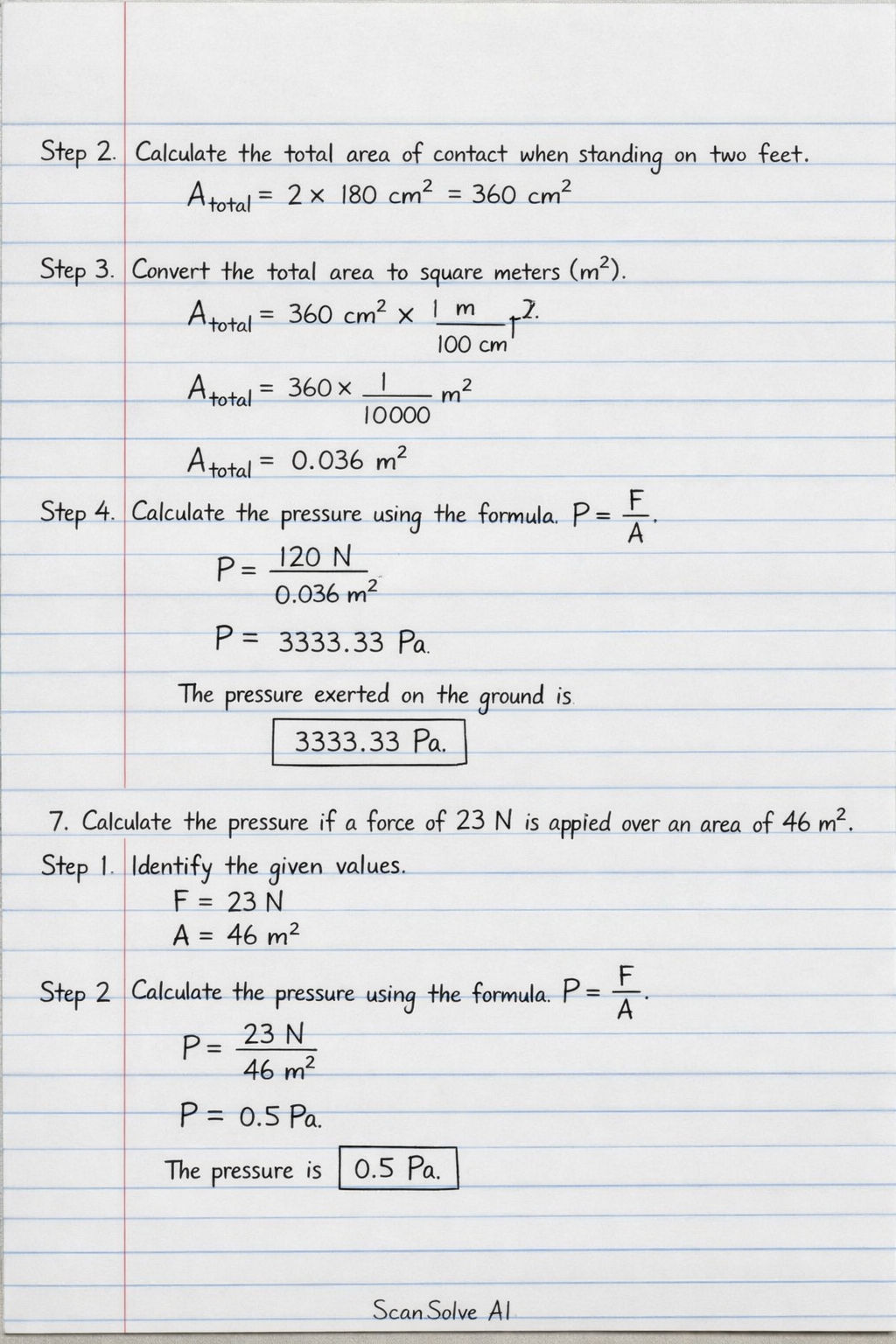
Handwritten Step-by-Step Solution
Get this as a handwritten image on WhatsApp — like a tutor wrote it for you.
Try on WhatsApp