
We read your photo as:
What are the adaptations of desert plants and the importance of route maps and data recording methods in field studies?
Geography
ScanSolve AI Answer
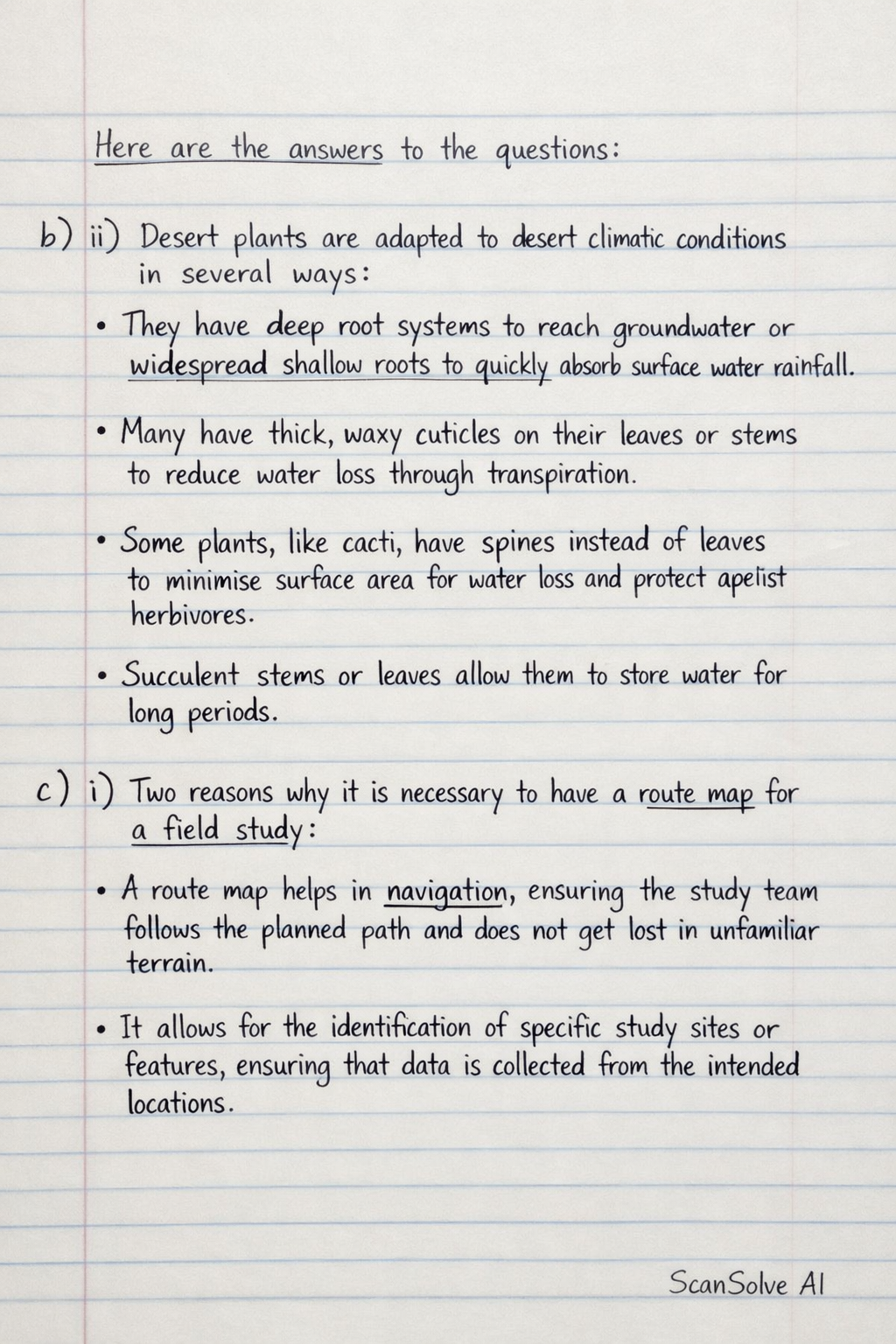
Here are the answers to the questions:
b) ii) Desert plants are adapted to desert climatic conditions in several ways:
- They have deep root systems to reach groundwater or widespread shallow roots to quickly absorb surface water after rainfall.
- Many have thick, waxy cuticles on their leaves or stems to reduce water loss through transpiration.
- Some plants, like cacti, have spines instead of leaves to minimize surface area for water loss and protect against herbivores.
- Succulent stems or leaves allow them to store water for long periods.
c) i) Two reasons why it is necessary to have a route map for a field study:
- A route map helps in navigation, ensuring the study team follows the planned path and does not get lost in unfamiliar terrain.
- It allows for the identification of specific study sites or features, ensuring that data is collected from the intended locations.
ii) Two methods used to record data during a field study:
- Note-taking: Writing down observations, measurements, and qualitative descriptions.
- Photography/Videography: Capturing visual evidence of the study area, vegetation, and specific features.
- a) The differentiation between weathering and mass wasting:
- Weathering is the in-situ breakdown and decomposition of rocks and minerals at or near the Earth's surface, involving little to no movement of the weathered material.
- Mass wasting (or mass movement) is the downslope movement of rock, soil, and regolith under the direct influence of gravity, often involving the movement of material that has already been weathered.
ii) Four processes of mechanical weathering:
- Frost action (or freeze-thaw weathering)
- Pressure release (or unloading)
- Thermal expansion and contraction (or block disintegration)
- Salt crystal growth (or salt weathering)
Was this helpful?
Still stuck on this one?
Ask a follow-up, and the answer starts from this question.
Got a different question?Ask your own question
More Geography Questions
QDescribe adaptations of xerophytes to their habitat, including adaptations for reducing water loss…Q3 (a) (i) State THREE problems faced by natural vegetation across the world today. (ii) Outline…QWhich of the following tools is used during fieldwork data collection to record visual evidence of…QTheir adaptation to drier areasQDescribe the adaptations of various organisms like cacti, fish, and frogs to their respective…
Handwritten Step-by-Step Solution
Get this as a handwritten image on WhatsApp — like a tutor wrote it for you.
Try on WhatsApp