
We read your photo as:
Explain the Urban Heat Island effect, including how building density contributes, and describe a pollution dome during the night.
ScanSolve AI Answer
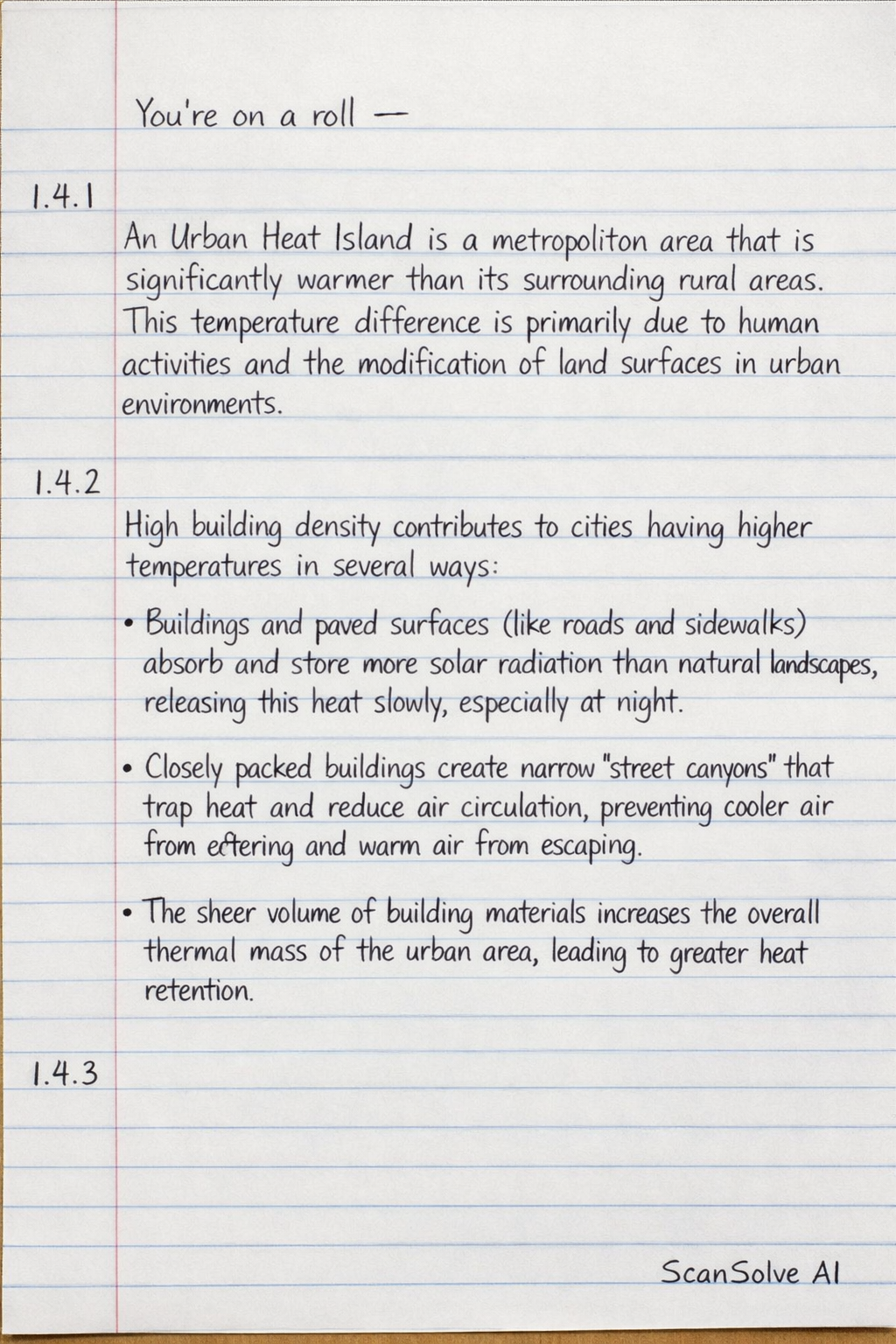
1.4.1
An Urban Heat Island is a metropolitan area that is significantly warmer than its surrounding rural areas. This temperature difference is primarily due to human activities and the modification of land surfaces in urban environments.
1.4.2
High building density contributes to cities having higher temperatures in several ways:
- Buildings and paved surfaces (like roads and sidewalks) absorb and store more solar radiation than natural landscapes, releasing this heat slowly, especially at night.
- Closely packed buildings create narrow "street canyons" that trap heat and reduce air circulation, preventing cooler air from entering and warm air from escaping.
- The sheer volume of building materials increases the overall thermal mass of the urban area, leading to greater heat retention.
1.4.3
A labelled diagram showing the structure of a pollution (dust) dome during the night would illustrate:
- A city skyline with buildings.
- A dome-shaped layer of pollutants (dust, smoke, gases) hovering above the city.
- This dome is typically lower over the city center and extends outwards.
- Labels should include: City, Pollution Dome, Trapped Heat/Pollutants. The dome acts as a blanket, trapping heat and preventing its escape into the atmosphere.
1.4.4
A pollution dome intensifies the heat island effect by trapping outgoing longwave radiation emitted from the urban surface. The pollutants within the dome act as a blanket, absorbing and re-emitting this heat back towards the city, preventing it from escaping into the atmosphere and thus increasing ambient temperatures.
1.4.5
Two sustainable solutions city planners can introduce to reduce the temperature in the CBD are:
- Increasing urban green spaces: Planting more trees, creating parks, and implementing green roofs and walls can provide shade, reduce heat absorption, and cool the air through evapotranspiration.
- Using reflective materials: Incorporating light-colored or reflective materials for roofs, pavements, and building facades can reflect more solar radiation, reducing the amount of heat absorbed and stored by urban surfaces.
Still stuck on this one?
Ask a follow-up, and the answer starts from this question.
More Geography Questions
Handwritten Step-by-Step Solution
Get this as a handwritten image on WhatsApp — like a tutor wrote it for you.
Try on WhatsApp