
We read your photo as:
Define weathering of rocks and explain any four processes of physical weathering.
Geography
ScanSolve AI Answer
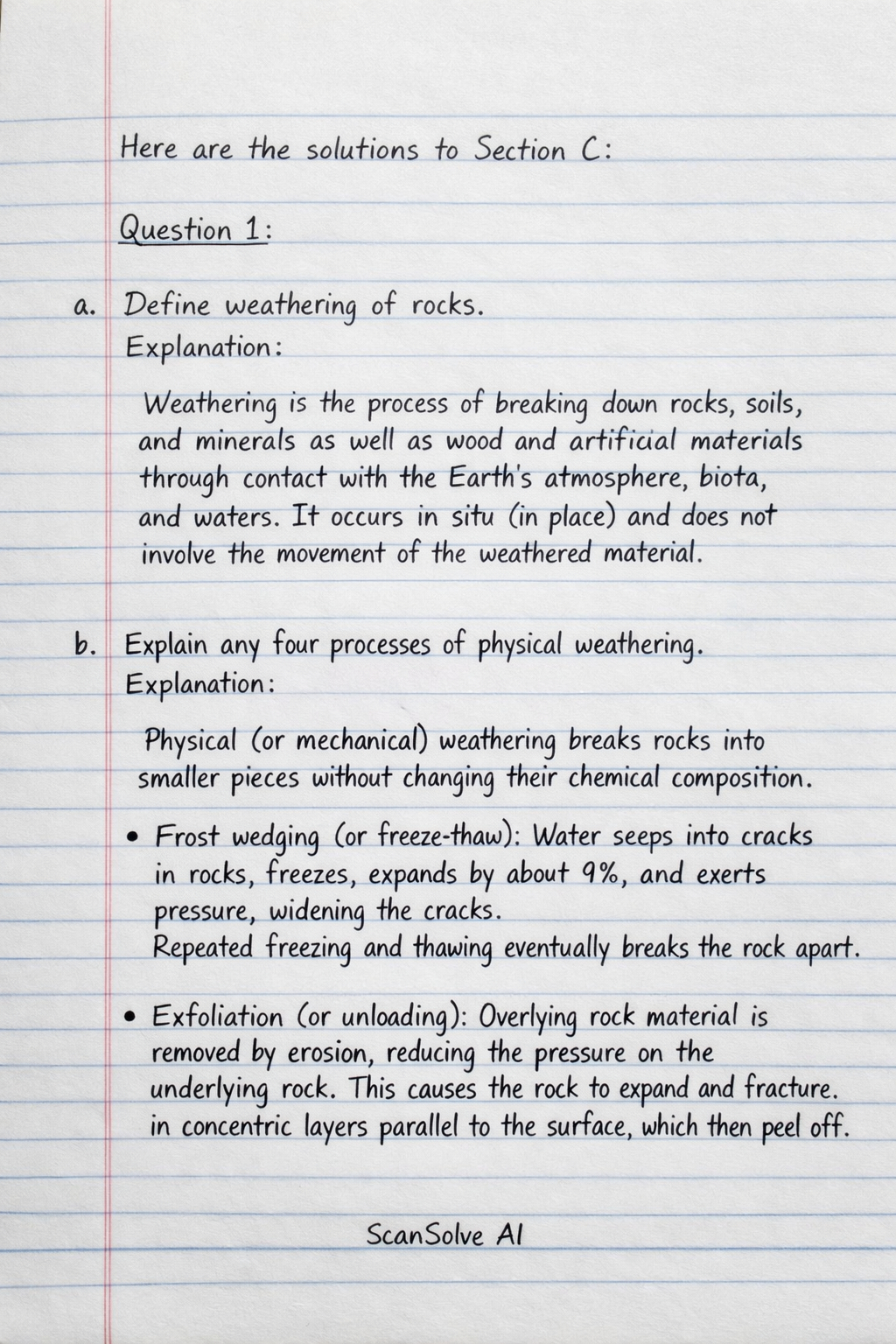
Here are the solutions to Section C:
Question 1:
-
a. Define weathering of rocks.
- Explanation: Weathering is the process of breaking down rocks, soils, and minerals as well as wood and artificial materials through contact with the Earth's atmosphere, biota, and waters. It occurs in situ (in place) and does not involve the movement of the weathered material.
-
b. Explain any four processes of physical weathering.
- Explanation: Physical (or mechanical) weathering breaks rocks into smaller pieces without changing their chemical composition.
- • Frost wedging (or freeze-thaw): Water seeps into cracks in rocks, freezes, expands by about 9%, and exerts pressure, widening the cracks. Repeated freezing and thawing eventually breaks the rock apart.
- • Exfoliation (or unloading): Overlying rock material is removed by erosion, reducing the pressure on the underlying rock. This causes the rock to expand and fracture in concentric layers parallel to the surface, which then peel off.
- • Thermal expansion and contraction: Rocks heat up and expand during the day and cool down and contract at night. Different minerals within a rock expand and contract at different rates, leading to internal stresses that cause the rock to fracture over time, especially in desert environments.
- • Salt crystal growth (or salt wedging): In arid and coastal regions, saltwater penetrates rock pores and cracks. As the water evaporates, salt crystals grow, exerting pressure on the rock and causing it to disintegrate.
-
c. State any three factors influencing the nature and rate of weathering of rocks.
- • Rock type and composition: Different minerals and rock structures have varying resistance to weathering. For example, granite is generally more resistant than limestone.
- • Climate: Temperature and moisture levels significantly impact weathering. High rainfall and warm temperatures accelerate chemical weathering, while freeze-thaw cycles are prominent in cold, wet climates.
- • Topography (relief): Steeper slopes promote faster removal of weathered material, exposing fresh rock to further weathering. Flatter areas may accumulate weathered material, slowing down the process.
Question 2:
-
a. Briefly differentiate between weather and climate.
- Explanation: Weather refers to the atmospheric conditions at a specific place and time, encompassing elements like temperature, precipitation, wind, and humidity over short periods (hours to days). Climate, on the other hand, describes the average weather patterns of a region over long periods, typically 30 years or more, including seasonal variations and extremes.
-
b. Discuss any four factors that can influence the climate of an area.
- Explanation: The climate of an area is determined by several interacting factors:
- • Latitude: Areas closer to the equator receive more direct sunlight and experience higher temperatures, while areas closer to the poles receive less direct sunlight and are colder. This influences temperature and seasonal variations.
- • Altitude: As altitude increases, air pressure and temperature generally decrease. High-altitude regions, like mountains, tend to be colder and often receive more precipitation than low-lying areas.
- • Proximity to large bodies of water: Oceans and large lakes moderate temperatures in nearby land areas. Water heats up and cools down more slowly than land, leading to milder winters and cooler summers in coastal regions compared to inland areas at the same latitude.
- • Ocean currents: Warm ocean currents (e.g., Gulf Stream) bring warmer temperatures and increased moisture to coastal regions, while cold currents (e.g., California Current) can lead to cooler, drier conditions and even deserts.
Question 3:
-
a. What is water cycle?
- Explanation: The water cycle (or hydrological cycle) is the continuous movement of water on, above, and below the surface of the Earth. It involves the circulation of water through various states (liquid, solid, gas) and reservoirs (oceans, atmosphere, land, groundwater).
-
b. Discuss the processes involved in the water cycle.
- Explanation: The water cycle is driven by solar energy and gravity, involving several key processes:
- • Evaporation: The process by which water changes from a liquid to a gas (water vapor) and rises into the atmosphere, primarily from oceans, lakes, and rivers.
- • Transpiration: The process by which plants release water vapor into the atmosphere through their leaves.
- • Condensation: As water vapor rises and cools in the atmosphere, it changes back into liquid water droplets or ice crystals, forming clouds.
- • Precipitation: Water released from clouds in the form of rain, snow, sleet, or hail, falling back to the Earth's surface.
- • Runoff: Water that flows over the land surface, eventually reaching rivers, lakes, and oceans.
- • Infiltration/Percolation: Water that seeps into the ground, becoming soil moisture or groundwater.
-
c. State any four importance of the water/hydrological cycle to mankind.
- • Provides freshwater: The water cycle continuously replenishes freshwater sources like rivers, lakes, and groundwater, which are essential for drinking, agriculture, and industry.
- • Regulates climate: Evaporation and condensation play a crucial role in transferring heat around the globe, influencing regional and global climate patterns.
- • Supports ecosystems: Water is fundamental for all life forms, supporting plant growth, animal habitats, and the overall biodiversity of ecosystems.
- • Generates energy: The movement of water in rivers and through dams is harnessed to generate hydroelectric power, a renewable energy source.
Was this helpful?
Still stuck on this one?
Ask a follow-up, and the answer starts from this question.
Got a different question?Ask your own question
More Geography Questions
QDiscuss any four types of mechanical weathering processes.QDescribe the process of rock weathering.QSECTION B PHYSICAL GEOGRAPHY Define any TWO of the following: Weathering. (ii) Wind abrasion. (iii)…QWhat are the three major types of weathering?QQuestion 1: Read the statements and classified each process as weathering, erosion and deposition…
Browse by topic:Earth Science
Handwritten Step-by-Step Solution
Get this as a handwritten image on WhatsApp — like a tutor wrote it for you.
Try on WhatsApp