
We read your photo as:
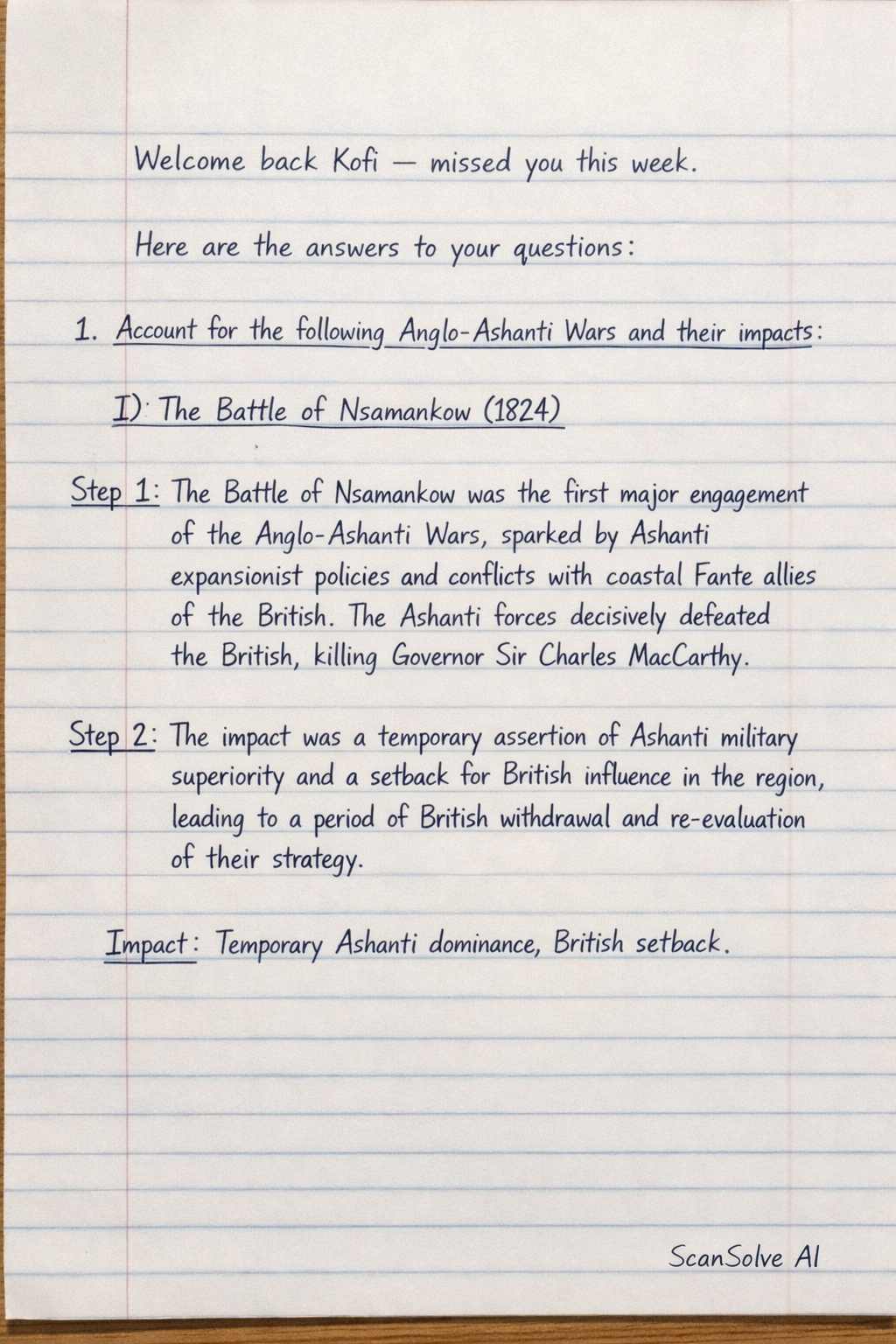
Account for the following Anglo-Ashanti Wars and their impacts: I) The Battle of Nsamankow (1824) II) The Battle of Akatamanso (1826) III) The Sagrenti War (1873)
ScanSolve AI Answer
Step-by-step solution
20 stepsHere are the answers to your questions:
-
Account for the following Anglo-Ashanti Wars and their impacts:
- I) The Battle of Nsamankow (1824)
The Battle of Nsamankow was the first major engagement of the Anglo-Ashanti Wars, sparked by Ashanti expansionist policies and conflicts with coastal Fante allies of the British.
The Ashanti forces decisively defeated the British, killing Governor Sir Charles MacCarthy.
The impact was a temporary assertion of Ashanti military superiority and a setback for British influence in the region, leading to a period of British withdrawal and re-evaluation of their strategy.
**Impact: Temporary Ashanti dominance, British setback.** * **II) The Battle of Akatamanso (1826)**This battle saw a combined force of British, Fante, Ga, and Denkyira troops confront the Ashanti army near Dodowa.
The allied forces, utilizing superior weaponry and tactics, inflicted a crushing defeat on the Ashanti.
The impact was a significant shift in power, ending Ashanti control over the coastal states and forcing them to sign a treaty in 1831, recognizing the independence of these states and establishing a new boundary.
**Impact: End of Ashanti coastal dominance, shift in regional power.** * **III) The Sagrenti War (1873)**Also known as the Third Anglo-Ashanti War, this conflict was triggered by Ashanti incursions into British-protected territories and disputes over trade routes.
A well-equipped British expeditionary force under Sir Garnet Wolseley marched on Kumasi, eventually capturing and burning the Ashanti capital.
The impact was the signing of the Treaty of Fomena, which compelled the Ashanti to pay a large indemnity, renounce claims over southern territories, and cease human sacrifices.
This war paved the way for the formal declaration of the Gold Coast as a British Crown Colony in 1874.
Impact: Ashanti defeat, Treaty of Fomena, British colonial expansion.* **IV) The Golden Stool War (1900)**This war, also known as the Yaa Asantewaa War, erupted when the British Governor of the Gold Coast, Sir Frederick Hodgson, demanded to sit on the Golden Stool, the sacred symbol of Ashanti sovereignty.
This insult provoked a fierce Ashanti rebellion led by Queen Mother Yaa Asantewaa.
Despite initial Ashanti successes, the British eventually suppressed the rebellion.
The impact was the final annexation of the Ashanti Confederacy into the Gold Coast Colony, the exile of Yaa Asantewaa and other Ashanti leaders, and the complete loss of Ashanti independence.
Impact: Ashanti annexation, loss of sovereignty, Yaa Asantewaa's exile.-
Examine the effects of the presence of the Europeans on the following:
- I) Education
-
European missionaries introduced Western-style education, establishing schools to convert Africans to Christianity and train clerks and catechists.
Later, the colonial government also set up schools to produce administrators and skilled labor for the colonial service.
This led to the emergence of a Western-educated elite, the spread of literacy, and the introduction of new subjects and teaching methods, fundamentally altering traditional forms of learning and knowledge transmission.
**Effect: Introduction of Western education, emergence of educated elite.** * **II) Sanitation and health care system**Europeans introduced Western medical practices, establishing hospitals, dispensaries, and public health initiatives to combat diseases like malaria and smallpox, primarily to protect their own personnel but also benefiting the local population.
They also implemented basic sanitation measures in urban areas.
This led to a reduction in mortality rates from certain diseases, the development of a formal healthcare infrastructure, and the introduction of new hygiene standards, though access and quality often remained unequal between Europeans and Africans.
**Effect: Introduction of Western medicine, improved sanitation, formal healthcare system.** * **III) Housing and architectural designs**European presence introduced new building materials such as cement, corrugated iron, and timber, along with new architectural styles like bungalows, administrative buildings, and barracks.
These designs often prioritized functionality, ventilation, and separation from local populations.
This influenced local construction, leading to a blend of traditional and European styles, particularly in urban centers, and a shift away from purely indigenous materials and designs.
**Effect: Introduction of new building materials and European architectural styles.** * **IV) Transport and communication**Europeans developed extensive transport and communication networks primarily to facilitate the extraction of raw materials, administration, and military control.
This included the construction of railways, roads, bridges, and ports.
These developments significantly improved internal and external connectivity, enabling faster movement of goods, people, and information, which in turn supported economic exploitation and administrative efficiency.
**Effect: Development of railways, roads, ports, and telegraph lines.**3. Examine the role of the following British colonial officials in shaping colonial policies in Ghana:
* **I) Secretary of State for the Colonies**The Secretary of State for the Colonies was a cabinet minister in the British government, based in London, responsible for the overall administration and policy direction of all British colonies.
They formulated imperial policy, approved major legislation, and appointed colonial governors.
Their role was to set the broad strategic framework for colonial rule, ensuring that policies in Ghana aligned with the wider interests of the British Empire, including economic exploitation, political control, and maintaining imperial prestige.
**Role: Formulated imperial policy, approved legislation, appointed governors.** * **II) The Governor**The Governor was the chief British representative in the Gold Coast (Ghana), directly responsible for implementing colonial policies and administering the territory.
They held executive, legislative, and often judicial powers, acting as the local head of government.
Their role involved maintaining law and order, overseeing local administration, collecting taxes, commanding military forces, and ensuring the colony's economic resources were exploited for British benefit, all while adhering to directives from the Secretary of State.
**Role: Implemented policies, administered the colony, maintained law and order.**
Still stuck on this one?
Ask a follow-up, and the answer starts from this question.
More History Questions
Handwritten Step-by-Step Solution
Get this as a handwritten image on WhatsApp — like a tutor wrote it for you.
Try on WhatsApp