
We read your photo as:
Describe five (5) common features of ancient African civilizations and explain how geographical features and climate influenced their development. Use specific examples from at least two different regions of Africa in your response. (20 marks)
ScanSolve AI Answer
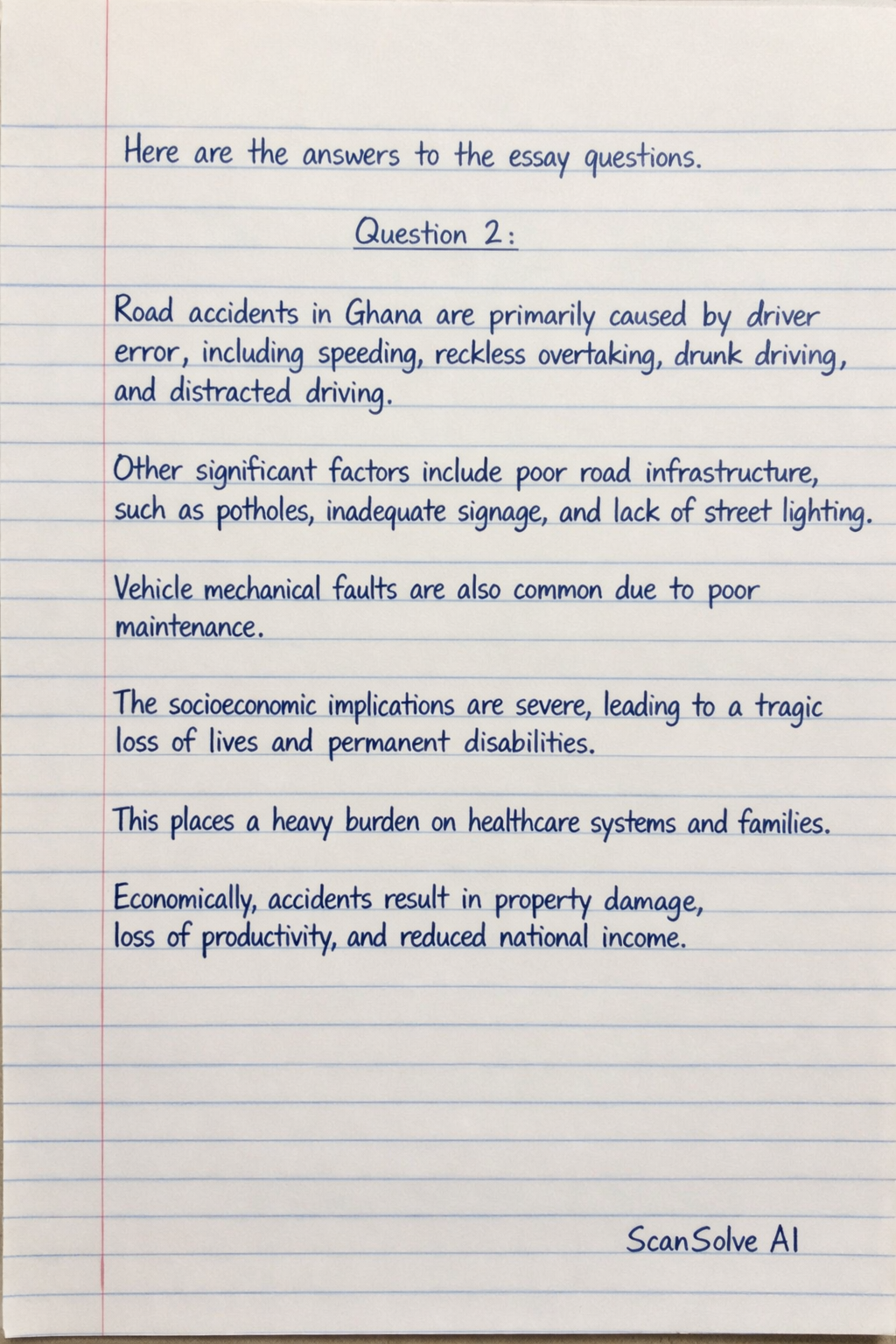
Here are the answers to the essay questions.
Question 2:
Road accidents in Ghana are primarily caused by driver error, including speeding, reckless overtaking, drunk driving, and distracted driving. Other significant factors include poor road infrastructure, such as potholes, inadequate signage, and lack of street lighting, as well as vehicle mechanical faults due to poor maintenance. The socioeconomic implications are severe, leading to a tragic loss of lives and permanent disabilities, which place a heavy burden on healthcare systems and families. Economically, accidents result in property damage, loss of productivity, and reduced national income.
Three effective strategies to minimize road accidents and enhance safety in Ghana include:
- Stricter Enforcement of Traffic Laws: Implementing consistent and visible police presence, using technology like speed cameras, and imposing severe penalties for violations to deter reckless driving.
- Improved Road Infrastructure and Maintenance: Investing in better road design, proper signage, adequate lighting, and regular maintenance to ensure safe driving conditions.
- Intensive Public Education and Awareness Campaigns: Educating drivers, pedestrians, and passengers on road safety rules, the dangers of drunk driving, distracted driving, and the importance of vehicle maintenance.
Question 3:
Ethics and ethical behavior are fundamental to the development of individuals and Ghanaian society, providing a moral compass that guides actions and decisions. At the individual level, ethics fosters integrity, responsibility, and trustworthiness, shaping character and promoting personal growth. In society, ethical conduct builds social cohesion, fairness, and justice, creating an environment where citizens can thrive.
Unethical behavior has detrimental consequences across all levels. Personally, it can lead to a loss of reputation, legal repercussions, and strained relationships. Organizationally, unethical practices like corruption or fraud result in a loss of public trust, financial penalties, reduced productivity, and a damaged brand image. At the societal level, widespread unethical behavior erodes public confidence in institutions, fosters corruption, hinders economic growth, and can lead to social instability and injustice.
Ethical conduct significantly contributes to national development by promoting good governance, ensuring accountability and transparency in public service. It attracts foreign investment by creating a predictable and trustworthy business environment, reduces corruption, and ensures the equitable distribution of resources. Ultimately, a society grounded in strong ethical principles fosters a productive workforce, strengthens democratic institutions, and builds a resilient nation capable of sustainable development.
Question 4:
Indigenous technologies profoundly impacted the development of ancient African societies, enabling significant advancements in various sectors. Metalworking, particularly iron smelting, revolutionized agriculture by providing durable tools like hoes and axes, leading to increased food production and supporting larger populations. It also enhanced military capabilities through the production of superior weapons, contributing to the rise of powerful kingdoms and empires. Irrigation systems, such as canals and water harvesting techniques, allowed communities to cultivate crops in diverse environments, including arid regions, ensuring food security and fostering settled agricultural societies. Transportation technologies, including the use of canoes for riverine travel and domesticated animals like donkeys and later camels for overland routes, facilitated the movement of goods and people across vast distances.
These technologies were crucial in facilitating extensive trade networks and cultural exchange across the continent. Metal tools and weapons became valuable trade commodities, and the knowledge of metallurgy itself spread, influencing other regions. Improved agricultural output from irrigation systems created surpluses that could be traded. Most significantly, efficient transportation systems enabled the Trans-Saharan trade and other regional networks, connecting diverse African societies. This exchange involved not only goods like gold, salt, kola nuts, and textiles but also the diffusion of ideas, languages, religious beliefs (such as Islam), artistic styles, and political structures, leading to the enrichment and interconnectedness of ancient African cultures.
Still stuck on this one?
Ask a follow-up, and the answer starts from this question.
More History Questions
Handwritten Step-by-Step Solution
Get this as a handwritten image on WhatsApp — like a tutor wrote it for you.
Try on WhatsApp