
We read your photo as:
Define History, Education, History of Education, and Realism. Explain 5 educational changes in Kenya since Independence, using examples.
History
ScanSolve AI Answer
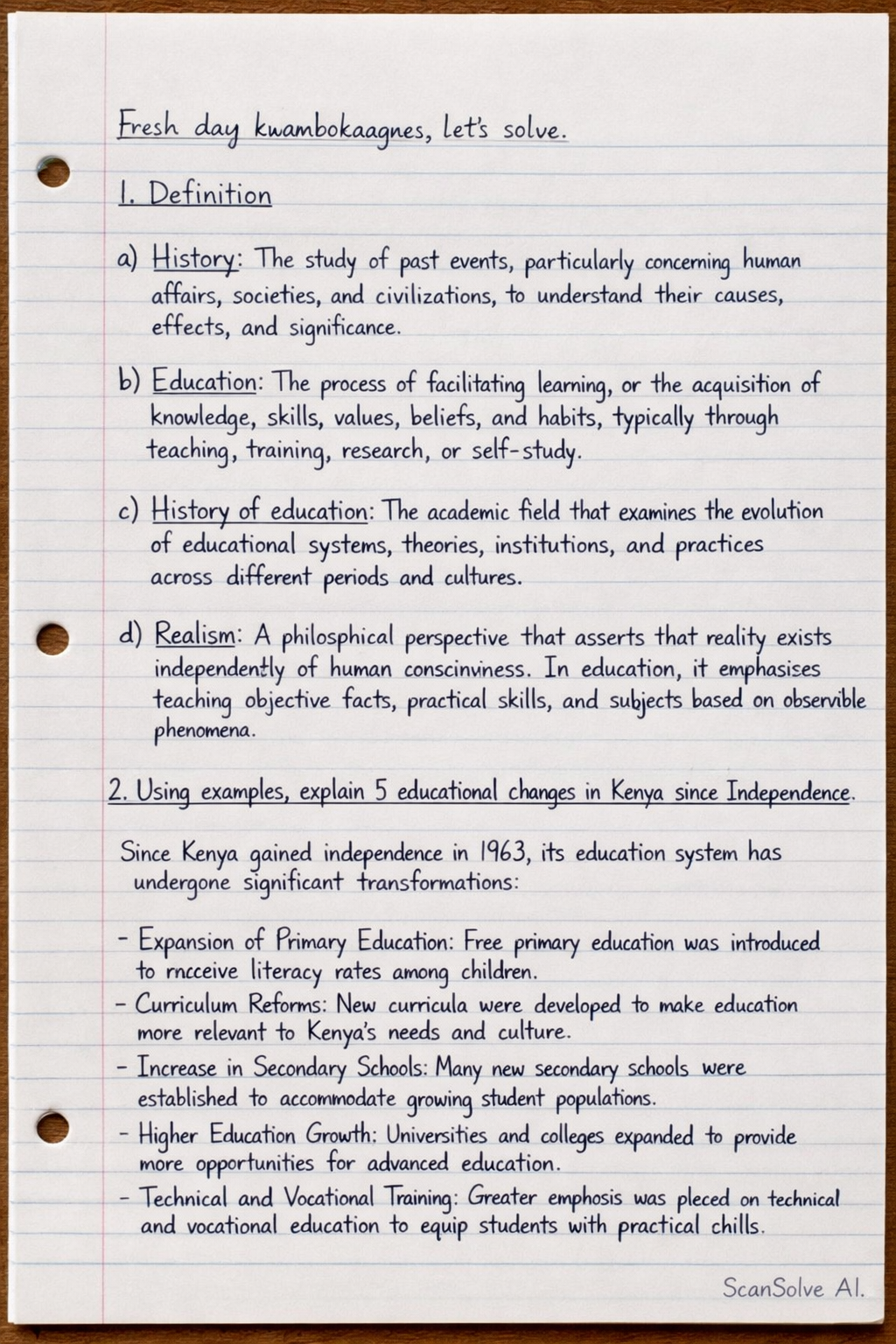
1. Definition
- a) History: The study of past events, particularly concerning human affairs, societies, and civilizations, to understand their causes, effects, and significance.
- b) Education: The process of facilitating learning, or the acquisition of knowledge, skills, values, beliefs, and habits, typically through teaching, training, research, or self-study.
- c) History of education: The academic field that examines the evolution of educational systems, theories, institutions, and practices across different periods and cultures.
- d) Realism: A philosophical perspective that asserts that reality exists independently of human consciousness. In education, it emphasizes teaching objective facts, practical skills, and subjects based on observable phenomena.
2. Using examples, explain 5 educational changes in Kenya since Independence.
Since Kenya gained independence in 1963, its education system has undergone significant transformations:
- i) Expansion of Access to Education:
- Change: The government has progressively worked to make education accessible to more Kenyans.
- Example: The introduction of Free Primary Education (FPE) in 2003 and Free Day Secondary Education (FDSE) in 2008 significantly increased enrollment rates, ensuring more children could attend school regardless of their economic background.
- ii) Curriculum Reforms:
- Change: There have been major overhauls of the national curriculum to align with national development goals and global trends.
- Example: The shift from the 7-4-2-3 system to the 8-4-4 system in 1985, which emphasized vocational skills, and more recently, the transition to the Competency-Based Curriculum (CBC) starting in 2017, which focuses on developing skills and competencies rather than rote memorization.
- iii) Emphasis on Technical and Vocational Education and Training (TVET):
- Change: Increased recognition and investment in TVET to address unemployment and provide practical skills for the job market.
- Example: The establishment of numerous Technical and Vocational Colleges (TVCs) and the upgrading of existing ones, along with policies promoting TVET as a viable career path, to equip youth with industry-relevant skills.
- iv) Integration of Information and Communication Technology (ICT):
- Change: Efforts to incorporate technology into teaching and learning processes.
- Example: The Digital Literacy Programme (DLP), which provided tablets to primary school learners and laptops to teachers, aiming to enhance digital literacy and integrate technology into classroom instruction.
- v) Increased Focus on Special Needs Education (SNE):
- Change: Greater attention and resources directed towards providing inclusive education for learners with disabilities.
- Example: The development of SNE policies, establishment of integrated units within mainstream schools, and training of specialized teachers to cater to the diverse learning needs of students with disabilities.
Was this helpful?
Still stuck on this one?
Ask a follow-up, and the answer starts from this question.
Got a different question?Ask your own question
More History Questions
QDiscuss four major educational changes that have taken place in Kenya since independence.QOutline major political development in Kenya between 1963 to 1991. Outline Five roles of the ruling…QProvide answers to the following questions about Kenyan history and geography.QDiscuss Kenya's political and economic history focusing on the period 1975-1992. Address key events…QWhat are the key aspects and historical developments of Social Studies education, particularly in…
Handwritten Step-by-Step Solution
Get this as a handwritten image on WhatsApp — like a tutor wrote it for you.
Try on WhatsApp