
We read your photo as:
What are the answers to the following multiple choice and true/false questions about African history, specifically regarding trade, resistance, and slavery?
History
ScanSolve AI Answer
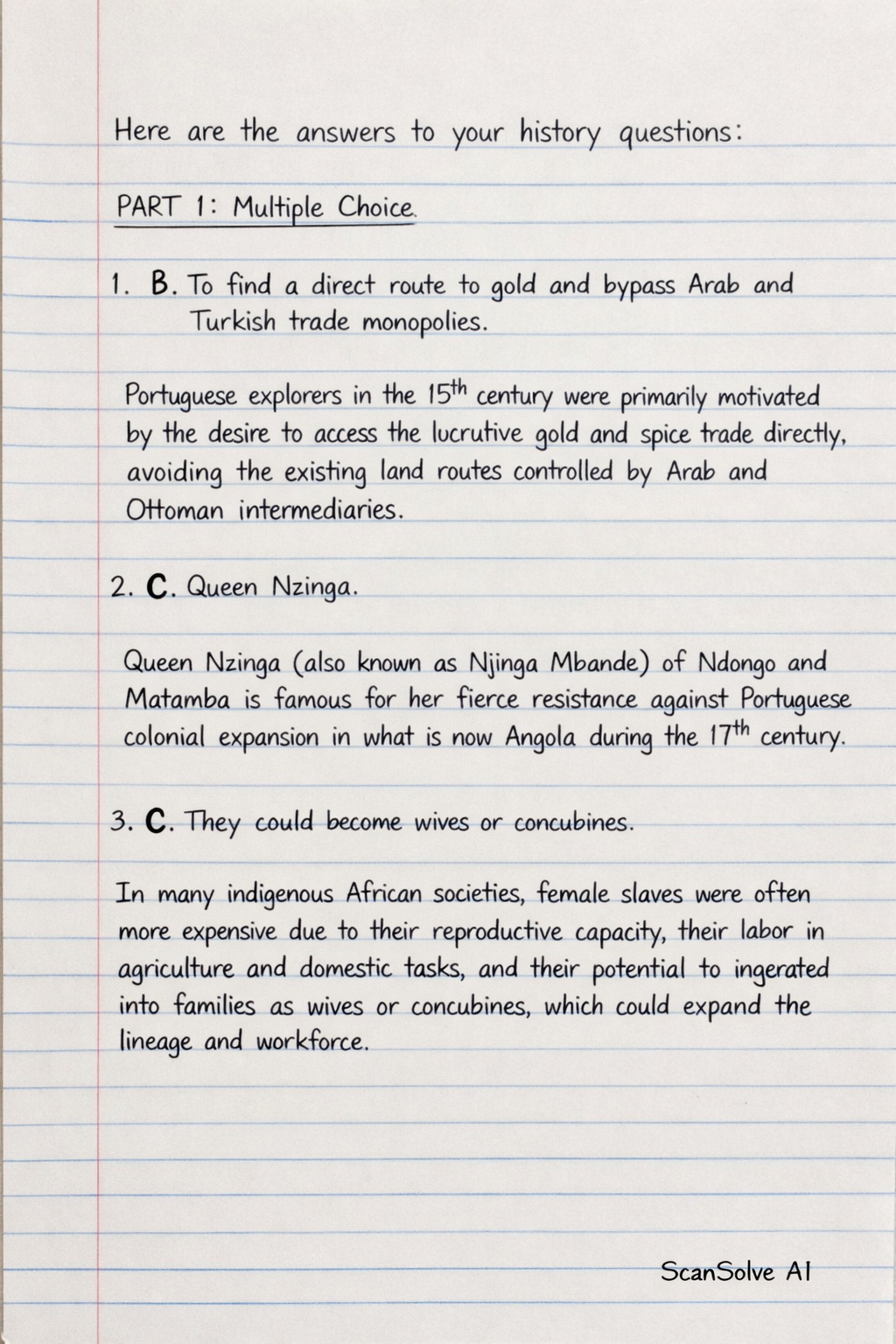
Here are the answers to your history questions:
PART 1: Multiple Choice
-
B. To find a direct route to gold and bypass Arab and Turkish trade monopolies.
- Portuguese explorers in the 15th century were primarily motivated by the desire to access the lucrative gold and spice trade directly, avoiding the existing land routes controlled by Arab and Ottoman intermediaries.
-
C. Queen Nzinga
- Queen Nzinga (also known as Njinga Mbande) of Ndongo and Matamba is famous for her fierce resistance against Portuguese colonial expansion in what is now Angola during the 17th century.
-
C. They could become wives or concubines.
- In many indigenous African societies, female slaves were often more expensive due to their reproductive capacity, their labor in agriculture and domestic tasks, and their potential to be integrated into families as wives or concubines, which could expand the lineage and workforce.
-
C. The Rozwi
- The Rozwi Empire (Changamire Dynasty) rose to prominence in the late 17th century in the region of present-day Zimbabwe and successfully expelled the Portuguese from their territories.
PART 2: True or False
-
❌ False.
- Slavery existed in various forms in Africa long before the arrival of Europeans in the 15th century.
-
✅ True.
- In many indigenous African legal systems, the ultimate power, including that over life and death for slaves, often rested with the highest authority, such as the king or chief.
-
❌ False.
- In many indigenous African societies, slaves could marry, have families, and sometimes even own property or achieve freedom and social integration over generations.
-
✅ True.
- The Trans-Saharan, Red Sea, and Indian Ocean slave trades were well-established and active for centuries before the Trans-Atlantic slave trade began in the 16th century.
PART 3: Fill-in-the-Blanks
-
Portuguese explorers established sugar plantations using enslaved Africans on the islands of São Tomé and Príncipe and Cape Verde.
-
The process by which a slave could gain their freedom and social standing is known as manumission.
Was this helpful?
Still stuck on this one?
Ask a follow-up, and the answer starts from this question.
Got a different question?Ask your own question
More History Questions
QWhat are the answers to the following history questions regarding early humans, trade, and…QWrite True or False for each statement regarding African history and its relations.QThe provided text is a solution to multiple-choice questions about the history of ancient African…QWhat were the answers to the following multiple choice questions about Nigerian and African history…QWhat are the answers to the following multiple-choice questions regarding Kenyan geography, history…
Handwritten Step-by-Step Solution
Get this as a handwritten image on WhatsApp — like a tutor wrote it for you.
Try on WhatsApp