
We read your photo as:
The provided text is a solution to multiple-choice questions about the history of ancient African kingdoms and trade routes. What are the questions that were answered?
ScanSolve AI Answer
here are the answers to the multiple-choice questions:
III. Choose the correct answer from the given alternatives
-
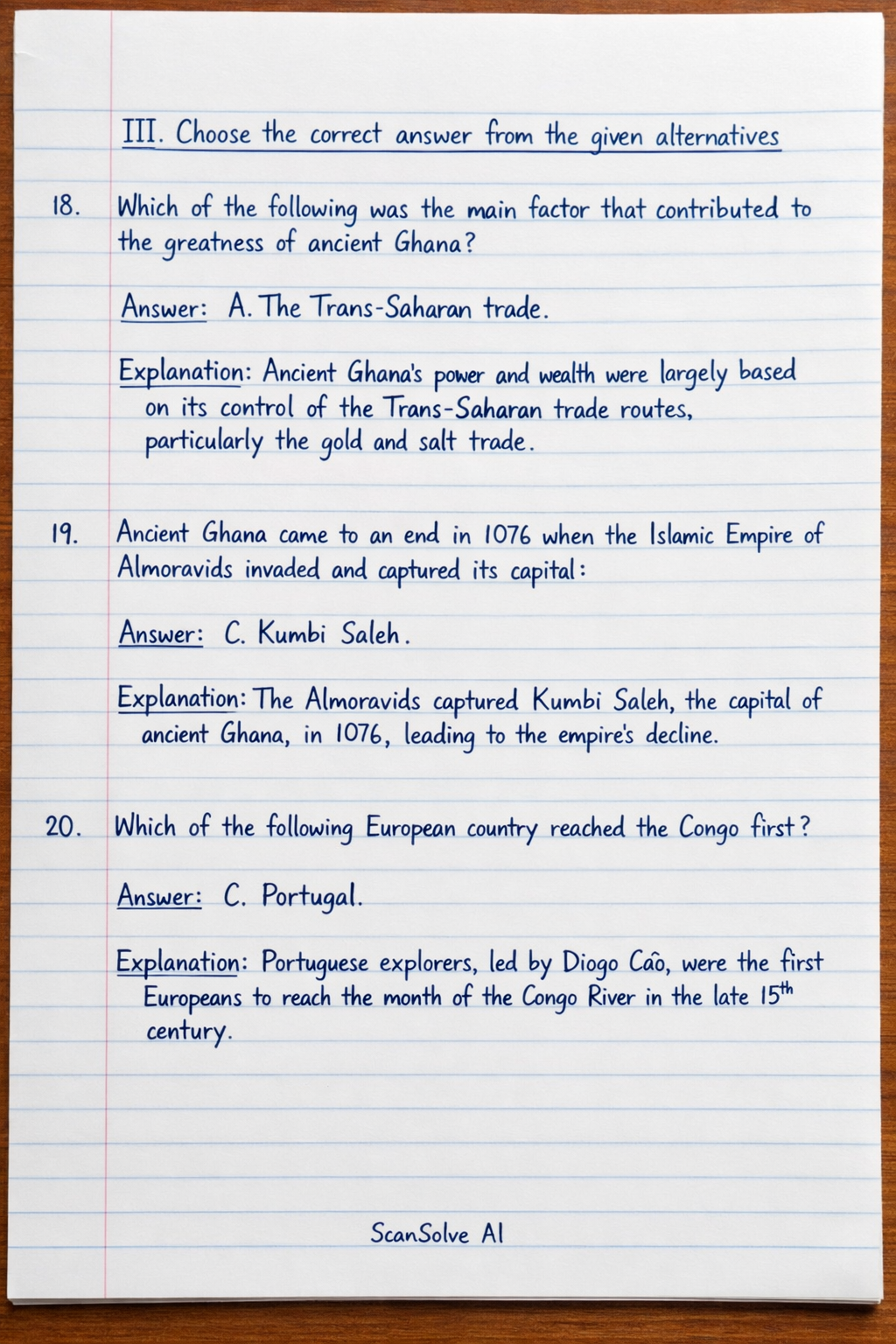
Which of the following was the main factor that contributed to the greatness of ancient Ghana?
- Answer: A. The Trans-Saharan trade
- Explanation: Ancient Ghana's power and wealth were largely based on its control of the Trans-Saharan trade routes, particularly the gold and salt trade.
-
Ancient Ghana came to an end in 1076 when the Islamic Empire of Almoravids invaded and captured its capital:
- Answer: C. Kumbi Saleh
- Explanation: The Almoravids captured Kumbi Saleh, the capital of ancient Ghana, in 1076, leading to the empire's decline.
-
Which of the following European country reached the Congo first?
- Answer: C. Portugal
- Explanation: Portuguese explorers, led by Diogo Cão, were the first Europeans to reach the mouth of the Congo River in the late 15th century.
-
Which of the following Swahili city-states became the main center of the East African gold and ivory trade?
- Answer: D. Kilwa
- Explanation: Kilwa was a dominant Swahili city-state that controlled much of the trade in gold and ivory along the East African coast.
-
The Hausa city-states emerged between 1000 and 1200AD in the present day:
- Answer: C. Nigeria
- Explanation: The Hausa city-states were located in what is now northern Nigeria and southern Niger.
-
All of the following were factors for the decline of Mamluks power except?
- Answer: C. cattle plague
- Explanation: While corruption, religious differences (especially with the rising Ottoman Empire), and droughts could contribute to the decline of an empire, a specific "cattle plague" is less commonly cited as a primary systemic factor for the overall decline of Mamluk power compared to political instability, economic shifts, and military threats.
-
Who was the greatest king of Mali who made a pilgrimage to Mecca in 1324?
- Answer: C. Mansa Musa
- Explanation: Mansa Musa is renowned for his extravagant pilgrimage to Mecca in 1324, which showcased the immense wealth of the Mali Empire.
-
The first phase of Trans-Atlantic Slave Trade, was known as the:
- Answer: A. Monopolistic slave trade
- Explanation: The early period of the Trans-Atlantic Slave Trade was characterized by European monarchs granting monopolies to specific companies or individuals to control the trade.
Still stuck on this one?
Ask a follow-up, and the answer starts from this question.
More History Questions
Handwritten Step-by-Step Solution
Get this as a handwritten image on WhatsApp — like a tutor wrote it for you.
Try on WhatsApp