
We read your photo as:
Evaluate (1+i)⁻¹ and express the result in the form a+bi.
Mathematics
ScanSolve AI Answer
Answer
Step-by-step solution
4 stepsTo evaluate , we first rewrite it as a fraction and then multiply the numerator and denominator by the conjugate of the denominator.
Rewrite the expression.
Multiply the numerator and denominator by the conjugate of the denominator.
The conjugate of is .
Simplify the expression.
The numerator becomes .
The denominator is a product of a complex number and its conjugate, which simplifies to for . Here, and .So the expression becomes:
Separate into real and imaginary parts.
Comparing this with the given options, it matches option (c).
The final answer is .
Was this helpful?
Try one yourself
A new problem that tests the same skill.
Still stuck on this one?
Ask a follow-up, and the answer starts from this question.
Got a different question?Ask your own question
More Mathematics Questions
QConvert the complex number (1)/(1+i) to a+ib form.QIf a + bi = (1+i)/(1−2i), find the values of the constants a and b.QExpress the following in the form a+bi: −1, 1+i, −5−12i, 3−4i, −2(sqrt(3)−i).QSimplify the following expression: (1 + 1)/((1+i)ⁿ − 1)(1+i)ⁿ − 1QWrite the given numbers in the form a+ib.
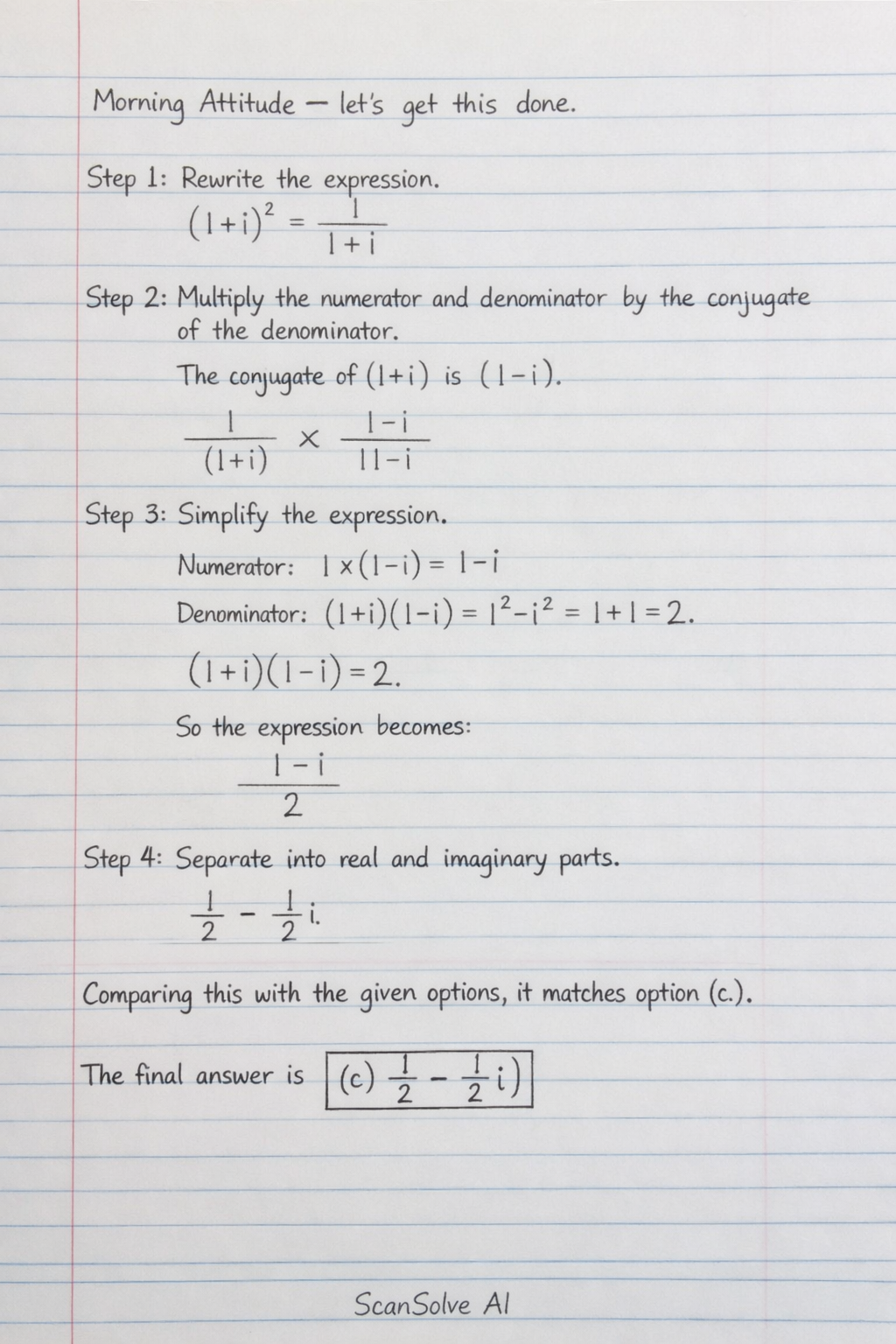
Handwritten Step-by-Step Solution
Get this as a handwritten image on WhatsApp — like a tutor wrote it for you.
Try on WhatsApp