We read your photo as:

If fog(x) = (2x−1)/x and g(x) = 5x + 2 find; a.) f(x) b.) The truth set of g⁻¹(x) + 3 = gof(x). 2. Find the measure of the obtuse angle between the lines 3x − 5y + 2 = 0 and x + 4y + 5 = 0

Mathematics

ScanSolve AI Answer

This answer stops before the end.

It was cut off when it was first written. Ask ScanSolve this question again for the full working.

Graph of g(x) = 5x + 2

Use the left and right arrow keys to trace the curve, up and down to jump between key points, and plus and minus to zoom.

Key points of g(x) = 5x + 2
Pointxy
x-intercept−0.40
y-intercept02

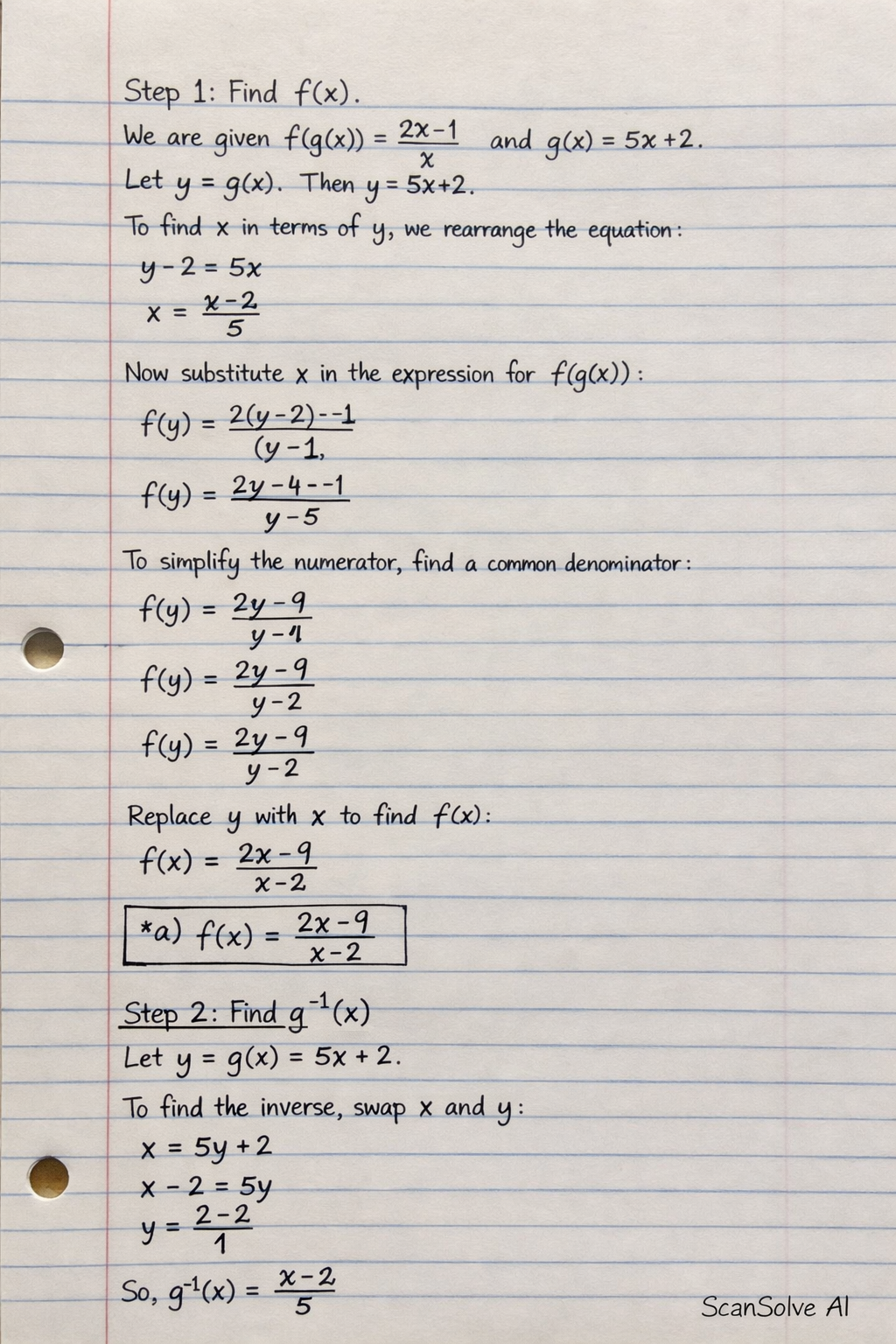
Step 1: Find f(x)f(x).
We are given f(g(x))=2x−1xf(g(x)) = \frac{2x-1}{x} and g(x)=5x+2g(x) = 5x+2.
Let y=g(x)y = g(x). Then y=5x+2y = 5x+2.
To find xx in terms of yy, we rearrange the equation:

y−2=5xy - 2 = 5x x=y−25x = \frac{y-2}{5}

Now substitute xx in the expression for f(g(x))f(g(x)):

f(y)=2(y−25)−1y−25f(y) = \frac{2\left(\frac{y-2}{5}\right)-1}{\frac{y-2}{5}} f(y)=2y−45−1y−25f(y) = \frac{\frac{2y-4}{5}-1}{\frac{y-2}{5}}

To simplify the numerator, find a common denominator:

f(y)=2y−4−55y−25f(y) = \frac{\frac{2y-4-5}{5}}{\frac{y-2}{5}} f(y)=2y−95y−25f(y) = \frac{\frac{2y-9}{5}}{\frac{y-2}{5}} f(y)=2y−9y−2f(y) = \frac{2y-9}{y-2}

Replace yy with xx to find f(x)f(x):

f(x)=2x−9x−2f(x) = \frac{2x-9}{x-2}

*a) f(x)=2x−9x−2\boxed{f(x) = \frac{2x-9}{x-2}}

Step 2: Find g−1(x)g^{-1}(x).
Let y=g(x)=5x+2y = g(x) = 5x+2.
To find the inverse, swap xx and yy:

x=5y+2x = 5y+2 x−2=5yx-2 = 5y y=x−25y = \frac{x-2}{5}

So, g−1(x)=x−25g^{-1}(x) = \frac{x-2}{5}.

Step 3: Find g∘f(x)g \circ f(x).
We have f(x)=2x−9x−2f(x) = \frac{2x-9}{x-2} and g(x)=5x+2g(x) = 5x+2.

g(f(x))=g(2x−9x−2)g(f(x)) = g\left(\frac{2x-9}{x-2}\right) g(f(x))=5(2x−9x−2)+2g(f(x)) = 5\left(\frac{2x-9}{x-2}\right) + 2 g(f(x))=5(2x−9)x−2+2(x−2)x−2g(f(x)) = \frac{5(2x-9)}{x-2} + \frac{2(x-2)}{x-2} g(f(x))=10x−45+2x−4x−2g(f(x)) = \frac{10x-45+2x-4}{x-2} g(f(x))=12x−49x−2g(f(x)) = \frac{12x-49}{x-2}

Step 4: Solve the equation g−1(x)+3=g∘f(x)g^{-1}(x) + 3 = g \circ f(x).
Substitute the expressions for g−1(x)g^{-1}(x) and g∘f(x)g \circ f(x):

x−25+3=12x−49x−2\frac{x-2}{5} + 3 = \frac{12x-49}{x-2}

Simplify the left side:

x−25+155=x−2+155=x+135\frac{x-2}{5} + \frac{15}{5} = \frac{x-2+15}{5} = \frac{x+13}{5}

Now the equation is:

x+135=12x−49x−2\frac{x+13}{5} = \frac{12x-49}{x-2}

Cross-multiply:

(x+13)(x−2)=5(12x−49)(x+13)(x-2) = 5(12x-49) x2−2x+13x−26=60x−245x^2 - 2x + 13x - 26 = 60x - 245 x2+11x−26=60x−245x^2 + 11x - 26 = 60x - 245

Rearrange into a quadratic equation ax2+bx+c=0ax^2+bx+c=0:

x2+11x−60x−26+245=0x^2 + 11x - 60x - 26 + 245 = 0 x2−49x+219=0x^2 - 49x + 219 = 0

Use the quadratic formula x=−b±b2−4ac2ax = \frac{-b \pm \sqrt{b^2-4ac}}{2a}:

x=−(−49)±(−49)2−4(1)(219)2(1)x = \frac{-(-49) \pm \sqrt{(-49)^2 - 4(1)(219)}}{2(1)} x=49±2401−8762x = \frac{49 \pm \sqrt{2401 - 876}}{2} x=49±15252x = \frac{49 \pm \sqrt{1525}}{2}

Simplify the square root: 1525=25×61=561\sqrt{1525} = \sqrt{25 \times 61} = 5\sqrt{61}.

x=49±5612x = \frac{49 \pm 5\sqrt{61}}{2}

The values of xx must not make any denominator zero. For f(x)f(x) and g(f(x))g(f(x)), x−2≠0x-2 \neq 0, so x≠2x \neq 2. The solutions found are not equal to 2.

*b) The truth set is {49−5612,49+5612}\boxed{\left\{\frac{49 - 5\sqrt{61}}{2}, \frac{49 + 5\sqrt{61}}{2}\right\}}

Step 5: Find the slopes of the lines.
The first line is 3x−5y+2=03x - 5y + 2 = 0.
Rearrange to slope-intercept form y=mx+cy = mx+c:

5y=3x+25y = 3x + 2 y=35x+25y = \frac{3}{5}x + \frac{2}{5}

The slope of the first line is m1=35m_1 = \frac{3}{5}.

The second line is x+4y+5=0x + 4y + 5 = 0.
Rearrange to slope-intercept form y=mx+cy = mx+c:

4y=−x−54y = -x - 5 y=−14x−54y = -\frac{1}{4}x - \frac{5}{4}

The slope of the second line is m2=−14m_2 = -\frac{1}{4}.

Step 6: Calculate the angle between the lines.
The formula for the angle θ\theta between two lines with slopes m1m_1 and m2m_2 is:

tan⁡θ=∣m1−m21+m1m2∣\tan \theta = \left| \frac{m_1 - m_2}{1 + m_1 m_2} \right|

Substitute the slopes:

tan⁡θ=∣35−(−14)1+(35)(−14)∣\tan \theta = \left| \frac{\frac{3}{5} - \left(-\frac{1}{4}\right)}{1 + \left(\frac{3}{5}\right)\left(-\frac{1}{4}\right)} \right| tan⁡θ=∣35+141−320∣\tan \theta = \left| \frac{\frac{3}{5} + \frac{1}{4}}{1 - \frac{3}{20}} \right|

Calculate the numerator:

35+14=1220+520=1720\frac{3}{5} + \frac{1}{4} = \frac{12}{20} + \frac{5}{20} = \frac{17}{20}

Calculate the denominator:

1−320=2020−320=17201 - \frac{3}{20} = \frac{20}{20} - \frac{3}{20} = \frac{17}{20}

Substitute these values back into the formula:

Was this helpful?

Still stuck on this one?

Ask a follow-up, and the answer starts from this question.

Got a different question?Ask your own question
Handwritten step-by-step solution preview

Handwritten Step-by-Step Solution

Get this as a handwritten image on WhatsApp — like a tutor wrote it for you.

Try on WhatsApp