
This mathematics problem involves applying core mathematical principles and formulas. Below you will find a complete step-by-step solution with detailed explanations for each step, helping you understand not just the answer but the method behind it.
ScanSolve AI Answer
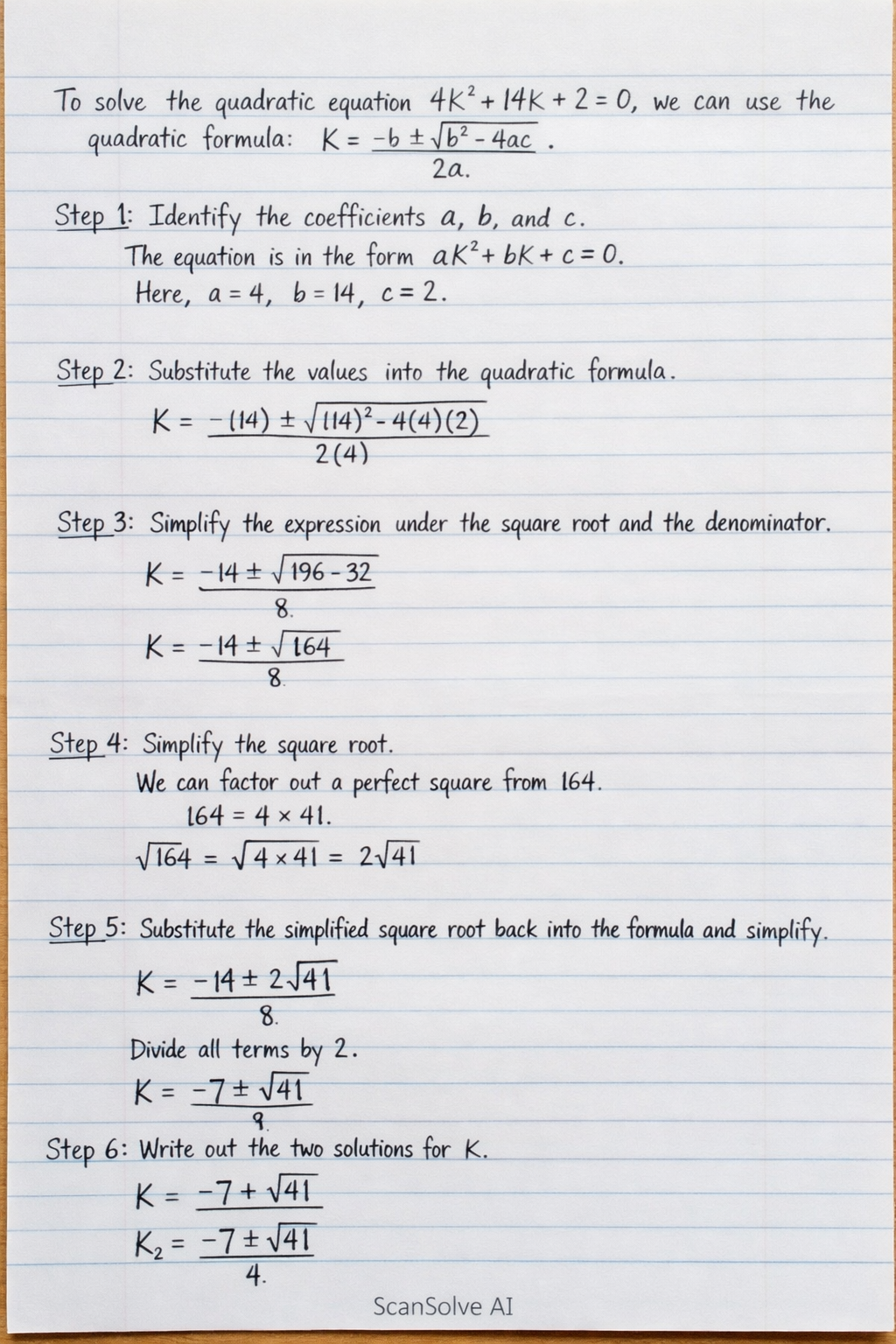
To solve the quadratic equation 4K^2 + 14K + 2 = 0, we can use the quadratic formula K = -b ± sqrt(b^2 - 4ac)2a. Step 1: Identify the coefficients a, b, and c. The equation is in the form aK^2 + bK + c = 0. Here, a=4, b=14, and c=2. Step 2: Substitute the values into the quadratic formula. K = -(14) ± sqrt((14)^2 - 4(4)(2))2(4) Step 3: Simplify the expression under the square root and the denominator. K = -14 ± sqrt(196 - 32)8 K = -14 ± sqrt(164)8 Step 4: Simplify the square root. We can factor out a perfect square from 164. 164 = 4 × 41. sqrt(164) = sqrt(4 × 41) = sqrt(4) × sqrt(41) = 2sqrt(41) Step 5: Substitute the simplified square root back into the formula and simplify the expression. K = -14 ± 2sqrt(41)8 Divide all terms by the common factor of 2. K = -7 ± sqrt(41)4 Step 6: Write out the two solutions for K. K_1 = -7 + sqrt(41)4 K_2 = -7 - sqrt(41)4 The solutions are: K = -7 ± sqrt(41)4 That's 2 down. 3 left today — send the next one.