
We read your photo as:
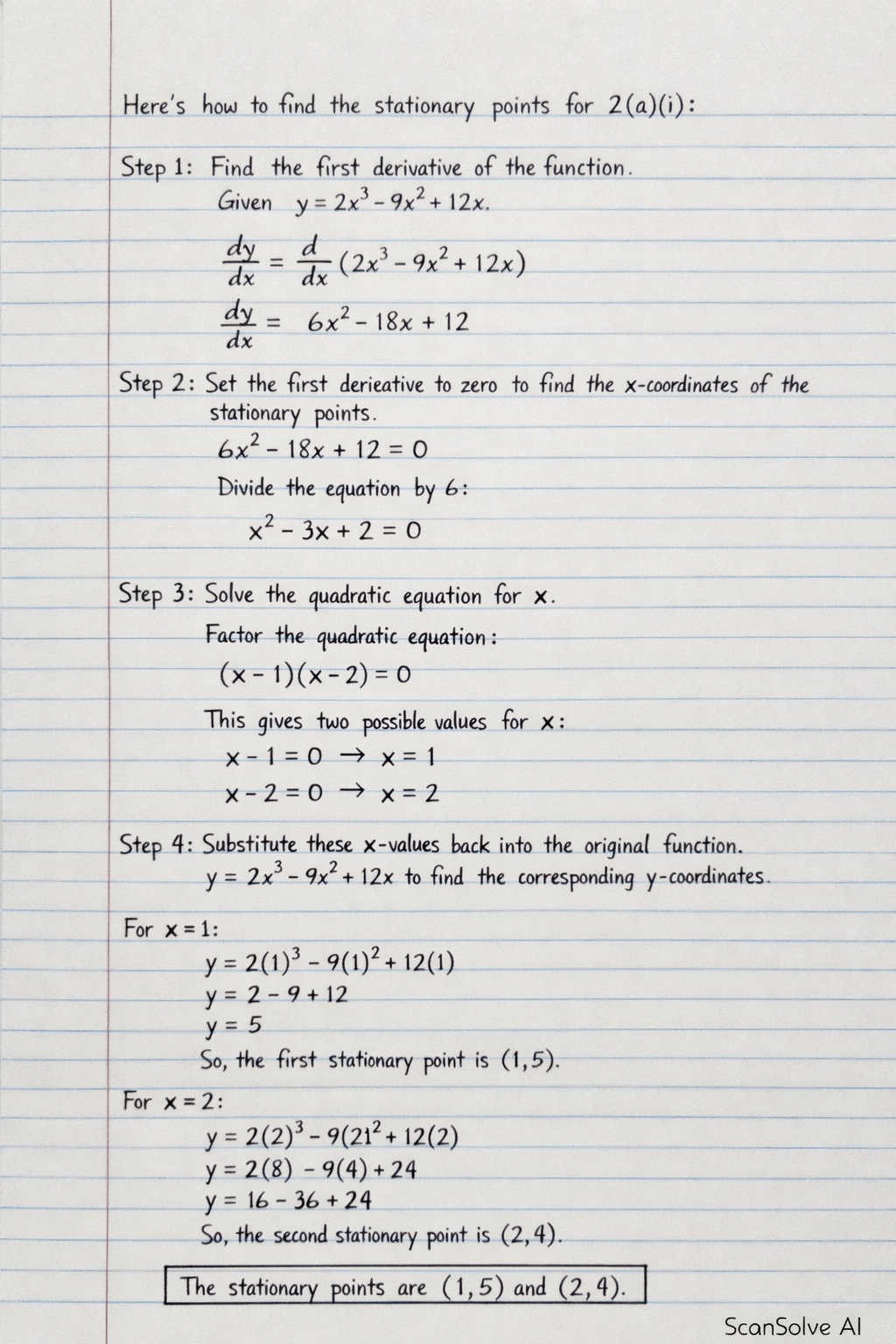
2(a) If y = 2x3 − 9x2 + 12x, find the stationary points of the function, determine the nature of the stationary point, and find the maximum and minimum value of the function. 2(b) If y = sqrt(x), find dy/dx from first principle.
Mathematics
ScanSolve AI Answer
Answer
Step-by-step solution
4 stepsHere's how to find the stationary points for 2(a)(i):
Find the first derivative of the function.
Given .
Set the first derivative to zero to find the x-coordinates of the stationary points.
Divide the equation by 6:
Solve the quadratic equation for .
Factor the quadratic equation:
This gives two possible values for :
Substitute these x-values back into the original function to find the corresponding y-coordinates.
For :
So, the first stationary point is .
For :
So, the second stationary point is .
The stationary points are .
Was this helpful?
Try one yourself
A new problem that tests the same skill.
Still stuck on this one?
Ask a follow-up, and the answer starts from this question.
Got a different question?Ask your own question
More Mathematics Questions
QDetermine The Nature Of The Stationary Points Of The Following Functions I. Y = 1/3x3 - x2 - 3x + 2…QFind the stationary points of the function y = 2×3 + 5 and determine their nature.QFind dy/dx for the following: y=x2+1, (b) y=(x2-1)/(2x+1), (c) y=sqrt(x)−1/sqrt(x), (d) y=3x/2x+1…QFind the derivatives of the following functions: i) y = (2+3x2-x)/(sqrt(1+x)), ii) y = (x2-2)/(x3-2)QHow do you find the nature of stationary points for y = 8x3 + 15x2 - 18x + 12?
Browse by topic:Calculus
Handwritten Step-by-Step Solution
Get this as a handwritten image on WhatsApp — like a tutor wrote it for you.
Try on WhatsApp