
We read your photo as:
Find the derivatives of the following functions: i) y = (2+3x2−x)/(sqrt(1+x)), ii) y = (x2−2)/(x3-2)
Mathematics
ScanSolve AI Answer
Answers
3 partsStep-by-step solution
9 stepsHere are the derivatives for the given functions:
Part i· 3 steps
To find the derivative of with respect to , we use the quotient rule .
Identify and and their derivatives.
Let , so .
Let , so .Apply the quotient rule.
Simplify the expression.
Part ii
To find the derivative of with respect to , we use the quotient rule.
Identify and and their derivatives.
Let , so .
Let , so .Apply the quotient rule.
Simplify the expression.
Part iii
To find the derivative of with respect to , we use the quotient rule.
Identify and and their derivatives.
Let , so .
Let , so .Apply the quotient rule.
Simplify the expression.
Was this helpful?
Still stuck on this one?
Ask a follow-up, and the answer starts from this question.
Got a different question?Ask your own question
More Mathematics Questions
QFind the derivatives of the following functions: y = 3((4x)) and f(x) = sqrt((x2 + 1))QFind the derivative of the following functions from first principles: i) y = x2 ii) y = 3x + 2 iii)…QFind the derivatives of the following functions from first principles or by using differentiation…QFind the derivatives of the following functions: y = 3 2x, y = −8 3x, and y = (1)/(32)
Browse by topic:Calculus
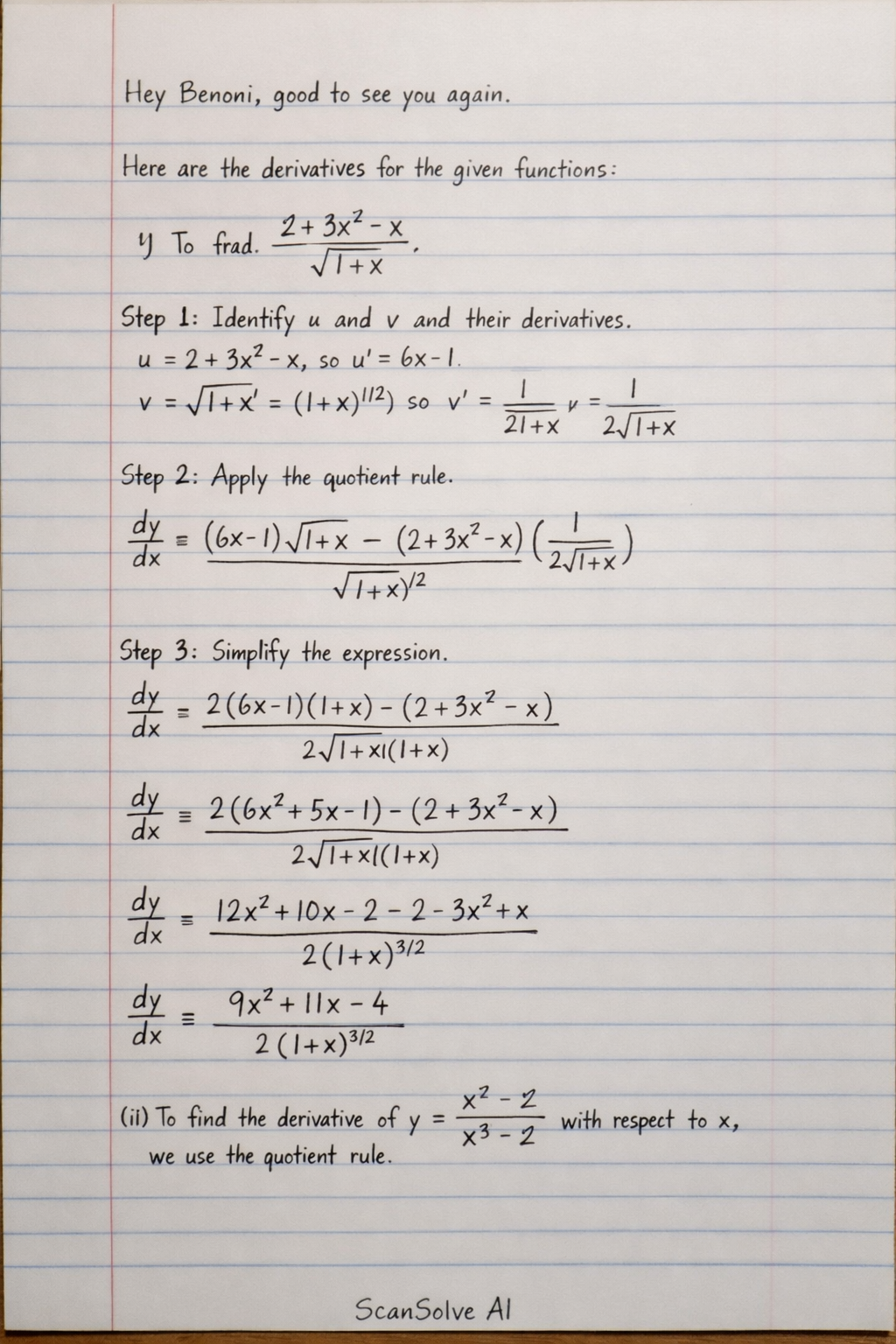
Handwritten Step-by-Step Solution
Get this as a handwritten image on WhatsApp — like a tutor wrote it for you.
Try on WhatsApp