
We read your photo as:
2 years ago, Salim was 3 times as old as his daughter and 6 years later he will be four years older than twice her age. How old are they now?
ScanSolve AI Answer
This answer stops before the end.
It was cut off when it was first written. Ask ScanSolve this question again for the full working.
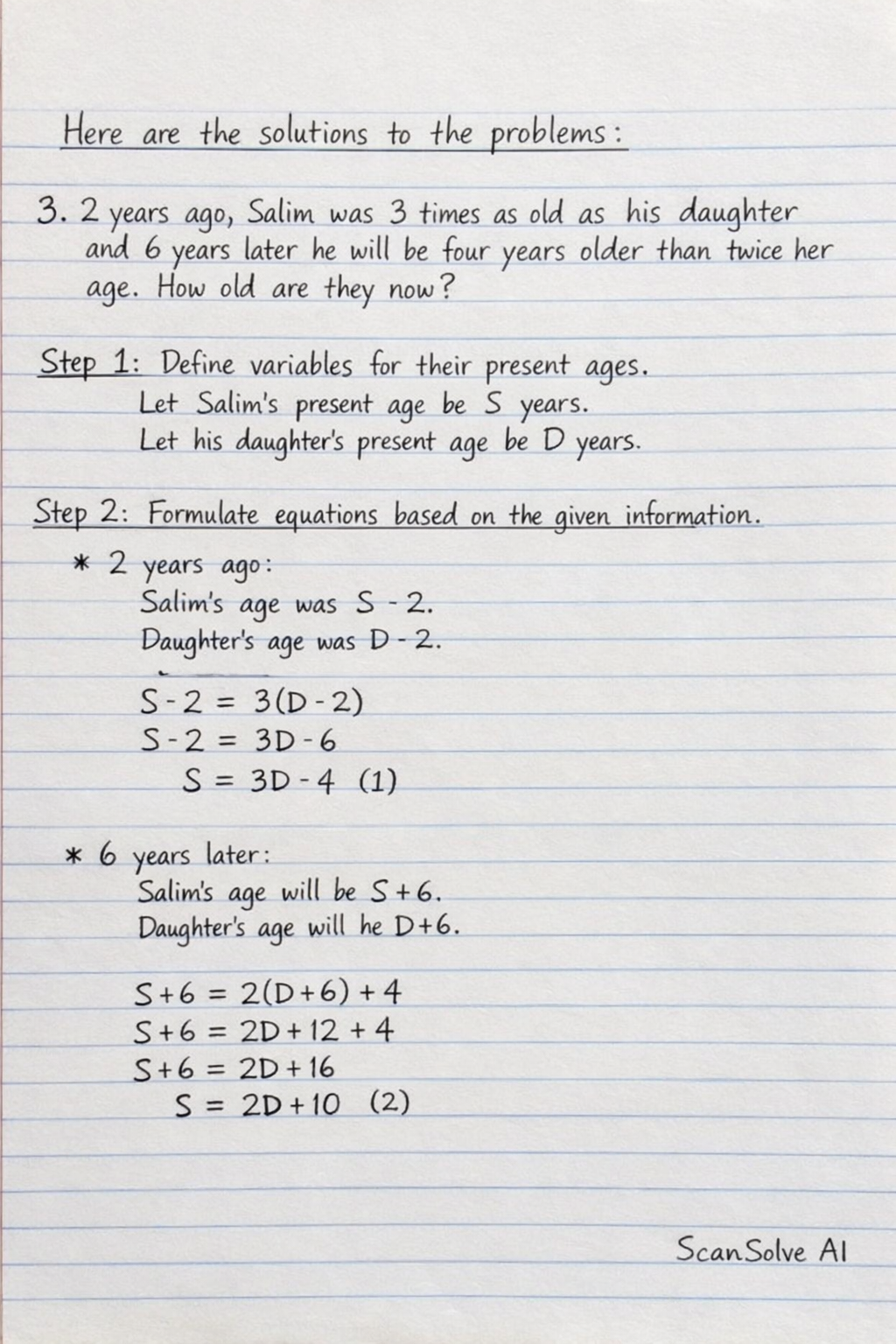
Here are the solutions to the problems:
3. 2 years ago, Salim was 3 times as old as his daughter and 6 years later he will be four years older than twice her age. How old are they now?
Step 1: Define variables for their present ages.
Let Salim's present age be years.
Let his daughter's present age be years.
Step 2: Formulate equations based on the given information.
- 2 years ago: Salim's age was . Daughter's age was . "Salim was 3 times as old as his daughter":
- 6 years later (from now): Salim's age will be . Daughter's age will be . "he will be four years older than twice her age":
Step 3: Solve the system of equations.
Set equation (1) equal to equation (2) since both equal :
Subtract from both sides:
Add 4 to both sides:
Substitute the value of into equation (1) to find :
Step 4: State their present ages.
Salim's present age is 38 years.
His daughter's present age is 14 years.
Their present ages are:
Salim:
Daughter:
4. The age of the father is twice the sum of the ages of his 2 children. After 20 years, his age will be equal to the sum of the ages of the children. Find the age of his father.
Step 1: Define variables.
Let the father's present age be years.
Let the sum of the present ages of his 2 children be years.
Step 2: Formulate equations based on the given information.
- Present ages: "The age of the father is twice the sum of the ages of his 2 children":
- After 20 years: Father's age will be . Each child's age will increase by 20 years. Since there are 2 children, the sum of their ages will increase by years. So, the sum of the children's ages will be . "his age will be equal to the sum of the ages of the children":
Step 3: Solve the system of equations.
Substitute equation (1) into equation (2):
Subtract from both sides:
Subtract 20 from both sides:
Now substitute the value of back into equation (1) to find :
Step 4: State the father's age.
The father's present age is 40 years.
The father's age is:
5. A fraction becomes if 2 is added to both numerator and the denominator. If 3 is added to both numerator and denominator it becomes . Find the fraction.
Step 1: Define variables.
Let the fraction be , where is the numerator and is the denominator.
Step 2: Formulate equations based on the given information.
- "A fraction becomes if 2 is added to both numerator and the denominator": Cross-multiply:
- "If 3 is added to both numerator and denominator it becomes ": Cross-multiply:
Step 3: Solve the system of equations.
We have the system:
- Multiply equation (1) by 5 and equation (2) by 9 to eliminate :
Subtract equation (4) from equation (3):
Substitute into equation (2):
Step 4: State the fraction.
The fraction is .
The fraction is:
6. The sum of the numerator and denominator of the fraction is 12. If the denominator is increased by 3 it fraction become . Find the fraction.
Step 1: Define variables.
Let the fraction be , where is the numerator and is the denominator.
Step 2: Formulate equations based on the given information.
- "The sum of the numerator and denominator of the fraction is 12":
- "If the denominator is increased by 3 it fraction become ": Cross-multiply:
Still stuck on this one?
Ask a follow-up, and the answer starts from this question.
More Mathematics Questions
Handwritten Step-by-Step Solution
Get this as a handwritten image on WhatsApp — like a tutor wrote it for you.
Try on WhatsApp