

This mathematics problem involves applying core mathematical principles and formulas. Below you will find a complete step-by-step solution with detailed explanations for each step, helping you understand not just the answer but the method behind it.
ScanSolve AI Answer
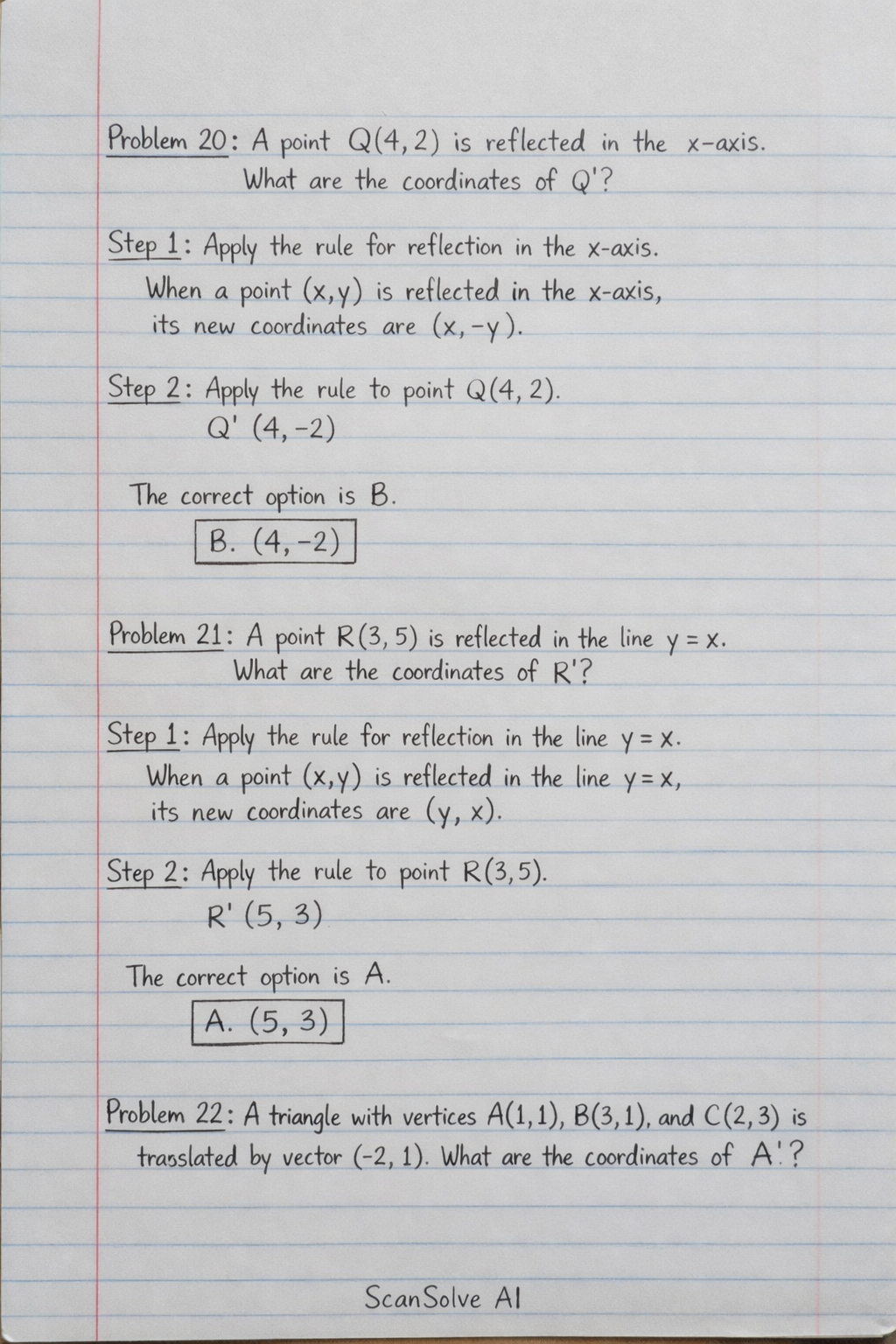
Problem 20: A point Q(4, 2) is reflected in the x-axis. What are the coordinates of Q'? Step 1: Apply the rule for reflection in the x-axis. When a point (x, y) is reflected in the x-axis, its new coordinates are (x, -y). Step 2: Apply the rule to point Q(4, 2). Q'(4, -2) The correct option is B. B. (4, -2) Problem 21: A point R(3, 5) is reflected in the line y = x. What are the coordinates of R'? Step 1: Apply the rule for reflection in the line y = x. When a point (x, y) is reflected in the line y = x, its new coordinates are (y, x). Step 2: Apply the rule to point R(3, 5). R'(5, 3) The correct option is A. A. (5, 3) Problem 22: A triangle with vertices A(1, 1), B(3, 1), and C(2, 3) is translated by vector (-2, 1). What are the coordinates of A'? Step 1: Apply the rule for translation. To translate a point (x, y) by a vector (v_x, v_y), the new coordinates are (x + v_x, y + v_y). Step 2: Apply the rule to vertex A(1, 1) with translation vector (-2, 1). A'(1 + (-2), 1 + 1) A'(1 - 2, 1 + 1) A'(-1, 2) The correct option is A. A. (-1, 2) Problem 23: A point P(2, 0) is rotated 90° counterclockwise about the origin. What are the coordinates of P'? Step 1: Apply the rule for a 90° counterclockwise rotation about the origin. When a point (x, y) is rotated 90° counterclockwise about the origin, its new coordinates are (-y, x). Step 2: Apply the rule to point P(2, 0). P'(-0, 2) P'(0, 2) The correct option is A. A. (0, 2) Problem 24: A shape is enlarged by a scale factor of 2. If the original area is 10 cm², what is the new area? Step 1: Recall the relationship between original area, new area, and scale factor. If a shape is enlarged by a scale factor k, the new area is k^2 times the original area. New Area = Original Area × (Scale Factor)^2 Step 2: Substitute the given values. New Area = 10 cm^2 × (2)^2 New Area = 10 cm^2 × 4 New Area = 40 cm^2 The correct option is C. C. 40 cm^2 Problem 25: Which of the following is NOT a method of data collection? Step 1: Analyze each option. • Questionnaire: A set of questions used to gather information from respondents. This is a method of data collection. • Interview: A conversation where questions are asked to elicit information. This is a method of data collection. • Observation: Watching and recording behavior or phenomena. This is a method of data collection. • Calculation: The process of determining a value or result using mathematical operations. This is a method of data analysis or processing, not collection. The correct option is D. D. Calculation Problem 26: A questionnaire is designed to collect data about students' study habits. Which is a good question? Step 1: Evaluate each question based on principles of good questionnaire design (clear, unbiased, specific, measurable). • A. "Do you study hard?" - This is subjective and leading. "Hard" is not clearly defined. • B. "How many hours do you study per week?" - This is specific, measurable, and neutral. It directly asks for a quantifiable aspect of study habits. • C. "Don't you think studying is important?" - This is a leading question, implying a desired answer. • D. "You study a lot, don't you?" - This is also a leading question, suggesting an expected response. The correct option is B. B. "How many hours do you study per week?" Problem 27: Which type of graph is best for showing the distribution of continuous data? Step 1: Consider the characteristics of each graph type. • Bar chart: Used for categorical or discrete data. • Pie chart: Used for showing proportions of a whole, typically with categorical data. • Histogram: Used to display the distribution of continuous numerical data, grouping data into bins. • Pictograph: Uses images to represent data, often for discrete categories. A histogram is specifically designed for showing the distribution of continuous data. The correct option is C. C. Histogram Problem 28: A box-and-whisker plot shows the following: minimum = 10, Q1 = 20, median = 30, Q3 = 40, maximum = 50. What is the interquartile range (IQR)? Step 1: Recall the formula for the Interquartile Range (IQR). IQR = Q_3 - Q_1 Step 2: Substitute the given values for Q1 and Q3. IQR = 40 - 20 IQR = 20 The correct option is B. B. 20 Problem 29: The data set is: 5, 8, 12, 15, 20. What is the range? Step 1: Identify the maximum and minimum values in the data set. Maximum value = 20 Minimum value = 5 Step 2: Calculate the range. Range = Maximum Value - Minimum Value Range = 20 - 5 Range = 15 The correct option is B. B. 15 Problem 30: For the data set 2, 4, 6, 8, 10, what is the standard deviation? (Approximate) Step 1: Calculate the mean () of the data set. = (2 + 4 + 6 + 8 + 10)/(5) = (30)/(5) = 6 Step 2: Calculate the variance (^2). ^2 = ( (x_i - )^2)/(n) ^2 = ((2-6)^2 + (4-6)^2 + (6-6)^2 + (8-6)^2 + (10-6)^2)/(5) ^2 = ((-4)^2 + (-2)^2 + (0)^2 + (2)^2 + (4)^2)/(5) ^2 = (16 + 4 + 0 + 4 + 16)/(5) ^2 = (40)/(5) = 8 Step 3: Calculate the standard deviation (). = sqrt(^2) = sqrt(8) ≈ 2.828 Rounding to two decimal places, ≈ 2.83. The correct option is A. A. 2.83 Problem 31: The variance of a data set is 16. What is the standard deviation? Step 1: Recall the relationship between variance and standard deviation. Standard deviation () is the square root of the variance (^2). = sqrt(^2) Step 2: Substitute the given variance. = sqrt(16) = 4 The correct option is B. B. 4 Problem 32: Which measure of dispersion is most affected by outliers? Step 1: Consider how each measure of dispersion is calculated. • Range: Calculated as Maximum - Minimum. Since it uses only the extreme values, it is highly sensitive to outliers. • Interquartile range (IQR): Calculated as Q3 - Q1. It focuses on the middle 50% of the data, making it resistant to outliers. • Variance: Involves squaring the differences from the mean. Outliers, being far from the mean, will have large squared differences, significantly increasing the variance. • Standard deviation: The square root of the variance, so it is also heavily influenced by outliers. Both Range, Variance, and Standard Deviation are affected by outliers. However, the Range is often considered the most affected because it relies solely on the two most extreme values, which are often the outliers themselves. Variance and standard deviation are also affected, but the range's dependence on only two points makes it extremely susceptible. Given the options, the range is the most directly and severely impacted by a single outlier. The correct option is A. A. Range