

This mathematics problem involves applying core mathematical principles and formulas. Below you will find a complete step-by-step solution with detailed explanations for each step, helping you understand not just the answer but the method behind it.
ScanSolve AI Answer
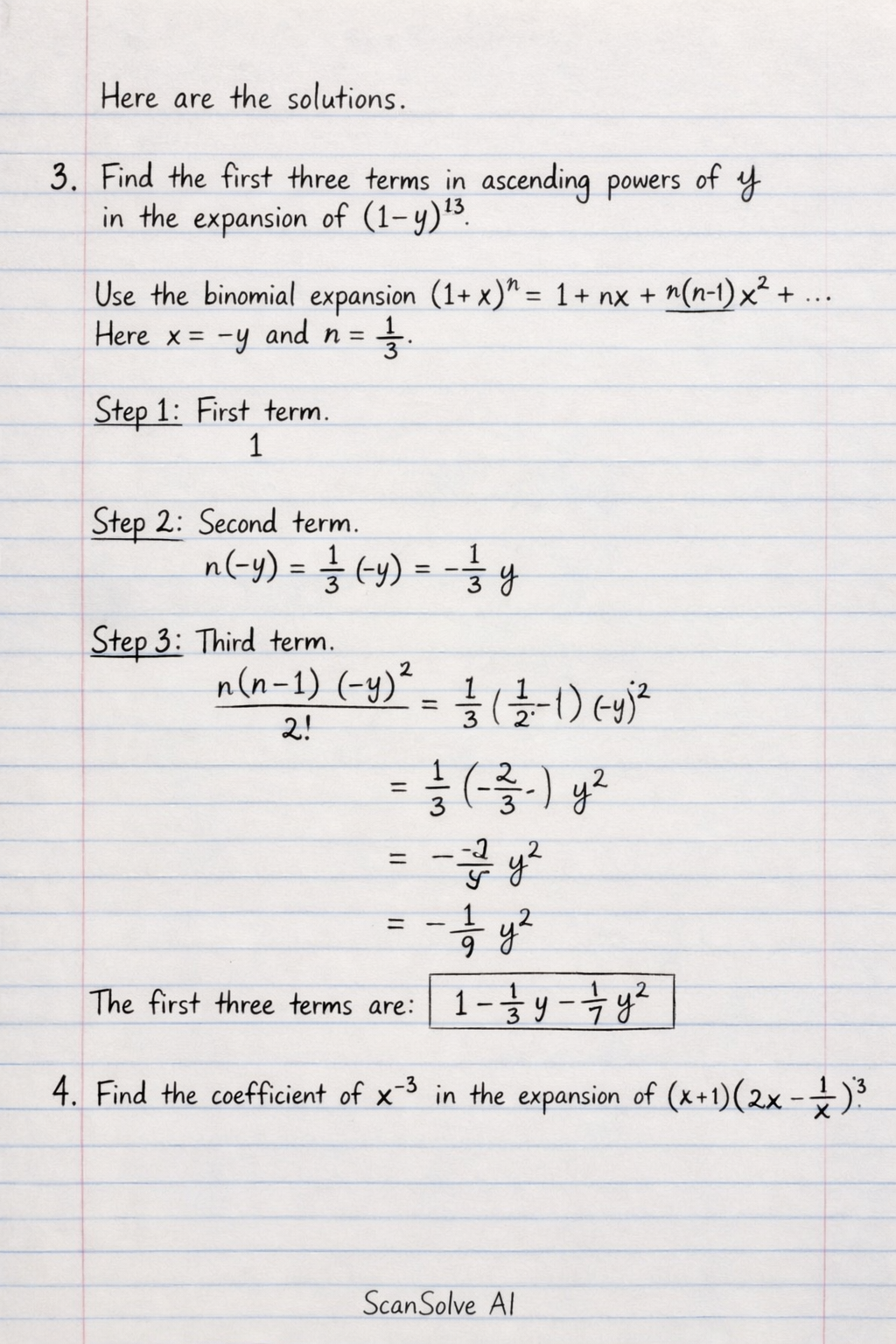
Here are the solutions. 3. Find the first three terms in ascending powers of y in the expansion of (1-y)^(1)/(3). Use the binomial expansion (1+x)^n = 1 + nx + (n(n-1))/(2!)x^2 + Here x=-y and n=(1)/(3). Step 1: First term. 1 Step 2: Second term. n(-y) = (1)/(3)(-y) = -(1)/(3)y Step 3: Third term. (n(n-1))/(2!)(-y)^2 = (1)/(3)((1)/(3)-1)2 y^2 = (1)/(3)(-(2)/(3))2 y^2 = (-2)/(9)2 y^2 = -(1)/(9)y^2 The first three terms are 1 - (1)/(3)y - (1)/(9)y^2. 4. Find the coefficient of x^-3 in the expansion of ((x+1)(2x - (1)/(x))^3). Step 1: Expand (2x - (1)/(x))^3. (2x - (1)/(x))^3 = (2x)^3 + 3(2x)^2(-(1)/(x)) + 3(2x)(-(1)/(x))^2 + (-(1)/(x))^3 = 8x^3 + 3(4x^2)(-(1)/(x)) + 3(2x)((1)/(x^2)) - (1)/(x^3) = 8x^3 - 12x + (6x)/(x^2) - (1)/(x^3) = 8x^3 - 12x + 6x^-1 - x^-3 Step 2: Multiply by (x+1). (x+1)(8x^3 - 12x + 6x^-1 - x^-3) = x(8x^3 - 12x + 6x^-1 - x^-3) + 1(8x^3 - 12x + 6x^-1 - x^-3) = (8x^4 - 12x^2 + 6x^0 - x^-2) + (8x^3 - 12x + 6x^-1 - x^-3) Step 3: Identify the coefficient of x^-3. The only term with x^-3 is -x^-3. The coefficient of x^-3 is -1. The final answer is -1.