

This biology question covers important biological concepts and processes. The step-by-step explanation below helps you understand the underlying mechanisms and reasoning.
ScanSolve AI Answer
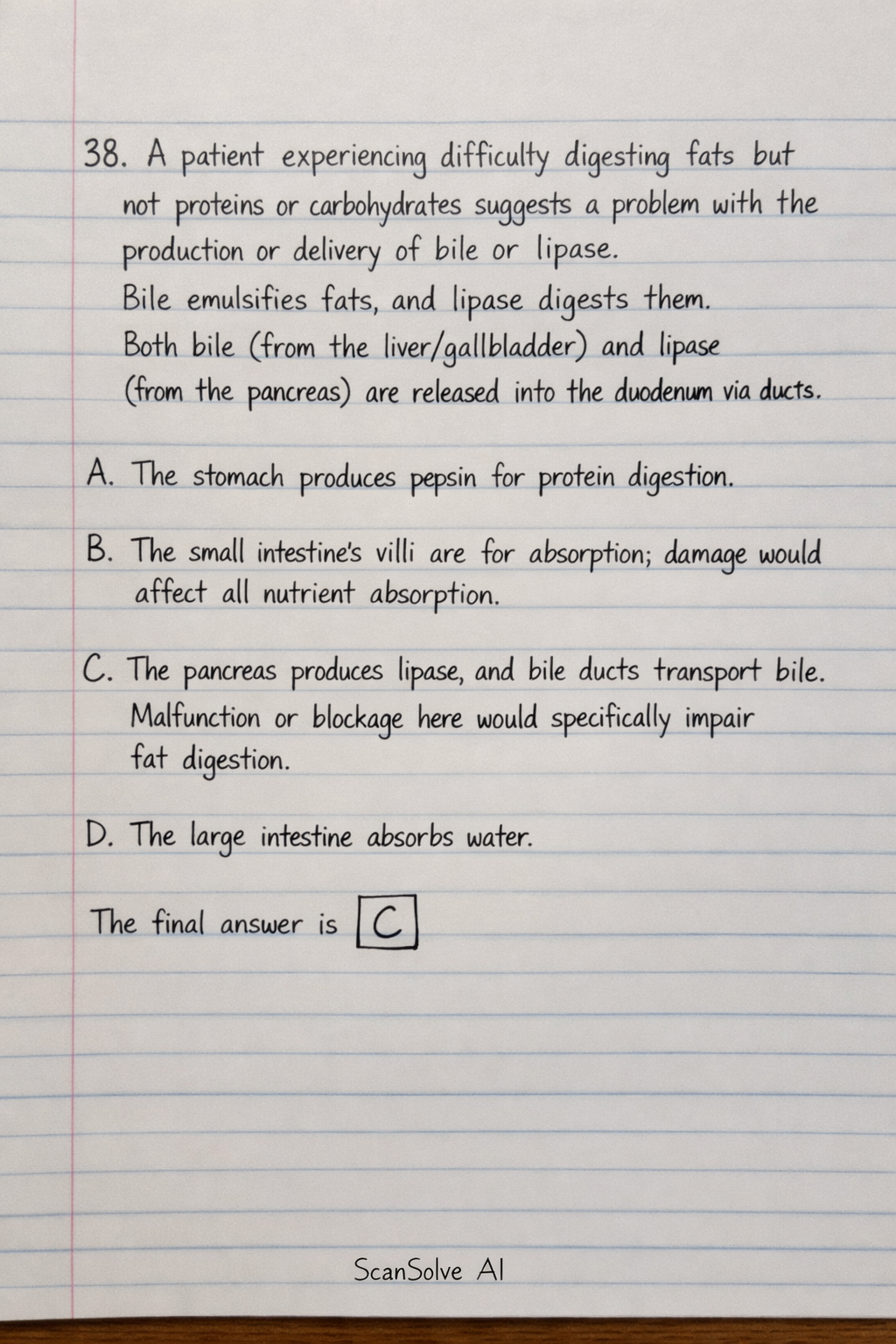
38. A patient experiencing difficulty digesting fats but not proteins or carbohydrates suggests a problem with the production or delivery of bile or lipase. Bile emulsifies fats, and lipase digests them. Both bile (from the liver/gallbladder) and lipase (from the pancreas) are released into the duodenum via ducts. A. The stomach produces pepsin for protein digestion. B. The small intestine's villi are for absorption; damage would affect all nutrient absorption. C. The pancreas produces lipase, and bile ducts transport bile. Malfunction or blockage here would specifically impair fat digestion. D. The large intestine absorbs water. The final answer is C 39. The description "Sequential change in the relative dominance of species within a community; can begin either on a bare rock or where soil already existed" is the definition of ecological succession. A. An ecological pyramid illustrates trophic levels. B. Ecological succession is the process of change in the species structure of an ecological community over time. C. Ecological diversity refers to the variety of life. D. A climax community is the stable end-stage of succession. The final answer is B 40. The cells specialized for transmitting electrical impulses are neurons. A. Receptors detect stimuli. B. Neurons are nerve cells that transmit electrical signals. C. Effectors (muscles or glands) carry out responses. D. Hormones are chemical messengers. The final answer is B 41. When a fish is removed from water and placed on dry land, its gills, which are adapted for gas exchange in water, collapse. A. Blood pressure changes are a consequence, not the primary cause of suffocation. B. The delicate gill filaments, supported by water, collapse and stick together in air, drastically reducing the surface area available for gas exchange, leading to suffocation. C. While fish cannot pump air, the structural collapse of the gills is the main issue. D. Temperature difference is not the immediate cause of suffocation. The final answer is B 42. In the starch test, a leaf is dipped in boiling water to kill the cells and stop enzyme activity. A. Chlorophyll is removed later using alcohol. B. Boiling water denatures enzymes, it does not activate them. C. Glucose is not converted to starch in boiling water. D. Boiling water denatures and destroys the enzymes within the leaf cells, preventing any further metabolic reactions that could interfere with the starch test. The final answer is D 43. Decomposers (bacteria and fungi) are essential for recycling nutrients from dead organic matter back into the soil. If they are reduced to near zero, nutrients would become locked up in dead biomass. A. An immediate decrease in producers is not the most critical long-term consequence. B. A rapid decrease in primary consumers would follow producer decline, but the root cause is nutrient availability. C. The cessation of nutrient cycling would lead to a severe loss of essential soil fertility, making nutrients unavailable for plants and disrupting the entire ecosystem. D. Decomposers release CO_2; their reduction would initially decrease, not increase, atmospheric CO_2 from decomposition. The final answer is C 44. Water moves from an area of higher water potential to an area of lower water potential across a partially permeable membrane by osmosis. Soil water typically has a higher water potential than the cytoplasm of root hair cells. A. Water moves by osmosis from the soil solution (higher water potential) into the root hair cells (lower water potential). B. Active transport moves substances against a gradient and requires energy; water movement is primarily passive. C. This describes water moving out of the root hair cells, which is incorrect in this scenario. D. Diffusion is a general term, but osmosis specifically describes water movement across a membrane. The final answer is A 45. Presbyopia, the difficulty in focusing on near objects experienced by elderly people, is caused by the lens losing its flexibility. A. A cloudy lens (cataract) causes general blurry vision, not specifically difficulty with near focus. B. The ciliary muscles contract to make the lens bulge for near vision. Losing the ability to relax would affect distant vision. C. With age, the eye's lens loses its elasticity and becomes less able to bulge (thicken) when the ciliary muscles contract, making it difficult to focus on close objects. D. The cornea's shape is primarily for fixed focusing; the lens is responsible for accommodation. The final answer is C