
We read your photo as:
4 Find three integers of which the sum is -9. (Hint: Use two positive integers and one negative integer)
ScanSolve AI Answer
Step-by-step solution
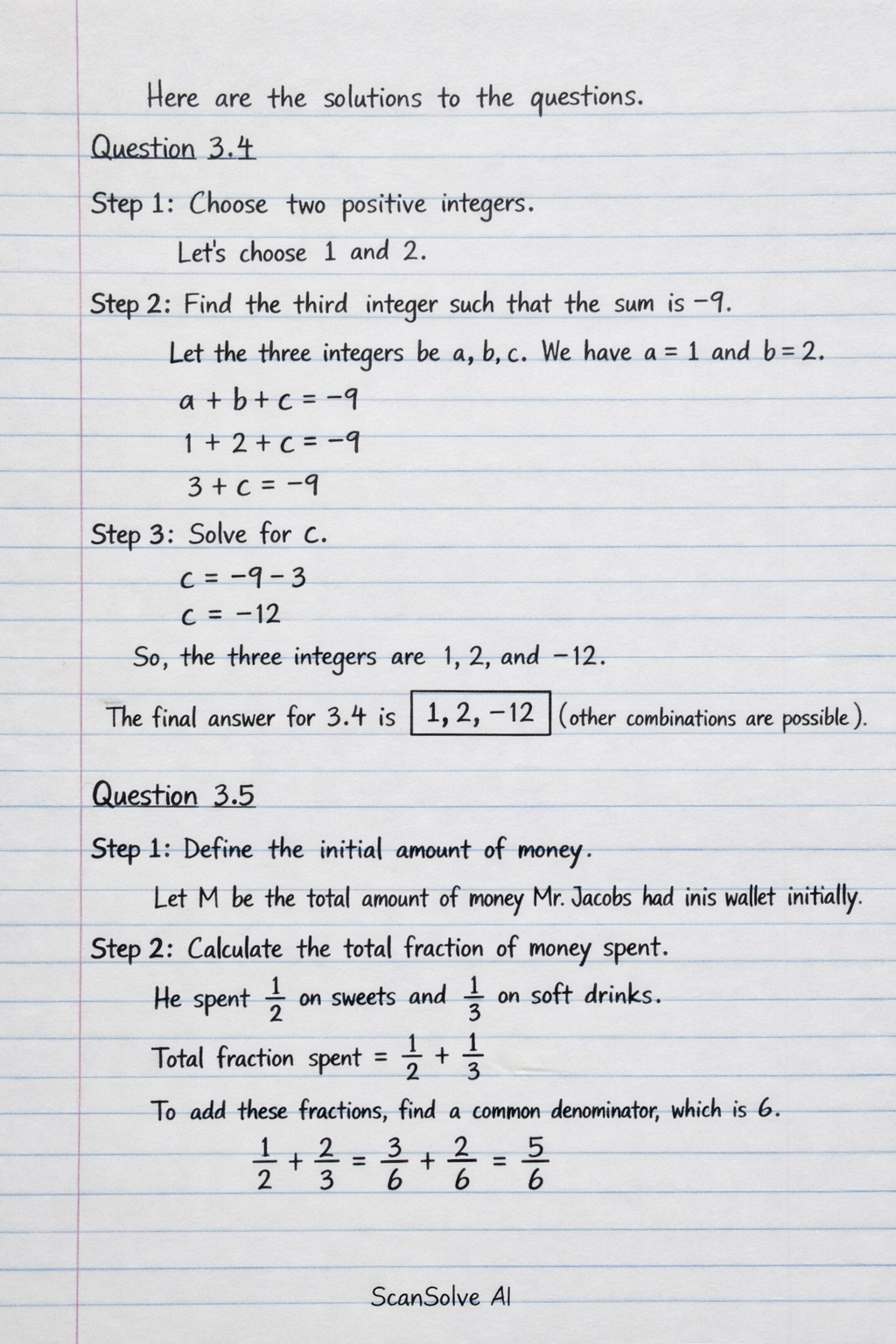
10 stepsHere are the solutions to the questions.
Question 3.4
Choose two positive integers.
Let's choose 1 and 2.
Find the third integer such that the sum is -9.
Let the three integers be . We have and .
Solve for .
So, the three integers are 1, 2, and -12.
The final answer for 3.4 is (other combinations are possible).
Question 3.5
Define the initial amount of money.
Let be the total amount of money Mr. Jacobs had in his wallet initially.
Calculate the total fraction of money spent.
He spent on sweets and on soft drinks.
Total fraction spent .
To add these fractions, find a common denominator, which is 6.Calculate the fraction of money remaining.
The fraction of money remaining is .
Use the remaining amount to find the initial money.
We are told that R25 is remaining, which represents of the initial money.
Solve for .
Multiply both sides by 6:
The final answer for 3.5 is .
Question 4.1.1
The pattern grows by adding a new row of squares at the top in each subsequent stage. The number of squares in the new row is equal to the stage number. The total number of squares in each stage is the sum of consecutive integers from 1 up to the stage number.
Question 4.1.2
Determine the number of squares in each stage.
Stage 1: 1 square
Stage 2: squares
Stage 3: squares
This is a sequence of triangular numbers, where the number of squares in stage is given by the formula .Calculate the number of squares for the 40th stage.
Substitute into the formula:
The final answer for 4.1.2 is .
Still stuck on this one?
Ask a follow-up, and the answer starts from this question.
More Mathematics Questions
Handwritten Step-by-Step Solution
Get this as a handwritten image on WhatsApp — like a tutor wrote it for you.
Try on WhatsApp