

This mathematics problem involves applying core mathematical principles and formulas. Below you will find a complete step-by-step solution with detailed explanations for each step, helping you understand not just the answer but the method behind it.
ScanSolve AI Answer
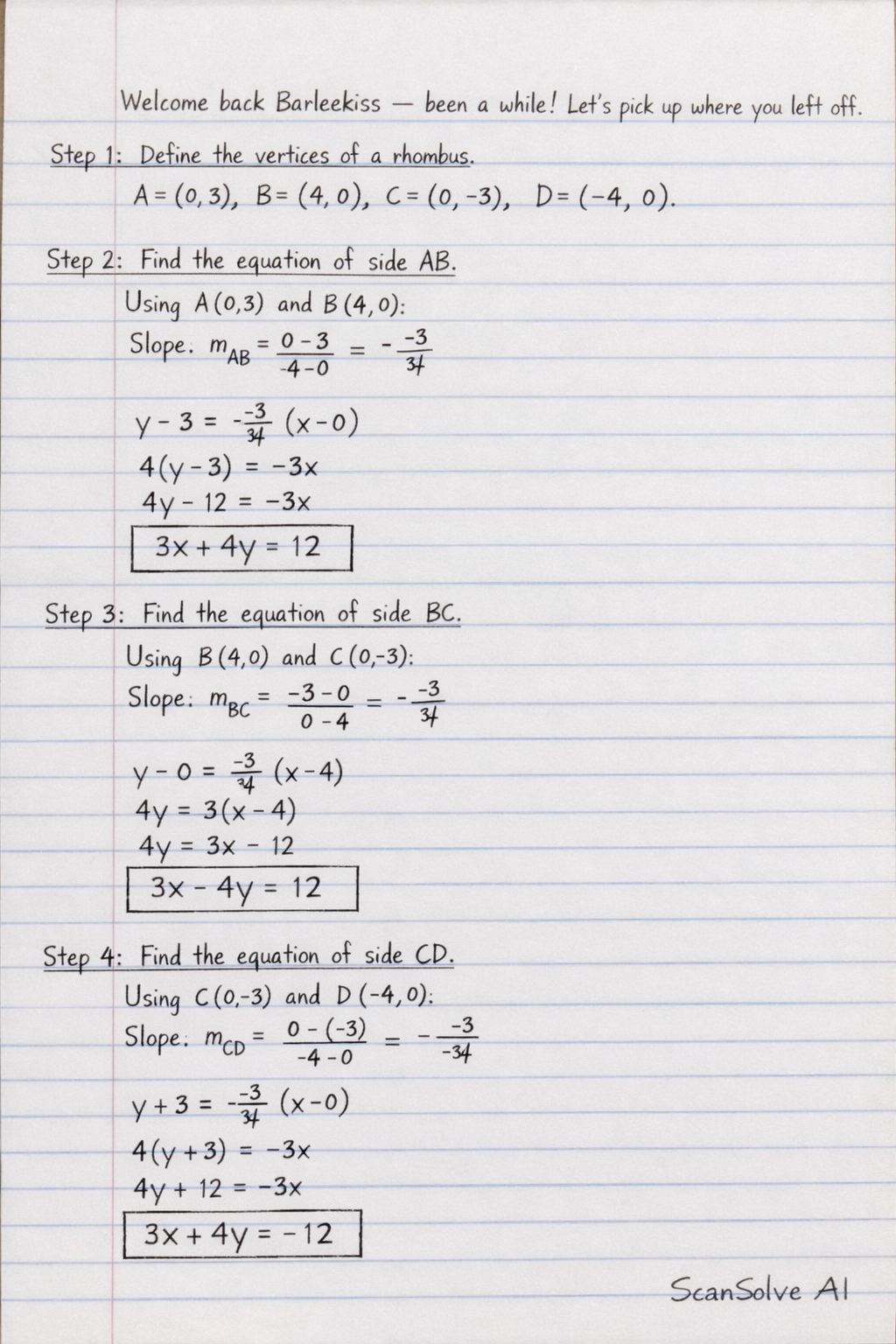
Step 1: Define the vertices of a rhombus. To construct a rhombus on a pair of axes, we define its vertices. Let's choose the vertices A=(0,3), B=(4,0), C=(0,-3), and D=(-4,0). Step 2: Find the equation of side AB. Using points A(0,3) and B(4,0), the slope is m_AB = (0-3)/(4-0) = -(3)/(4). The equation of the line is y - 3 = -(3)/(4)(x - 0). 4(y - 3) = -3x 4y - 12 = -3x 3x + 4y = 12 Step 3: Find the equation of side BC. Using points B(4,0) and C(0,-3), the slope is m_BC = (-3-0)/(0-4) = (-3)/(-4) = (3)/(4). The equation of the line is y - 0 = (3)/(4)(x - 4). 4y = 3(x - 4) 4y = 3x - 12 3x - 4y = 12 Step 4: Find the equation of side CD. Using points C(0,-3) and D(-4,0), the slope is m_CD = (0-(-3))/(-4-0) = (3)/(-4) = -(3)/(4). The equation of the line is y - (-3) = -(3)/(4)(x - 0). 4(y + 3) = -3x 4y + 12 = -3x 3x + 4y = -12 Step 5: Find the equation of side DA. Using points D(-4,0) and A(0,3), the slope is m_DA = (3-0)/(0-(-4)) = (3)/(4). The equation of the line is y - 0 = (3)/(4)(x - (-4)). 4y = 3(x + 4) 4y = 3x + 12 3x - 4y = -12 Step 6: What do you notice? We notice that: • Opposite sides have the same slope (m_AB = m_CD = -(3)/(4) and m_BC = m_DA = (3)/(4)), indicating that opposite sides are parallel. • The equations of opposite sides (e.g., 3x+4y=12 and 3x+4y=-12) share the same x and y coefficients, differing only in the constant term. This is characteristic of parallel lines. Step 7: Investigate for different quadrilaterals. • A parallelogram will also have opposite sides with the same slope, meaning their equations will differ only by a constant. • A rectangle is a parallelogram with adjacent sides perpendicular. This means the product of the slopes of adjacent sides will be -1. • A square is a rectangle with all sides equal. It will exhibit both parallel opposite sides and perpendicular adjacent sides. • A trapezium (or trapezoid) has only one pair of opposite sides that are parallel, so only two of its side equations will have the same slope. • A kite has two pairs of equal-length adjacent sides. There is no general rule for the slopes of its sides, but its diagonals are perpendicular. • A general quadrilateral has no specific relationships between the slopes or equations of its sides. Drop the next question.