

This mathematics problem involves applying core mathematical principles and formulas. Below you will find a complete step-by-step solution with detailed explanations for each step, helping you understand not just the answer but the method behind it.
ScanSolve AI Answer
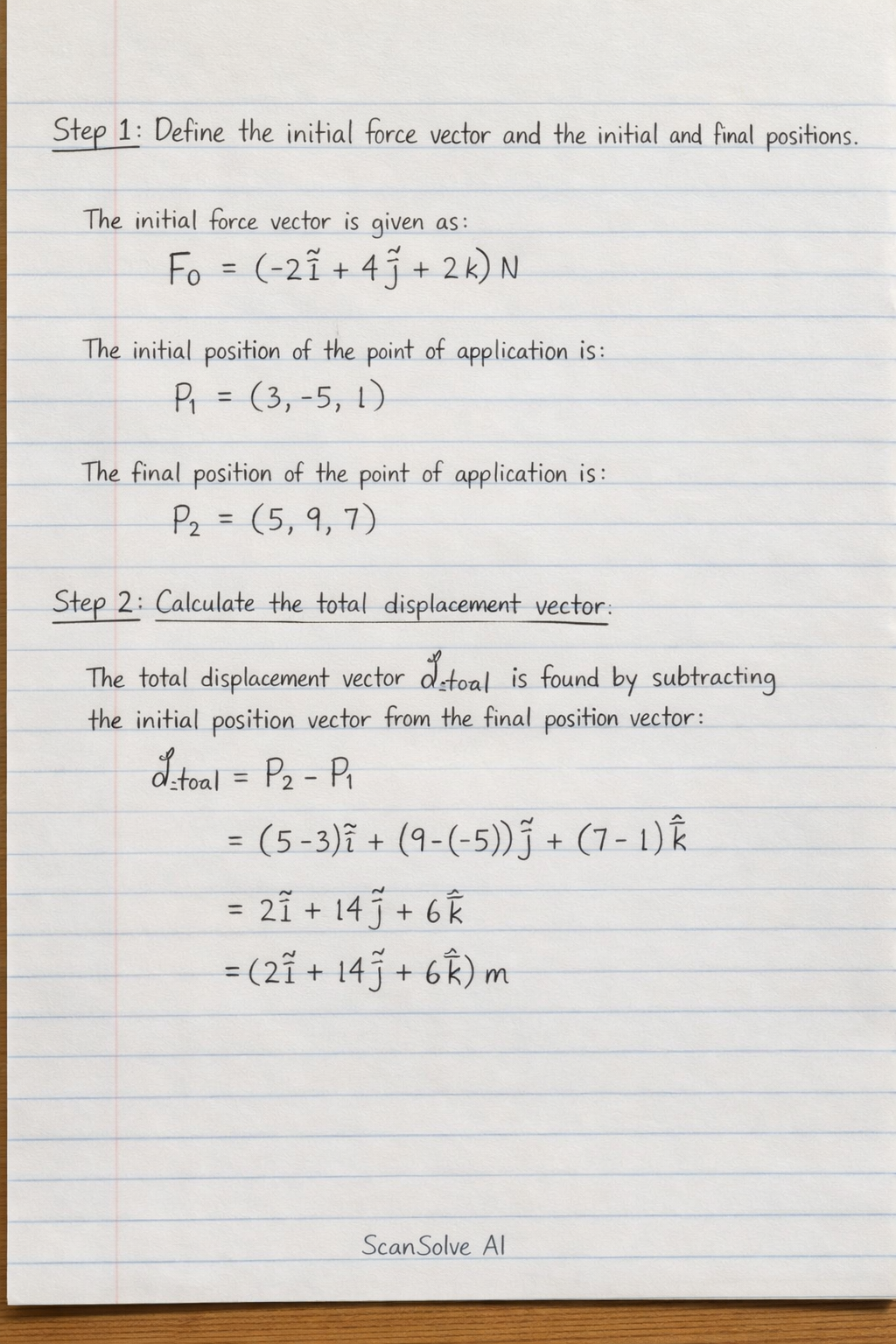
Step 1: Define the initial force vector and the initial and final positions. The initial force vector is given as: F_0 = (-2i + 4j + 2k)\, N The initial position of the point of application is: P_1 = (3, -5, 1) The final position of the point of application is: P_2 = (5, 9, 7) Step 2: Calculate the total displacement vector. The total displacement vector d_total is found by subtracting the initial position vector from the final position vector: d_total = P_2 - P_1 = (5-3)i + (9-(-5))j + (7-1)k d_total = (2i + 14j + 6k)\, m Step 3: Determine the displacement vectors for the two phases. The problem states that the force is halved when the point of application has moved half the distance. This means the total displacement is divided into two equal halves. Displacement for the first half: d_1 = (1)/(2)d_total = (1)/(2)(2i + 14j + 6k) = (1i + 7j + 3k)\, m Displacement for the second half: d_2 = (1)/(2)d_total = (1)/(2)(2i + 14j + 6k) = (1i + 7j + 3k)\, m Step 4: Calculate the work done during the first half of the displacement. During the first half, the force is F_0. The work done W_1 is the dot product of F_0 and d_1: W_1 = F_0 · d_1 = (-2i + 4j + 2k) · (1i + 7j + 3k) W_1 = (-2)(1) + (4)(7) + (2)(3) W_1 = -2 + 28 + 6 W_1 = 32\, J Step 5: Calculate the work done during the second half of the displacement. During the second half, the force is halved, so F_1 = (1)/(2)F_0: F_1 = (1)/(2)(-2i + 4j + 2k) = (-1i + 2j + 1k)\, N The work done W_2 is the dot product of F_1 and d_2: W_2 = F_1 · d_2 = (-1i + 2j + 1k) · (1i + 7j + 3k) W_2 = (-1)(1) + (2)(7) + (1)(3) W_2 = -1 + 14 + 3 W_2 = 16\, J Step 6: Calculate the total work done. The total work done W_total is the sum of the work done in both halves: W_total = W_1 + W_2 W_total = 32\, J + 16\, J W_total = 48\, J The final answer is 48 J. That's 2 down. 3 left today — send the next one.