
But what happened to the 1 ,after dividing x²/x² in the numerator aren't we supposed to get 1
Mathematics
ScanSolve AI Answer
Answer
You are right that becomes 1.
In Step 3, the original expression was .
We divided every term in both the numerator and the denominator by :
-
Numerator:
As , each of these terms goes to 0. So, the numerator approaches .
-
Denominator:
As , becomes 1, and goes to 0. So, the denominator approaches .
Therefore, the limit becomes . The 1 from is indeed in the denominator, as shown in the calculation.
Was this helpful?
Still stuck on this one?
Ask a follow-up, and the answer starts from this question.
Got a different question?Ask your own question
More Mathematics Questions
QI don't quite understand this after diving the numerator by x² aren't we supposed to be left with…QEvaluate x+1 all divided by x²+2-1QIf f(x) is divided by x−1 and the quotient is2x2+x2and the reminder is 3 what is f(x)QDivide the entire equation by the coefficient of x².QDivide x2 - 2x2 - 5x + 6 by x−1 Divide 6x2 - 13x + 5 by 2x−1 Find the quotient when x3+x2-x-1 is…
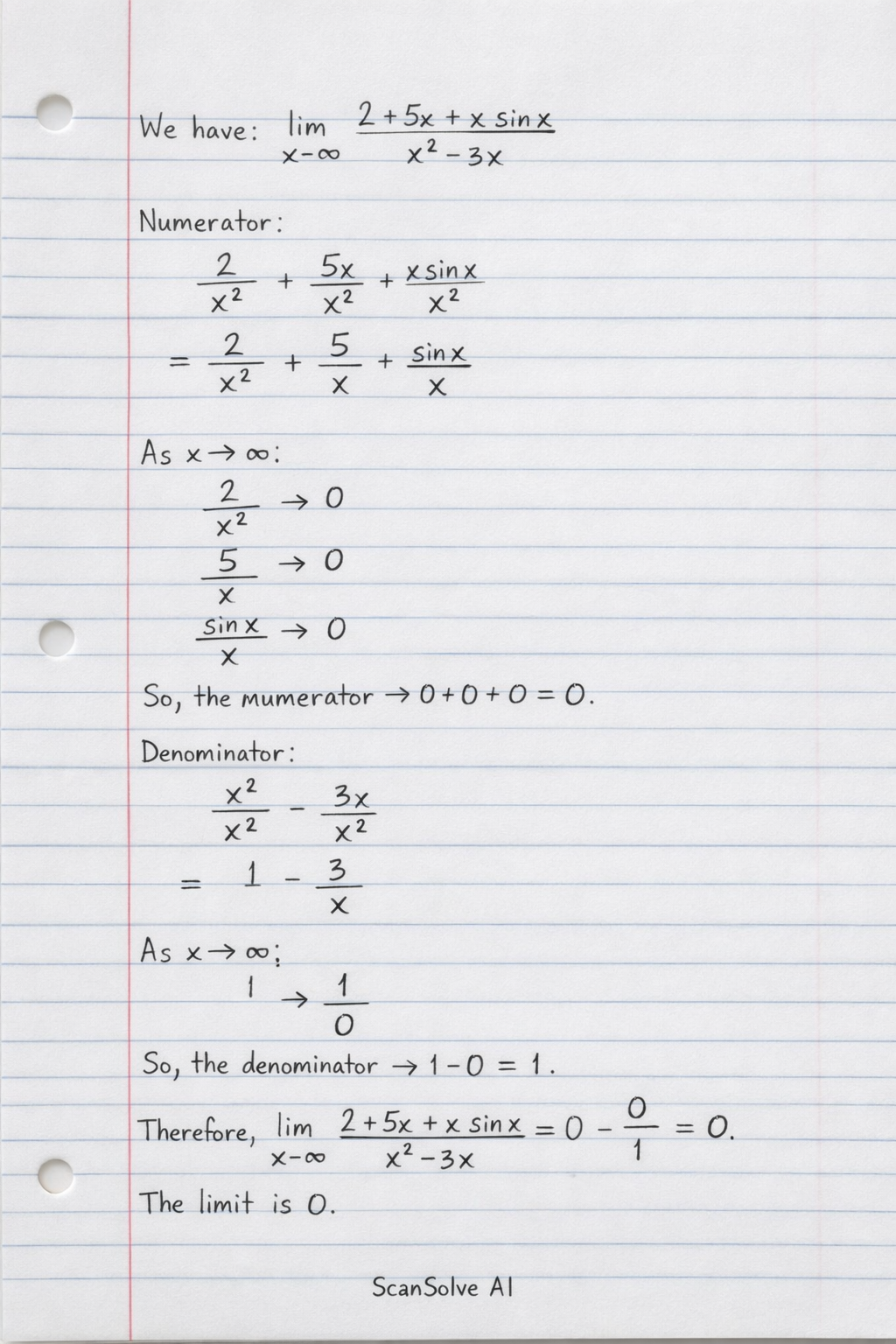
Handwritten Step-by-Step Solution
Get this as a handwritten image on WhatsApp — like a tutor wrote it for you.
Try on WhatsApp