

This mathematics problem involves applying core mathematical principles and formulas. Below you will find a complete step-by-step solution with detailed explanations for each step, helping you understand not just the answer but the method behind it.
ScanSolve AI Answer
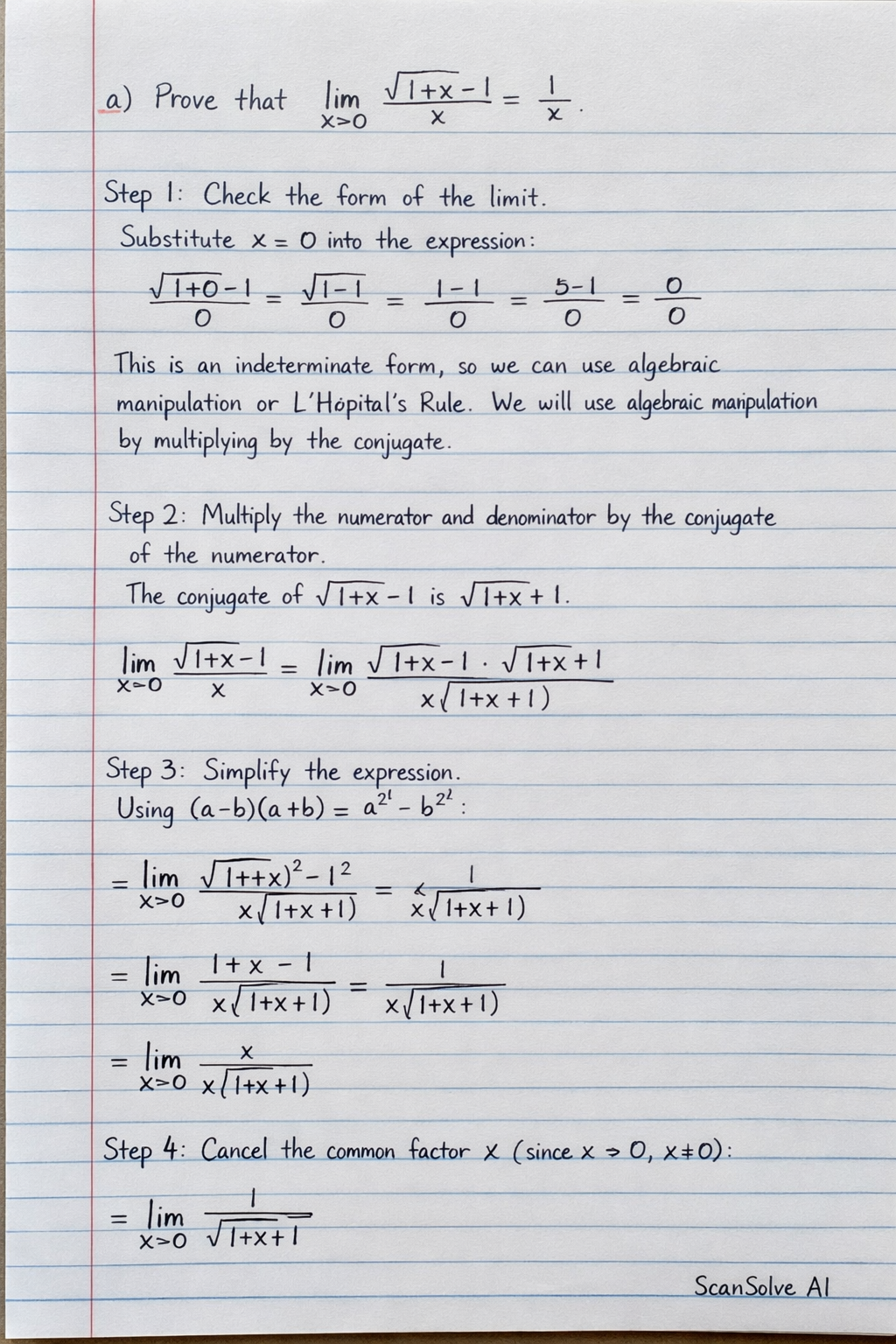
*a) Prove that _x 0 sqrt(1+x)-1x = (1)/(2). Step 1: Check the form of the limit. Substitute x=0 into the expression: sqrt(1+0)-10 = sqrt(1)-10 = (1-1)/(0) = (0)/(0) This is an indeterminate form, so we can use algebraic manipulation or L'Hôpital's Rule. We will use algebraic manipulation by multiplying by the conjugate. Step 2: Multiply the numerator and denominator by the conjugate of the numerator. The conjugate of sqrt(1+x)-1 is sqrt(1+x)+1. _x 0 sqrt(1+x)-1x = _x 0 sqrt(1+x)-1x × sqrt(1+x)+1sqrt(1+x)+1 Step 3: Simplify the expression. Using the difference of squares formula (a-b)(a+b) = a^2 - b^2: = _x 0 (sqrt(1+x))^2 - 1^2x(sqrt(1+x)+1) = _x 0 ((1+x) - 1)/(x(sqrt(1+x)+1)) = _x 0 (x)/(x(sqrt(1+x)+1)) Step 4: Cancel the common factor x (since x 0, x ≠ 0). = _x 0 (1)/(sqrt(1+x)+1) Step 5: Substitute x=0 into the simplified expression. = (1)/(sqrt(1+0)+1) = (1)/(sqrt(1)+1) = (1)/(1+1) = (1)/(2) Thus, _x 0 sqrt(1+x)-1x = (1)/(2). *b) Determine _x 0 e^x + e^-x - 2x^2. Step 1: Check the form of the limit. Substitute x=0 into the expression: e^0 + e^-0 - 20^2 = (1 + 1 - 2)/(0) = (0)/(0) This is an indeterminate form, so we can apply L'Hôpital's Rule. Step 2: Apply L'Hôpital's Rule for the first time. Let f(x) = e^x + e^-x - 2 and g(x) = x^2. Then f'(x) = (d)/(dx)(e^x + e^-x - 2) = e^x - e^-x. And g'(x) = (d)/(dx)(x^2) = 2x. _x 0 (f'(x))/(g'(x)) = _x 0 e^x - e^-x2x Step 3: Check the form of the new limit. Substitute x=0 into the new expression: e^0 - e^-02(0) = (1 - 1)/(0) = (0)/(0) This is still an indeterminate form, so we apply L'Hôpital's Rule again. Step 4: Apply L'Hôpital's Rule for the second time. Let f''(x) = (d)/(dx)(e^x - e^-x) = e^x - (-e^-x) = e^x + e^-x. And g''(x) = (d)/(dx)(2x) = 2. _x 0 (f''(x))/(g''(x)) = _x 0 e^x + e^-x2 Step 5: Substitute x=0 into the simplified expression. = e^0 + e^-02 = (1 + 1)/(2) = (2)/(2) = 1 The value of the limit is 1.