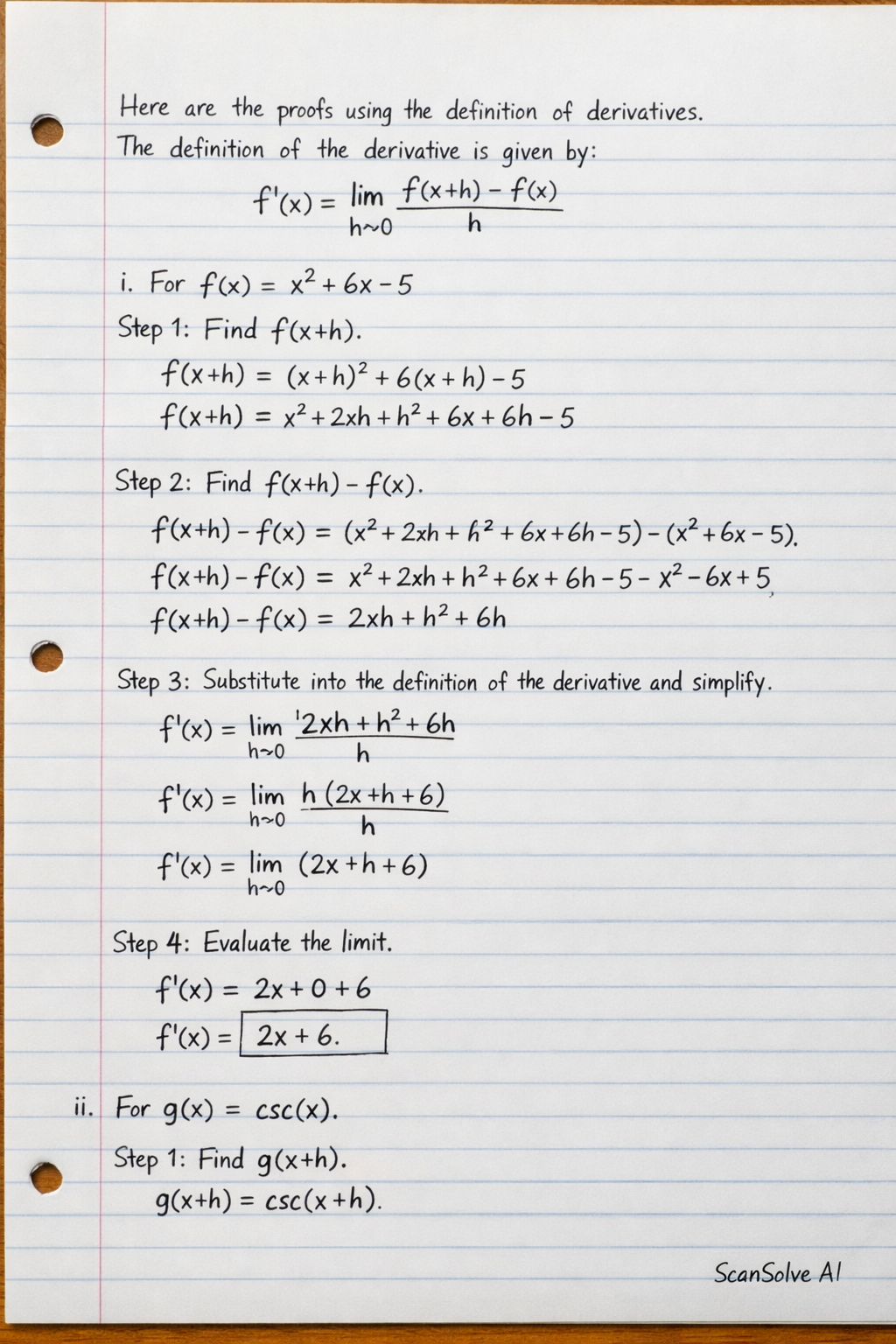
Here are the proofs using the definition of derivatives.
The definition of the derivative is given by:
f′(x)=limh→0hf(x+h)−f(x)
i. For f(x)=x2+6x−5
Step 1: Find f(x+h).
f(x+h)=(x+h)2+6(x+h)−5
f(x+h)=x2+2xh+h2+6x+6h−5
Step 2: Find f(x+h)−f(x).
f(x+h)−f(x)=(x2+2xh+h2+6x+6h−5)−(x2+6x−5)
f(x+h)−f(x)=x2+2xh+h2+6x+6h−5−x2−6x+5
f(x+h)−f(x)=2xh+h2+6h
Step 3: Substitute into the definition of the derivative and simplify.
f′(x)=limh→0h2xh+h2+6h
Factor out h from the numerator:
f′(x)=limh→0hh(2x+h+6)
Cancel h (since h=0 in the limit process):
f′(x)=limh→0(2x+h+6)
Step 4: Evaluate the limit.
f′(x)=2x+0+6
f′(x)=2x+6
ii. For g(x)=csc(x)
Step 1: Find g(x+h).
g(x+h)=csc(x+h)
Step 2: Find g(x+h)−g(x).
g(x+h)−g(x)=csc(x+h)−csc(x)
Convert to sines:
g(x+h)−g(x)=sin(x+h)1−sin(x)1
Find a common denominator:
g(x+h)−g(x)=sin(x+h)sin(x)sin(x)−sin(x+h)
Step 3: Substitute into the definition of the derivative.
g′(x)=limh→0hsin(x+h)sin(x)sin(x)−sin(x+h)
g′(x)=limh→0hsin(x+h)sin(x)sin(x)−sin(x+h)
Use the sum-to-product identity: sinA−sinB=2cos(2A+B)sin(2A−B).
Let A=x and B=x+h. Then A+B=2x+h and A−B=−h.
sin(x)−sin(x+h)=2cos(22x+h)sin(2−h)
Using sin(−θ)=−sin(θ):
sin(x)−sin(x+h)=−2cos(x+2h)sin(2h)
Step 4: Substitute this back into the limit expression.
g′(x)=limh→0hsin(x+h)sin(x)−2cos(x+2h)sin(2h)
Rearrange terms to use the special limit limθ→0θsinθ=1:
g′(x)=limh→0[2hsin(2h)⋅sin(x+h)sin(x)−cos(x+2h)]
Step 5: Evaluate the limit.
As h→0:
limh→02hsin(2h)=1
limh→0cos(x+2h)=cos(x)
limh→0sin(x+h)=sin(x)
g′(x)=1⋅sin(x)sin(x)−cos(x)
g′(x)=−sin(x)cos(x)⋅sin(x)1
Using the identities sin(x)cos(x)=cot(x) and sin(x)1=csc(x):
g′(x)=−cot(x)csc(x)
3 done, 2 left today. You're making progress.