
We read your photo as:
800 jerrycans fill a tank. One jerrycan weighs 20 kg. How many litres does the tank hold? A bucket contains 45.6 litres of water. The empty bucket weighs 3 kg. (i) What is the mass of the full bucket?
ScanSolve AI Answer
Answers
2 partsStep-by-step solution
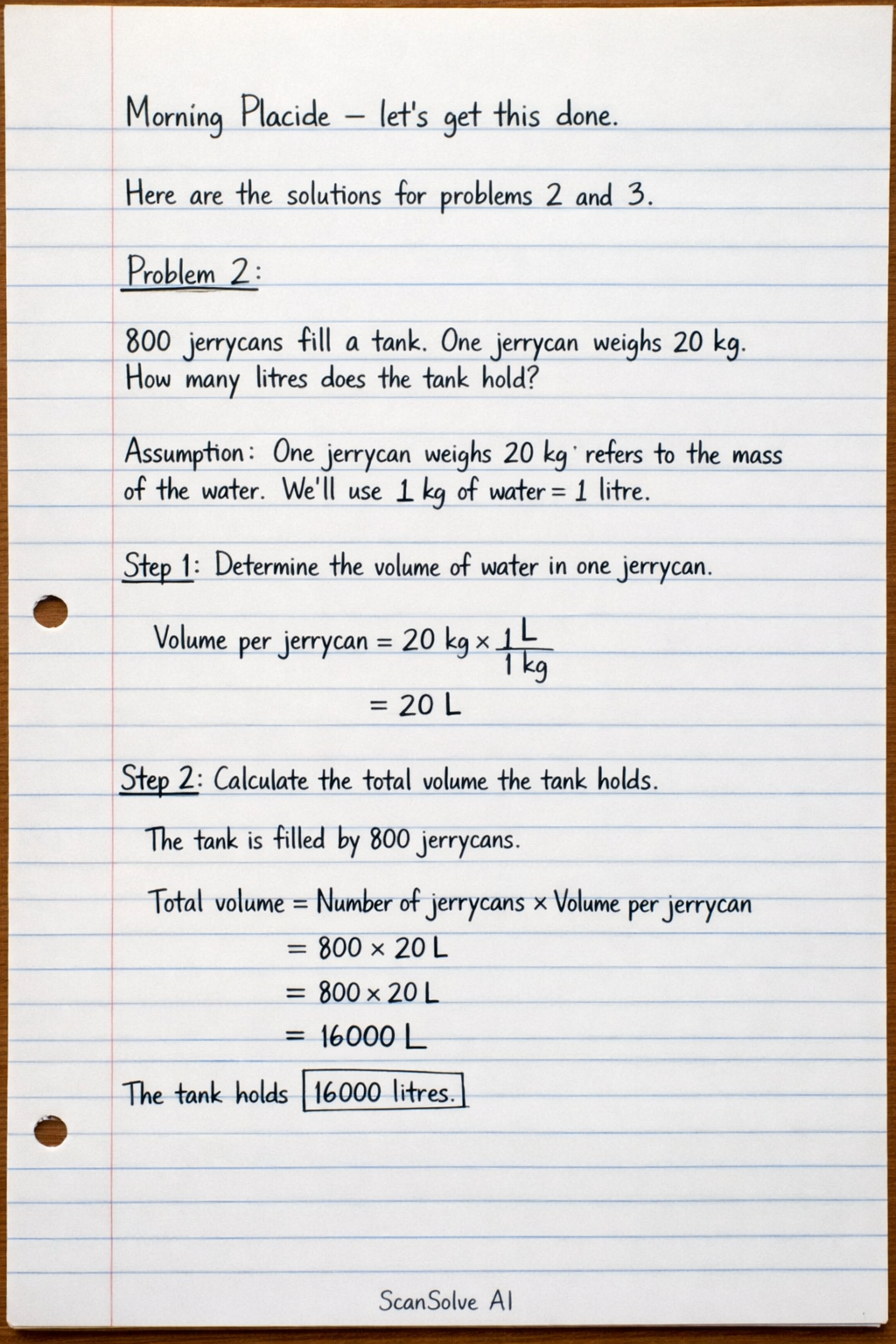
3 stepsHere are the solutions for problems 2 and 3.
:
"800 jerrycans fill a tank. One jerrycan weighs 20 kg. How many litres does the tank hold?"
Assumption: We assume that "One jerrycan weighs 20 kg" refers to the mass of the water contained in one jerrycan. We also use the density of water, where 1 kg of water has a volume of 1 litre.
Step 1: Determine the volume of water in one jerrycan.
Given that 1 kg of water is approximately 1 litre, if one jerrycan contains 20 kg of water, then its volume is 20 litres.
Step 2: Calculate the total volume the tank holds.
The tank is filled by 800 jerrycans.
The tank holds .
:
"A bucket contains 45.6 litres of water. The empty bucket weighs 3 kg."
"(i) What is the mass of the full bucket?"
"(ii) What is the volume of the water that fills the bucket in cm³?"
Part i· 2 steps
Mass of the full bucket
Calculate the mass of the water.
We use the density of water, where 1 litre of water has a mass of 1 kg.
Calculate the total mass of the full bucket.
The mass of the full bucket is .
Part ii
Volume of the water that fills the bucket in cm³
Convert the volume from litres to cubic centimetres.
We know that 1 litre is equal to 1000 cubic centimetres ().
The volume of the water that fills the bucket is .
Try one yourself
A new problem that tests the same skill.
Still stuck on this one?
Ask a follow-up, and the answer starts from this question.
More Mathematics Questions
Handwritten Step-by-Step Solution
Get this as a handwritten image on WhatsApp — like a tutor wrote it for you.
Try on WhatsApp