
An empty 60 litre petrol tank has a mass of 10kg. Its mass when full of fuel of relative density 0.72 is
ScanSolve AI Answer
Answer
Step-by-step solution
4 stepsTo calculate the mass of the tank when full of fuel, we need to find the mass of the fuel and add it to the mass of the empty tank.
Convert the volume of the tank to cubic meters.
The volume of the tank is .
Since :Calculate the density of the fuel.
The relative density of the fuel is 0.72.
The density of water () is .
Relative density is defined as the ratio of the density of a substance to the density of water:So, the density of the fuel () is:
Calculate the mass of the fuel.
The mass of the fuel () is its density multiplied by its volume:
Calculate the total mass of the tank when full.
The mass of the empty tank () is .
The mass of the tank when full () is the sum of the mass of the empty tank and the mass of the fuel:The final answer is .
Try one yourself
A new problem that tests the same skill.
Still stuck on this one?
Ask a follow-up, and the answer starts from this question.
More Physics Questions
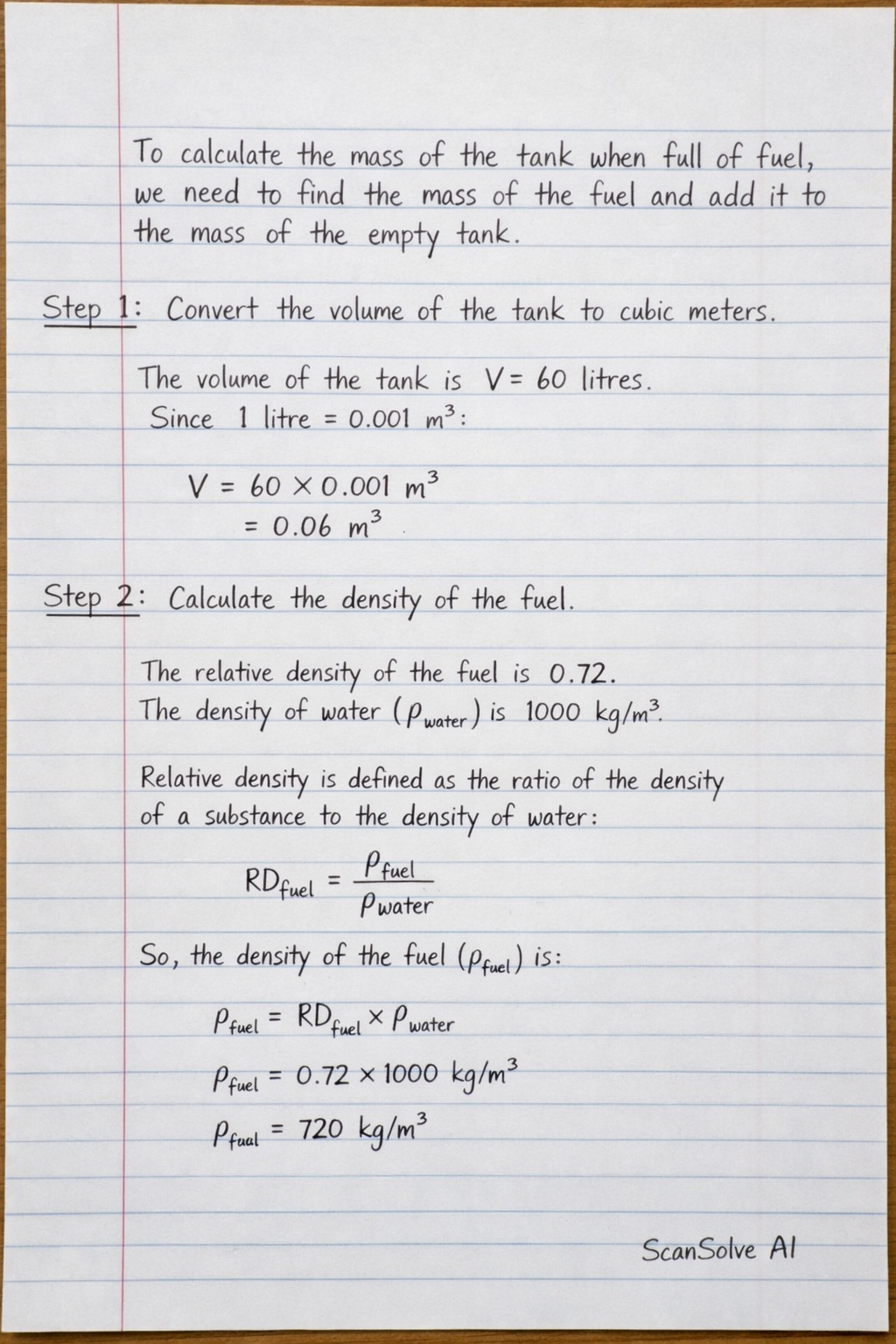
Handwritten Step-by-Step Solution
Get this as a handwritten image on WhatsApp — like a tutor wrote it for you.
Try on WhatsApp