
We read your photo as:
A 10 m long ladder reaches a window 8 m high from a wall at a distance x. Find the distance 'x'.
ScanSolve AI Answer
Step-by-step solution
22 stepshere are the solutions to the problems:
2.
Find the length of AD using the Pythagorean theorem in .
In right-angled :
Find the length of (CD) using the Pythagorean theorem in .
In right-angled :
The value of is .
3.
Identify the components of the right-angled triangle.
The ladder, the wall, and the ground form a right-angled triangle.
Hypotenuse (ladder length) m
One leg (height of window) m
Other leg (distance from wall) mApply the Pythagorean theorem.
The distance is .
4.
A triplet is a Pythagorean triplet if , where is the largest number.- i) 3, 7, 9
Check if .
$$ 3^2 + 7^2 = 9 + 49 = 58 $$ $$ 9^2 = 81 $$ Since $58 \neq 81$, (3, 7, 9) is **not** a Pythagorean triplet.- ii) 7, 24, 25
Check if .
$$ 7^2 + 24^2 = 49 + 576 = 625 $$ $$ 25^2 = 625 $$ Since $625 = 625$, (7, 24, 25) **is** a Pythagorean triplet.The Pythagorean triplet is .
5.
Identify the known sides of the right-angled triangle.
Hypotenuse cm
One leg cm
Let the third side be cm.Apply the Pythagorean theorem.
The length of its third side is .
6.
Visualize the movement as a right-angled triangle.
The man's movement east (10 m) and north (24 m) form the two legs of a right-angled triangle. His displacement from the starting point is the hypotenuse.
Leg 1 (East) m
Leg 2 (North) m
Let the displacement be m.Apply the Pythagorean theorem.
The man's displacement from the starting point is .
7.
Identify the sides of the triangle and the longest side.
Sides are 15 cm, 36 cm, and 39 cm. The longest side is 39 cm.
For a triangle to be right-angled, the square of the longest side must be equal to the sum of the squares of the other two sides (Pythagorean theorem).Check if the Pythagorean theorem holds.
Since , the triangle is a right-angled triangle.
The triangle is a .8.
Identify the components of the right-angled triangle.
The ladder, the wall, and the ground form a right-angled triangle.
Hypotenuse (ladder length) m
One leg (distance from wall) m
Other leg (height on wall) mApply the Pythagorean theorem.
The height of the wall where the ladder reaches is .
9.
Visualize the setup and form a right-angled triangle.
Draw a horizontal line from the top of the shorter pole to the taller pole. This forms a right-angled triangle.
The horizontal distance between the poles is one leg m.
The difference in heights of the poles is the other leg m.
The distance between their tops is the hypotenuse. Let this be .Apply the Pythagorean theorem.
The distance between their tops is .
10.
Identify the sides of the triangle and the longest side.
Sides are 6.5 cm, 6 cm, and 2.5 cm. The longest side is 6.5 cm.
For a triangle to be right-angled, the square of the longest side must be equal to the sum of the squares of the other two sides.Check if the Pythagorean theorem holds.
Since , the triangle is a right-angled triangle.
If it is a right-angled triangle, the hypotenuse is always the longest side.
The hypotenuse is .11.
Identify the components of the right-angled triangle formed by the diagonal.
The adjacent sides of a rectangle form the legs of a right-angled triangle, and the diagonal is the hypotenuse.
Leg 1 cm
Leg 2 cm
Let the diagonal be cm.Apply the Pythagorean theorem.
The length of its diagonal is .
12.
Identify the properties of an isosceles right triangle.
An isosceles right triangle has two equal sides (legs) and a right angle. Since it's right-angled at C, the legs are AC and BC.
Given cm, then cm.
AB is the hypotenuse.Apply the Pythagorean theorem.
The length of AB is .
Still stuck on this one?
Ask a follow-up, and the answer starts from this question.
More Mathematics Questions
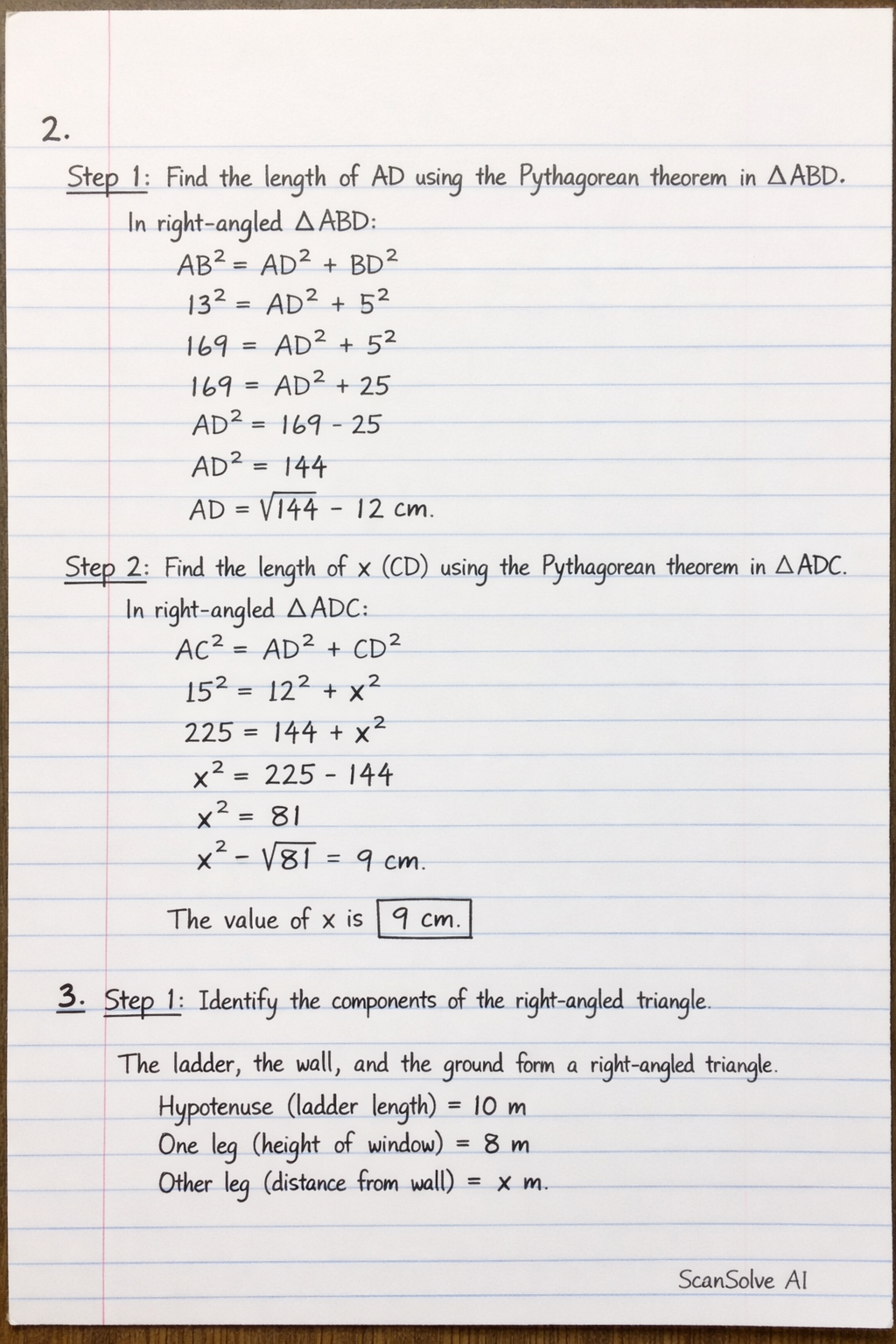
Handwritten Step-by-Step Solution
Get this as a handwritten image on WhatsApp — like a tutor wrote it for you.
Try on WhatsApp