
We read your photo as:
A bag contains 13 cubes numbered 1 to 13. Two cubes are drawn sequentially without replacement. What is the probability that both cubes are odd numbered?
Mathematics
ScanSolve AI Answer
Step-by-step solution
6 stepsHere are the solutions to the probability questions:
There are 13 cubes numbered from 1 to 13.
The odd numbers are , so there are 7 odd cubes.
The even numbers are , so there are 6 even cubes.
Two cubes are drawn one after the other without replacement.
- a) What is the probability that both cubes are odd numbered?
Find the probability of drawing an odd cube first.
There are 7 odd cubes out of 13 total cubes. $$ P(\text{1st cube is odd}) = \frac{7}{13} $$Find the probability of drawing a second odd cube, given the first was odd and not replaced.
After drawing one odd cube, there are 6 odd cubes left and a total of 12 cubes remaining. $$ P(\text{2nd cube is odd} | \text{1st cube is odd}) = \frac{6}{12} = \frac{1}{2} $$Multiply the probabilities to find the probability that both cubes are odd.
$$ P(\text{both are odd}) = P(\text{1st odd}) \times P(\text{2nd odd} | \text{1st odd}) $$ $$ P(\text{both are odd}) = \frac{7}{13} \times \frac{1}{2} $$ $$ P(\text{both are odd}) = \frac{7}{26} $$ The probability that both cubes are odd numbered is $\boxed{\frac{7}{26}}$.-
b) What is the probability that only one is even numbered?
This means one cube is even and the other is odd. There are two possible scenarios:
Scenario 1: The first cube is even, and the second cube is odd.
Scenario 2: The first cube is odd, and the second cube is even.
-
Calculate the probability for Scenario 1 (1st Even, 2nd Odd).
$$ P(\text{1st Even}) = \frac{6}{13} $$ After drawing one even cube, there are 7 odd cubes left and 12 total cubes remaining. $$ P(\text{2nd Odd} | \text{1st Even}) = \frac{7}{12} $$ $$ P(\text{1st Even, 2nd Odd}) = \frac{6}{13} \times \frac{7}{12} = \frac{1}{13} \times \frac{7}{2} = \frac{7}{26} $$Calculate the probability for Scenario 2 (1st Odd, 2nd Even).
$$ P(\text{1st Odd}) = \frac{7}{13} $$ After drawing one odd cube, there are 6 even cubes left and 12 total cubes remaining. $$ P(\text{2nd Even} | \text{1st Odd}) = \frac{6}{12} = \frac{1}{2} $$ $$ P(\text{1st Odd, 2nd Even}) = \frac{7}{13} \times \frac{1}{2} = \frac{7}{26} $$Add the probabilities of the two scenarios.
$$
P(\text{only one is even}) = P(\text{1st Even, 2nd Odd}) + P(\text{1st Odd, 2nd Even})
$$
$$
P(\text{only one is even}) = \frac{7}{26} + \frac{7}{26}
$$
$$
P(\text{only one is even}) = \frac{14}{26} = \frac{7}{13}
$$
The probability that only one cube is even numbered is $\boxed{\frac{7}{13}}$.
Was this helpful?
Still stuck on this one?
Ask a follow-up, and the answer starts from this question.
Got a different question?Ask your own question
More Mathematics Questions
QA piece of paper is drawn from a box containing slips of paper numbered 1 to 10. What is the…QIf a die is tossed once, what is the probability of obtaining an even number?QA bag contains 6 balls, 4 red and 2 black. What is the probability of drawing two balls of the same…QA bag contains 3 red balls and 4 black balls. If two balls are drawn without replacement, what is…QA number is chosen at random from the set S = 3, 5, 6, 8, 11, 14, 17. What is the probability that…
Browse by topic:Statistics
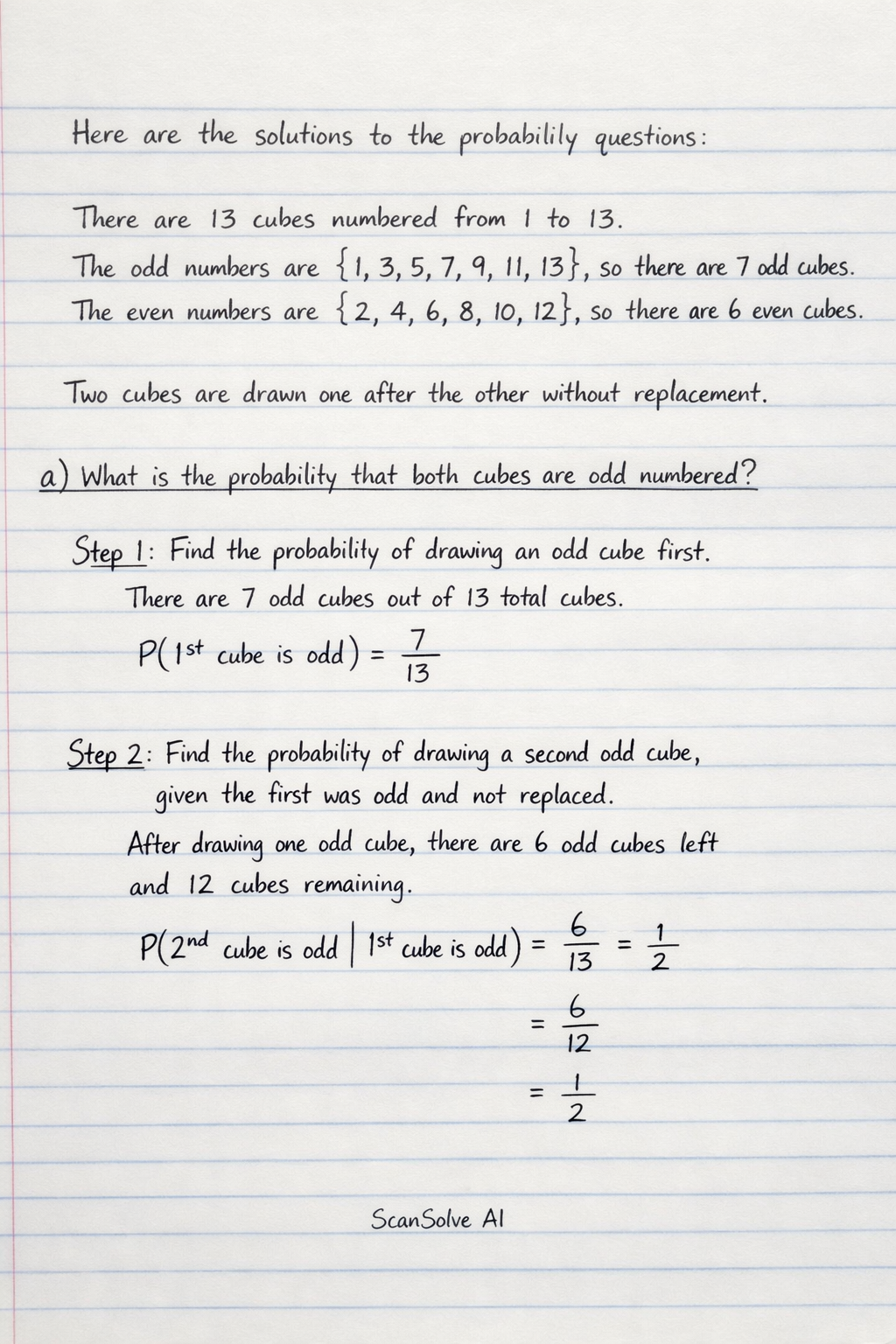
Handwritten Step-by-Step Solution
Get this as a handwritten image on WhatsApp — like a tutor wrote it for you.
Try on WhatsApp