
We read your photo as:
A bag contains 8 black, 5 white, and 7 pink identical bottles. Two bottles are picked at random one after the other with replacement. Find the probabilities that they are all pink, the first is white
ScanSolve AI Answer
Step-by-step solution
23 stepsHere are the solutions to questions 11, 12, 13, and 36.
Question 11:
A bag contains 8 black, 5 white, and 7 pink identical bottles.
Total number of bottles .
Two bottles are picked at random one after the other with replacement.
a) They are all pink?
Calculate the probability of picking a pink bottle.
Since the picking is with replacement, the probability of picking two pink bottles is the product of their individual probabilities.
The probability that they are all pink is .
b) The first is white and the second is white?
Calculate the probability of picking a white bottle.
Since the picking is with replacement, the probability of picking two white bottles is the product of their individual probabilities.
The probability that the first is white and the second is white is .
c) The first is pink and the second is white?
Calculate the probability of picking a pink bottle first.
Calculate the probability of picking a white bottle second (with replacement, so the total number of bottles and the number of white bottles remain the same).
Multiply the probabilities.
The probability that the first is pink and the second is white is .
Question 12:
A motorist travels from town R to town S on a bearing of for 54 km. He then travels from town S to town Q on a bearing of for 80 km.i) The distance between town R and town Q, correct to one decimal place.
Draw a diagram representing the journey.
Let be the North line at R and be the North line at S.
The bearing of S from R is . So, the angle between and RS is .
The line SR makes an angle of with the South line at S (alternate interior angles).
The angle from the North line at S, clockwise to SR, is .
The bearing of Q from S is . This is the angle from the North line at S, clockwise to SQ.Calculate the interior angle of the triangle RSQ.
So, triangle RSQ is a right-angled triangle with the right angle at S.
Use the Pythagorean theorem to find the distance RQ.
Correct to one decimal place, the distance between town R and town Q is .
ii) The bearing of town Q from town R.
Find the angle in the right-angled triangle RSQ.
The bearing of Q from R is the angle from the North line at R, clockwise to RQ.
This is the initial bearing of S from R plus .
Correct to one decimal place, the bearing of town Q from town R is .
Question 13:
Points A, B, and C have position vectors: , , and .a) Find the vectors and .
Calculate .
Calculate .
The vectors are and .
b) Determine the position vector of point D such that .
Calculate .
Find the position vector of D, .
We know , so .
The position vector of point D is .
c) Show whether points A, B, C are collinear.
For points A, B, C to be collinear, vector must be a scalar multiple of vector (i.e., for some scalar ).
We have and .
Check if there is a scalar such that .
From the x-components: .
From the y-components: .
Since the value of is not consistent (), is not a scalar multiple of .
Therefore, points A, B, C are .Question 36:
Solve the equation: .Find a common denominator for the fractions, which is $6x$.
Multiply the entire equation by to eliminate the denominators.
Simplify the terms.
Rearrange the equation into the standard quadratic form .
Use the quadratic formula to solve for .
Here, , , .
Calculate the square root and simplify.
Still stuck on this one?
Ask a follow-up, and the answer starts from this question.
More Mathematics Questions
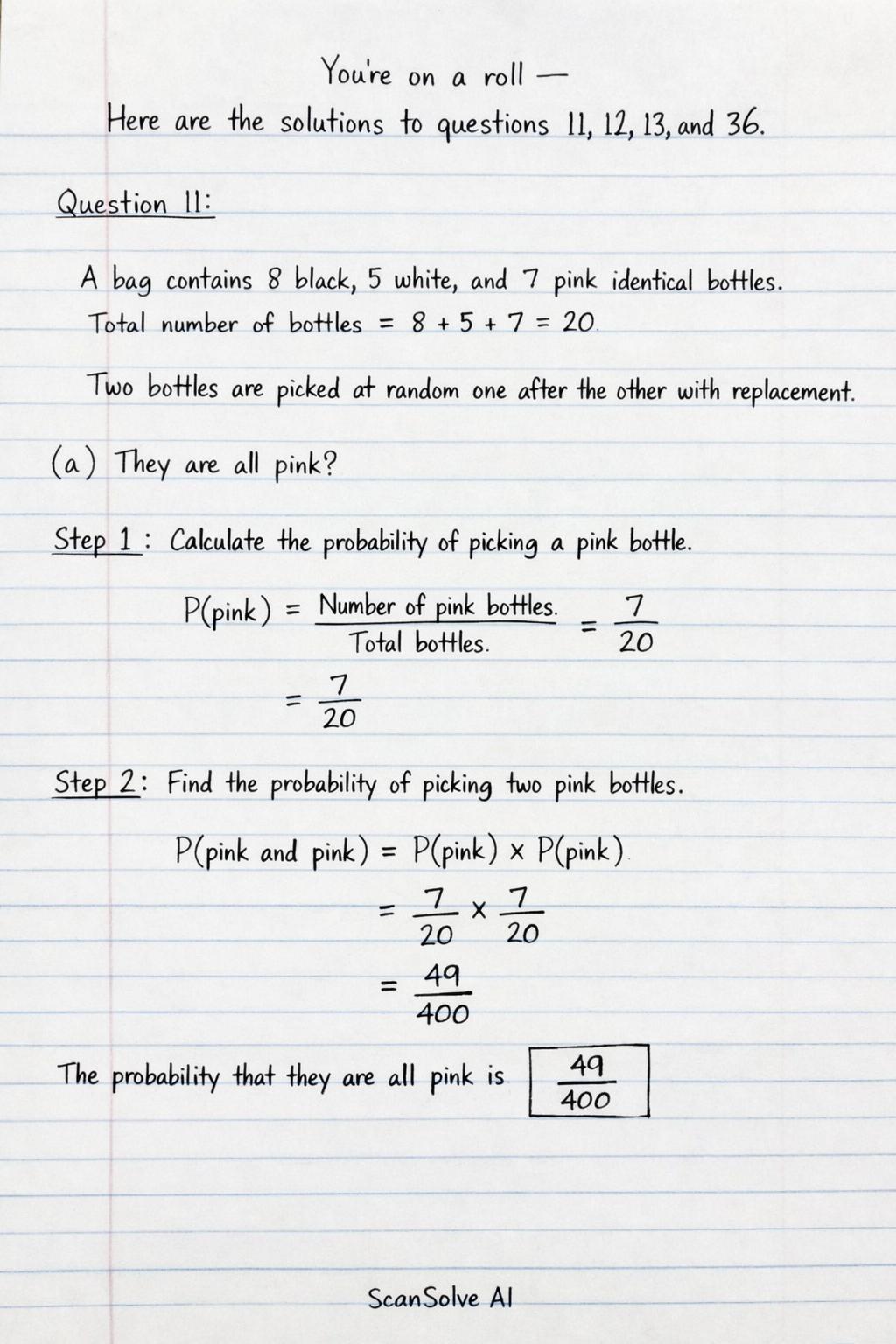
Handwritten Step-by-Step Solution
Get this as a handwritten image on WhatsApp — like a tutor wrote it for you.
Try on WhatsApp