
We read your photo as:
Task: how many line of planes of symmetry has the following: 1. Pentagon, 2. Prism (i) rectangular (ii) square, 3. Cuboid
Mathematics
ScanSolve AI Answer
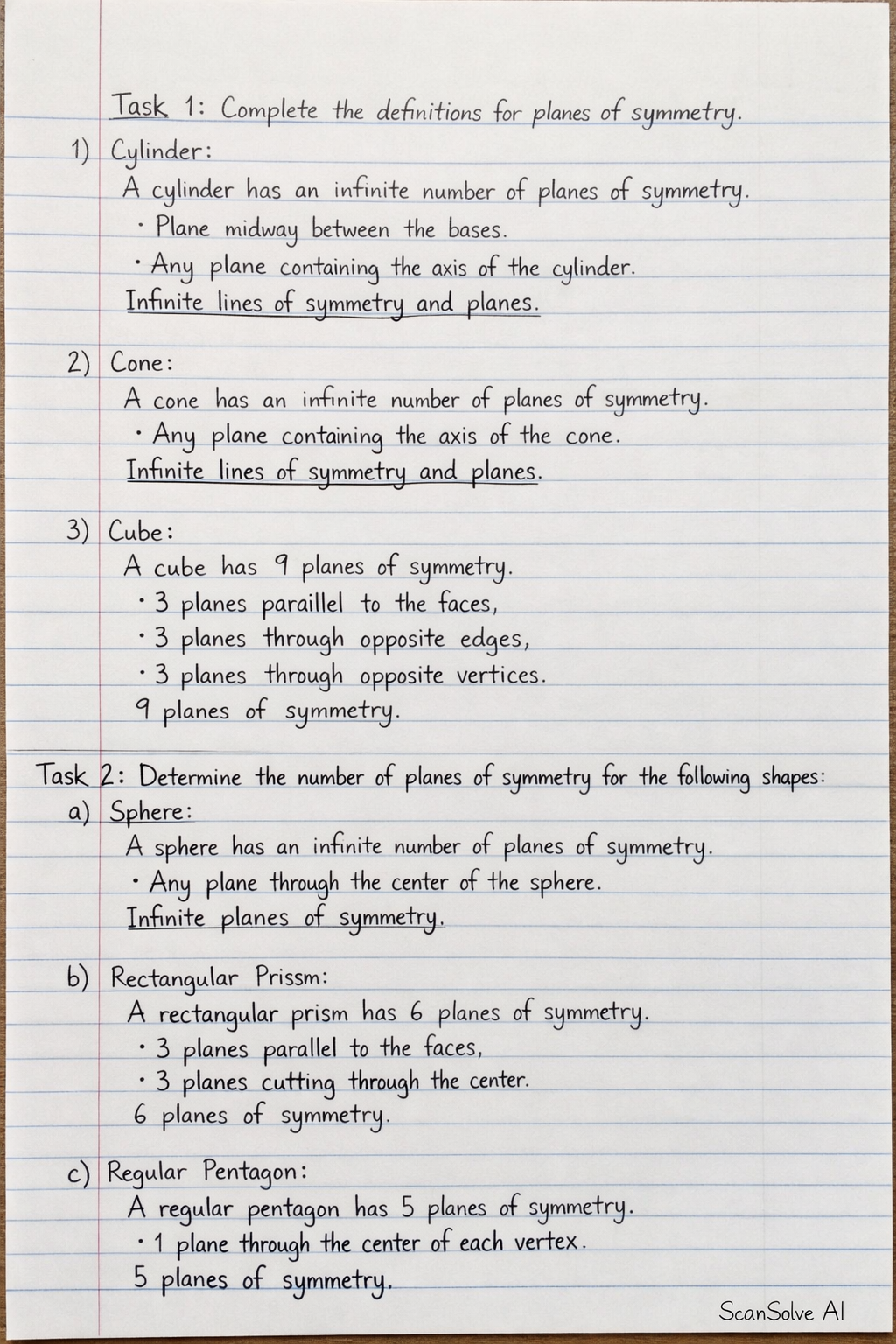
The image contains two main tasks related to symmetry.
Task 1: Complete the definitions for planes of symmetry.
- Cylinder: A cylinder has an infinite number of planes of symmetry. These include the plane midway between the bases and parallel to them, and any plane containing the axis of the cylinder.
- Cone: A cone has an infinite number of planes of symmetry. These are any planes that contain the axis of the cone.
- Cube: A cube has 9 planes of symmetry. These include three planes parallel to the faces, three planes passing through opposite edges, and three planes passing through opposite vertices.
Task 2: Determine the number of planes of symmetry for the following shapes.
- Pentagon: A regular pentagon (a 2D shape) has 5 lines of symmetry. If the question refers to a 3D pentagonal prism, it would have 6 planes of symmetry (1 rotational plane through the middle, and 5 planes passing through the midpoints of the sides and the axis). Assuming it refers to a 2D regular pentagon.
- Prism:
- Rectangular Prism: A rectangular prism (or cuboid) has 3 planes of symmetry. These planes pass through the midpoints of opposite faces.
- Square Prism (Cube): A square prism with equal sides is a cube. A cube has 9 planes of symmetry.
- Cuboid: A cuboid (which is a rectangular prism) has 3 planes of symmetry.
Here are the final answers:
- Cylinder:
- Cone:
- Cube:
- Pentagon:
- Rectangular Prism:
- Square Prism (Cube):
- Cuboid:
Was this helpful?
Still stuck on this one?
Ask a follow-up, and the answer starts from this question.
Got a different question?Ask your own question
More Mathematics Questions
QI told you that question 4 is a square prism and you solved for a square pyrimad.how many lines of…QLook at the different polyhedra. Identify the surfaces (faces), vertices and edges. Visualise how…QDescribe the nets for a cuboid, triangular prism, rectangular prism, and tetrahedron.QIdentify the shapes: Pentagon, Hexagon. What is the number of sides for each shape?QAnswer these questions. i. Does the shape have a line or lines of symmetry? Answer yes or no. ii…
Browse by topic:Geometry
Handwritten Step-by-Step Solution
Get this as a handwritten image on WhatsApp — like a tutor wrote it for you.
Try on WhatsApp