
F(x)=1/x24 Sketch graph
ScanSolve AI Answer
Use the left and right arrow keys to trace the curve, up and down to jump between key points, and plus and minus to zoom.
| Point | x | y |
|---|
Step-by-step solution
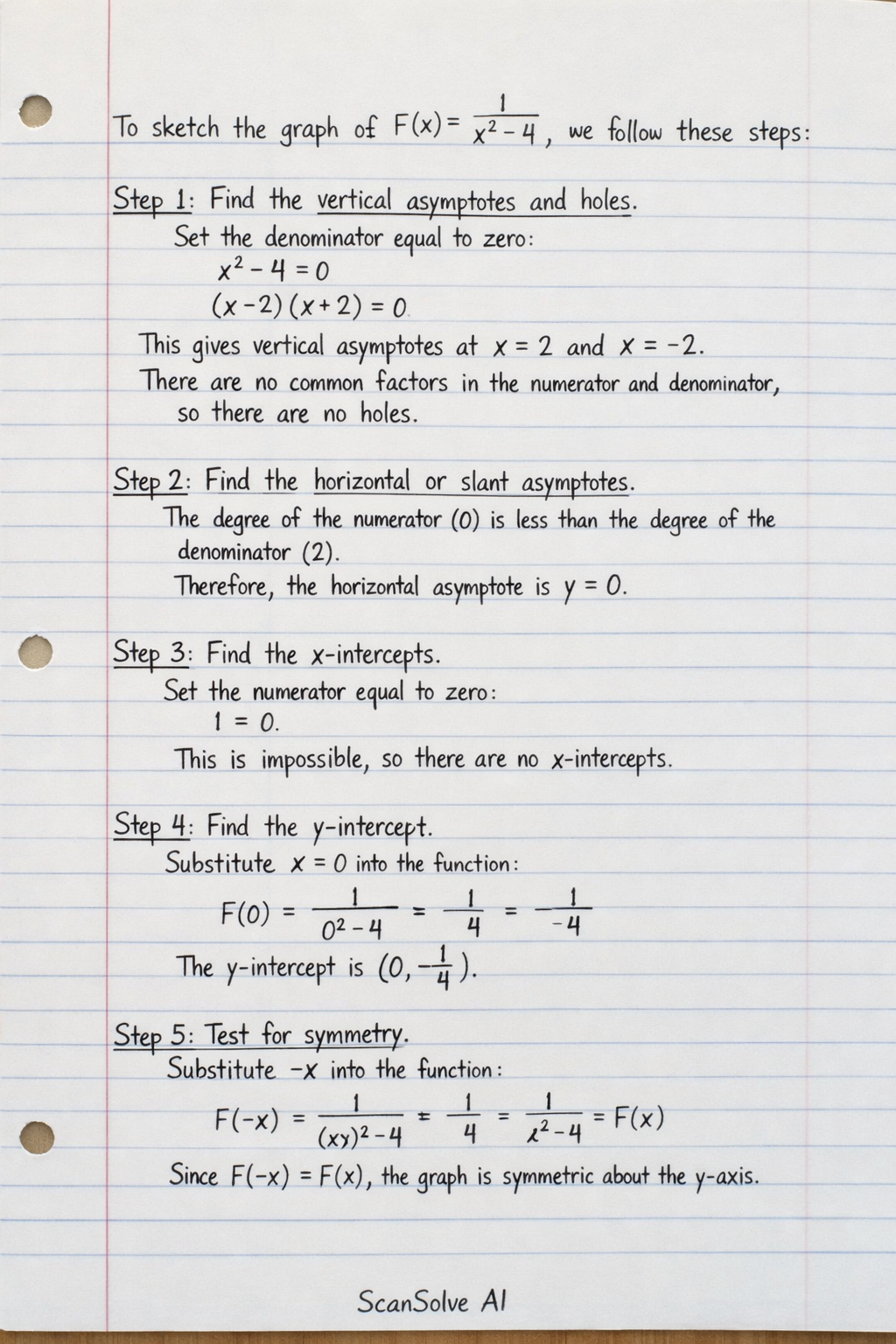
7 stepsTo sketch the graph of , we follow these steps:
Find the vertical asymptotes and holes.
Set the denominator equal to zero:
This gives vertical asymptotes at and .
There are no common factors in the numerator and denominator, so there are no holes.Find the horizontal or slant asymptotes.
The degree of the numerator (0) is less than the degree of the denominator (2).
Therefore, the horizontal asymptote is .Find the x-intercepts.
Set the numerator equal to zero:
This is impossible, so there are no x-intercepts.
Find the y-intercept.
Substitute into the function:
The y-intercept is .
Test for symmetry.
Substitute into the function:
Since , the graph is symmetric about the y-axis.
Plot additional points.
We have vertical asymptotes at and , and a horizontal asymptote at . The y-intercept is .
Let's pick points in the intervals , , and :- For : . Point: .
- For : . Point: .
- For : . Point: .
- For : . Point: .
Sketch the graph**.
- Draw dashed vertical lines at and .
- Draw a dashed horizontal line at (the x-axis).
- Plot the y-intercept at .
- Plot the additional points: , , , .
- Connect the points, ensuring the graph approaches the asymptotes.
- For , the graph is above the x-axis and approaches as and as .
- For , the graph is below the x-axis, passing through , and approaches as and as .
- For , the graph is above the x-axis and approaches as and as .
The key features for sketching the graph are:
- Vertical Asymptotes:
- Horizontal Asymptote:
- X-intercepts:
- Y-intercept:
- Symmetry:
- Additional points:
Still stuck on this one?
Ask a follow-up, and the answer starts from this question.
More Mathematics Questions
Handwritten Step-by-Step Solution
Get this as a handwritten image on WhatsApp — like a tutor wrote it for you.
Try on WhatsApp