
We read your photo as:
A carton contain 72 bottles of drink. If 38 bottles are alcoholic and the other bottles are non-alcoholic. What is the probability of picking a bottle of non-alcoholic drinks?
ScanSolve AI Answer
Answers
3 partsStep-by-step solution
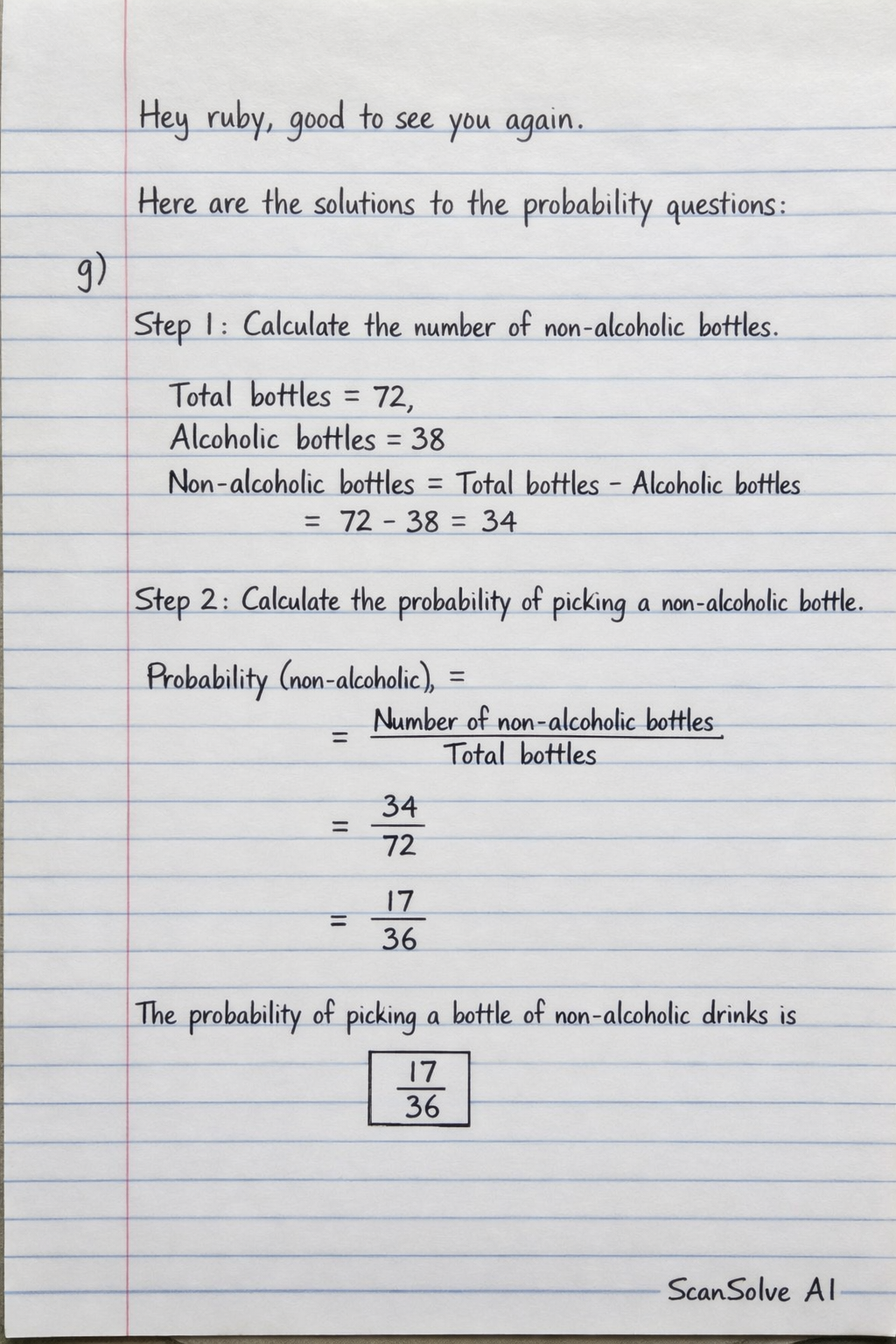
6 stepsHere are the solutions to the probability questions:
Part g· 2 steps
Calculate the number of non-alcoholic bottles.
Total bottles = 72
Alcoholic bottles = 38
Non-alcoholic bottles = Total bottles - Alcoholic bottlesCalculate the probability of picking a non-alcoholic bottle.
Probability (non-alcoholic) =
The probability of picking a bottle of non-alcoholic drinks is .
Part h
Identify the total number of cards and favorable outcomes.
A standard pack of playing cards has 52 cards.
Number of hearts = 13
Number of queen of spades = 1
The queen of spades is not a heart, so these events are mutually exclusive.Calculate the probability of picking a heart or the queen of spades.
Probability (heart or queen of spades) =
The probability that it is either a heart or the queen of spades is .
Part h(i)
Identify the total possible outcomes and favorable outcomes.
When a coin is tossed, there are 2 possible outcomes: Heads or Tails.
The number of favorable outcomes for getting a tail is 1.Calculate the probability of getting a tail.
Probability (tail) =
The probability of getting a tail is .
j)
This question is ambiguous due to missing information. The phrase "If there are 50 blue balls, orange balls and the rest are pink balls" does not specify the number of orange balls. Without knowing the number of orange balls, it is not possible to determine the number of pink balls or to accurately calculate the probability of obtaining at least two blue balls when 30 balls are removed.
Try one yourself
A new problem that tests the same skill.
Still stuck on this one?
Ask a follow-up, and the answer starts from this question.
More Mathematics Questions
Handwritten Step-by-Step Solution
Get this as a handwritten image on WhatsApp — like a tutor wrote it for you.
Try on WhatsApp