
We read your photo as:
A box contains 90 discs numbered 1 to 90. Find the probability that a disc drawn at random bears a two-digit number or a perfect square number.
ScanSolve AI Answer
Answers
3 partsStep-by-step solution
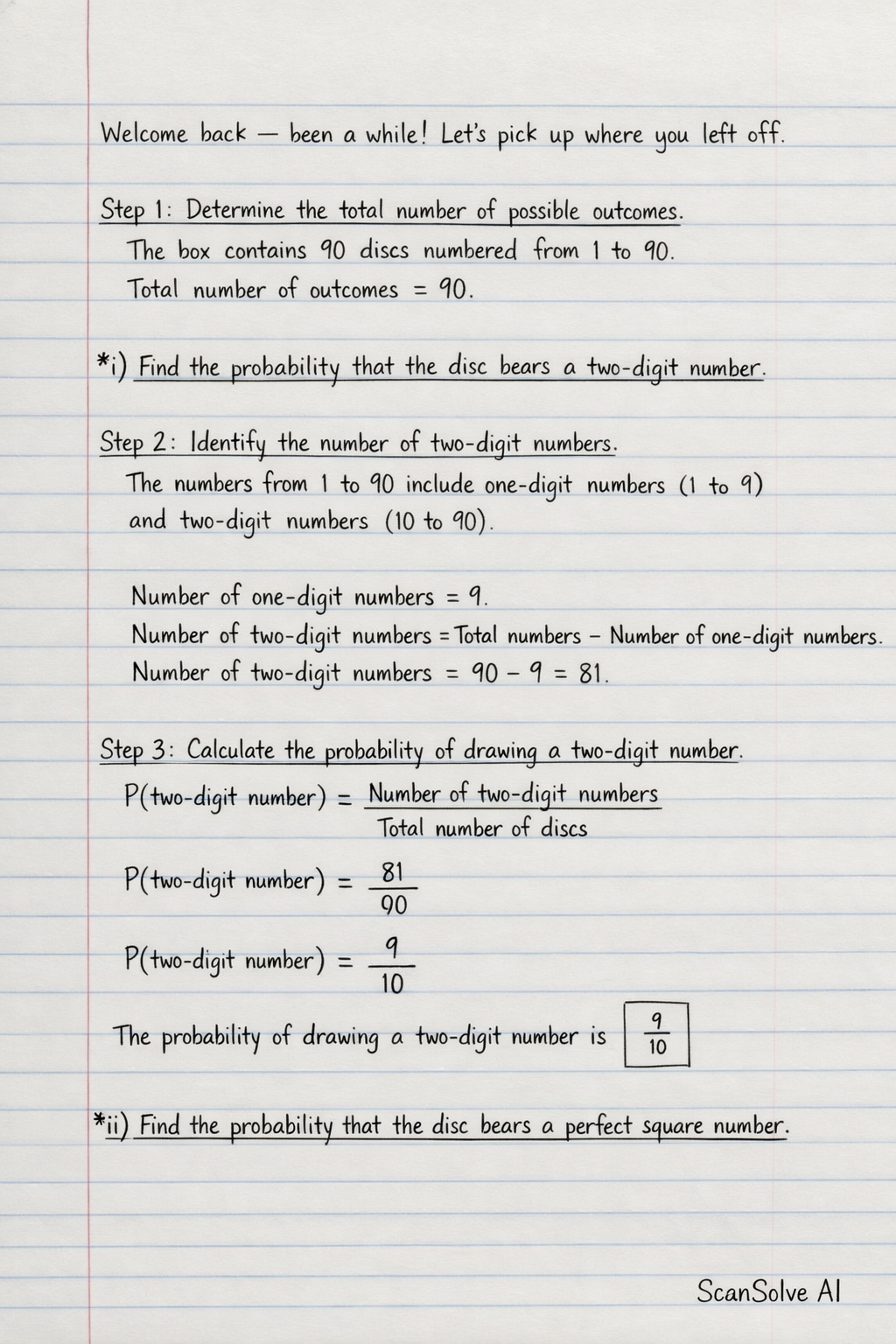
6 stepsStep 1: Determine the total number of possible outcomes.
The box contains 90 discs numbered from 1 to 90.
Total number of outcomes .
Part i· 2 steps
Find the probability that the disc bears a two-digit number.
Identify the number of two-digit numbers.
The numbers from 1 to 90 include one-digit numbers (1 to 9) and two-digit numbers (10 to 90).
Number of one-digit numbers .
Number of two-digit numbers
Number of two-digit numbers .Calculate the probability of drawing a two-digit number.
The probability of drawing a two-digit number is .
Part ii
Find the probability that the disc bears a perfect square number.
Identify the perfect square numbers between 1 and 90.
Perfect squares are numbers that can be expressed as .
The perfect squares are:
(, which is greater than 90, so it's not included).
Number of perfect square numbers .Calculate the probability of drawing a perfect square number.
The probability of drawing a perfect square number is .
Part iii
Find the probability that the disc bears a number divisible by 5.
Identify the numbers divisible by 5 between 1 and 90.
These are 5, 10, 15, ..., 90.
To find the count, divide the last number by 5:
Number of numbers divisible by 5 .Calculate the probability of drawing a number divisible by 5.
The probability of drawing a number divisible by 5 is .
Try one yourself
A new problem that tests the same skill.
Still stuck on this one?
Ask a follow-up, and the answer starts from this question.
More Mathematics Questions
Handwritten Step-by-Step Solution
Get this as a handwritten image on WhatsApp — like a tutor wrote it for you.
Try on WhatsApp