
We read your photo as:
A circle has center P(5,5) and radius 5. Find its equation in the form x2 + y2 + cx + dy + e = 0.
ScanSolve AI Answer
Answer
Step-by-step solution
7 stepsHere are the solutions to the circle geometry questions:
7. The diagram below shows a circle with center P(5,5) and radius 5 units.
Part a· 3 steps
Write down in terms of x and y the equation of the circle in the form where a, b, c, d and e are constants. (2mks)
Use the standard equation of a circle.
The standard equation of a circle with center and radius is .
Given center , so and .
Given radius .Substitute the values into the standard equation.
Expand and rearrange the equation into the form .
Here, .
Part b
Determine the gradient of PQ (1m)
Part c· 4 steps
Find the equation of the tangent at Q in the form (3mks)
Note: The diagram mentioned in the question is not provided. Without the diagram, the specific coordinates of point Q cannot be determined. Therefore, parts b) and c) cannot be solved to a numerical answer. Below is the general method for solving these parts if the coordinates of Q were known.
General Method for b) and c):
Identify the coordinates of Q.
Let's assume, for demonstration purposes, that point Q has coordinates . (These coordinates would be given in the missing diagram).
The center of the circle is .Calculate the gradient of the radius PQ (for part b).
The gradient is given by the formula:
This would yield a specific numerical value if were known.
Calculate the gradient of the tangent at Q (for part c).
The tangent at any point on a circle is perpendicular to the radius at that point.
If is the gradient of the radius PQ, then the gradient of the tangent, , is the negative reciprocal of :Find the equation of the tangent at Q (for part c).
Using the point-slope form of a linear equation, , with point and gradient :
This equation would then be rearranged into the form .
Try one yourself
A new problem that tests the same skill.
Still stuck on this one?
Ask a follow-up, and the answer starts from this question.
More Mathematics Questions
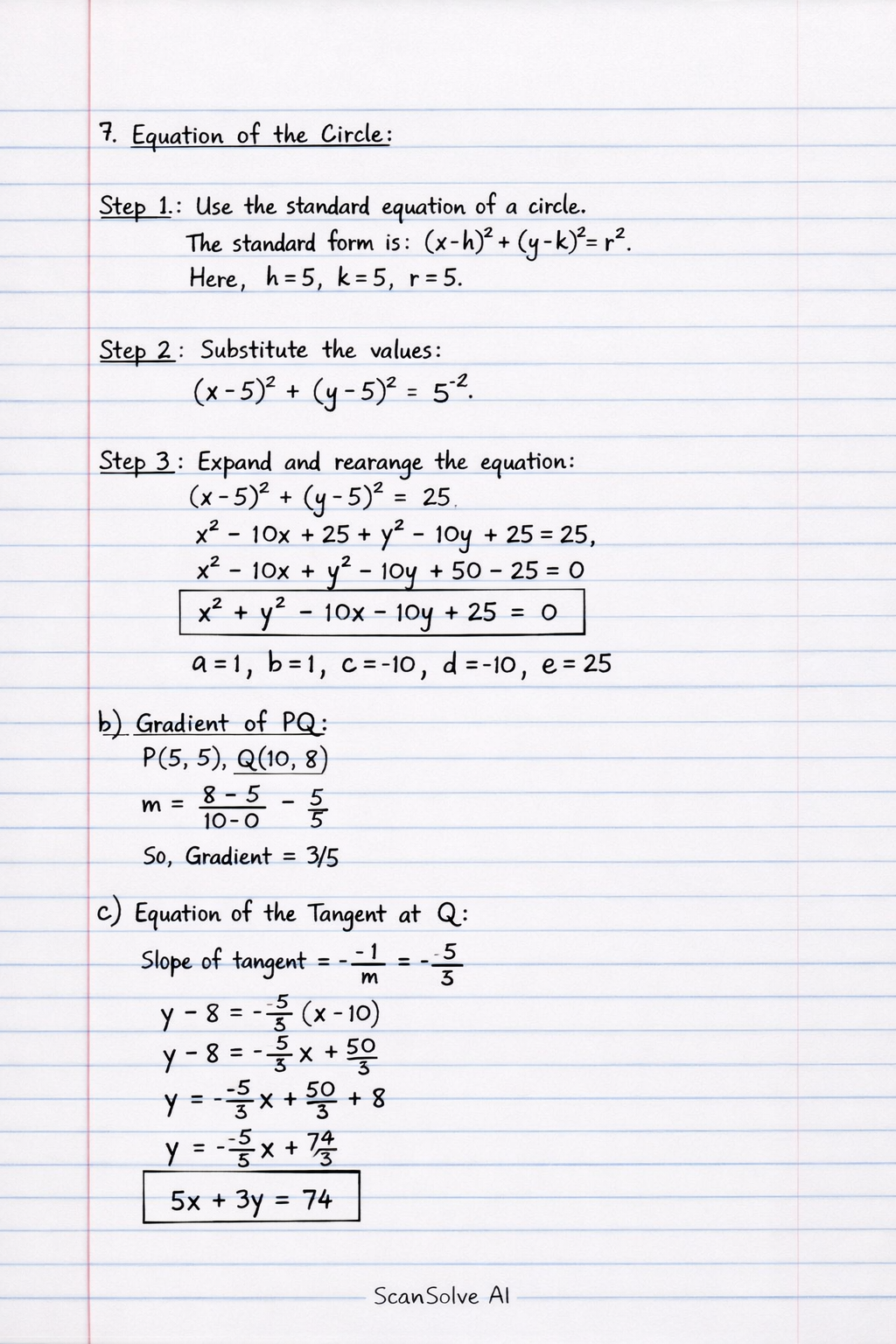
Handwritten Step-by-Step Solution
Get this as a handwritten image on WhatsApp — like a tutor wrote it for you.
Try on WhatsApp