
We read your photo as:
A circle has its centre at M(-2; 1) and passes through S(1; -2). Determine the coordinates of M and the radius of the circle. Determine the equation of the tangent RS.
ScanSolve AI Answer
Step-by-step solution
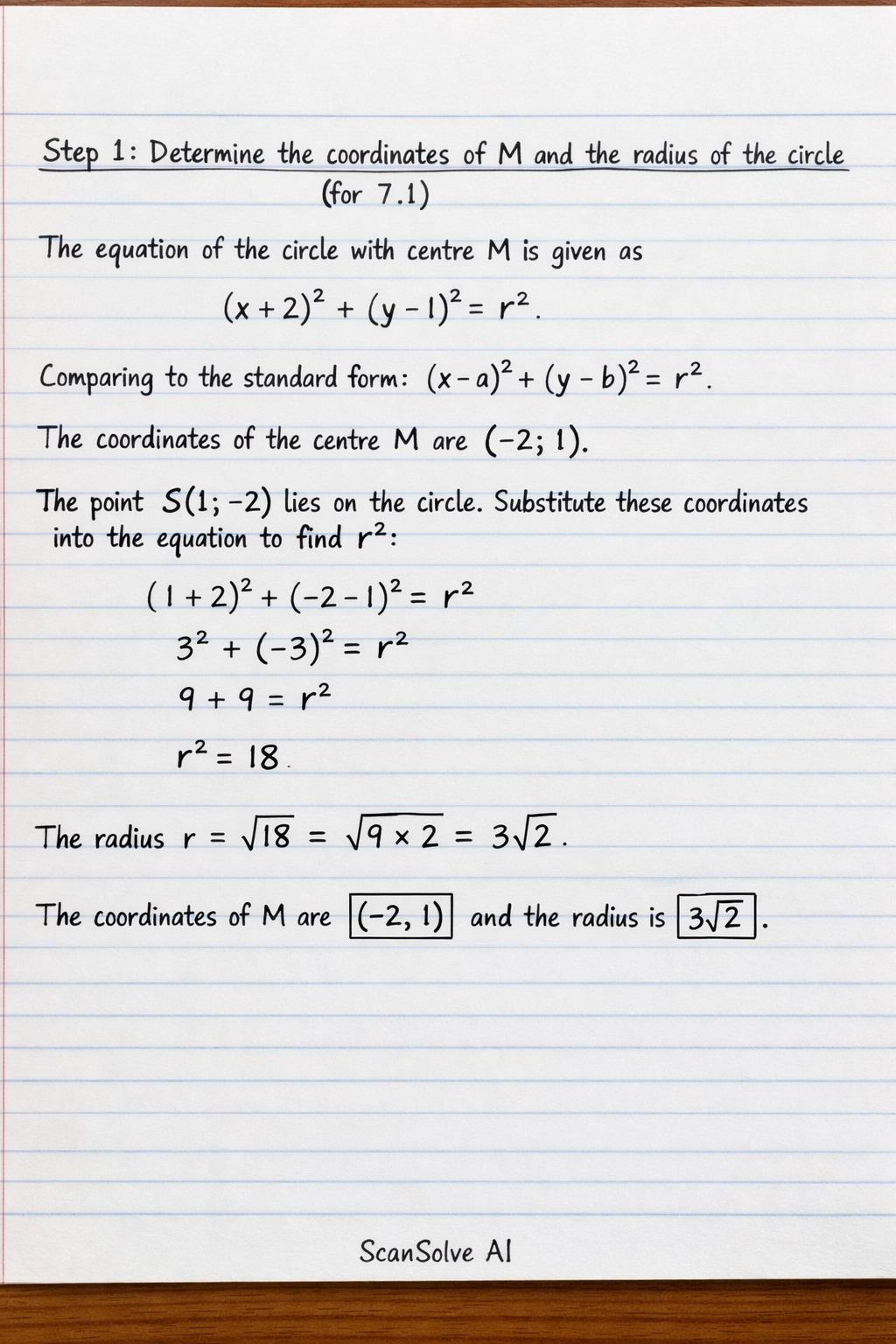
3 stepsDetermine the coordinates of M and the radius of the circle (for 7.1)
The equation of the circle with centre M is given as .
Comparing this to the standard form of a circle equation , the coordinates of the centre M are .
The point S lies on the circle. Substitute these coordinates into the equation to find :The radius .
The coordinates of M are and the radius is .Determine the equation of the tangent RS (for 7.2)
The tangent RS touches the circle at point S. The radius MS is perpendicular to the tangent at S.
First, calculate the gradient of the radius MS, , using M and S:Since the tangent RS is perpendicular to the radius MS, the gradient of the tangent, , is the negative reciprocal of :
Now, use the point-slope form of a linear equation, , with point S and :
The equation of the tangent RS is .
Determine the coordinates of point P (for 7.3)
The circles with centres P and M touch externally at point S. This means S lies on the line segment MP.
We are given the ratio MS : MP = 1 : 3.
This implies that the distance from M to S is one-third of the distance from M to P.
Let M be and S be . Let P be .
We can use the section formula or vector approach. Using the vector approach:
The vector represents the displacement from M to S:Since MS : MP = 1 : 3, the vector is 3 times the vector :
The vector also represents the displacement from M to P:
Equating the components of :
The coordinates of point P are .
Still stuck on this one?
Ask a follow-up, and the answer starts from this question.
More Mathematics Questions
Handwritten Step-by-Step Solution
Get this as a handwritten image on WhatsApp — like a tutor wrote it for you.
Try on WhatsApp