
We read your photo as:
A circle with center O has a radius of 5 cm. A chord PQ has a length of 6 cm. Calculate (i) the distance of the chord from the center O, and (ii) the angle POQ.
ScanSolve AI Answer
Answers
2 partsStep-by-step solution
6 stepsStep 1: Identify the given information.
A circle with center has a radius cm.
A chord has a length of 6 cm.
Part i· 3 steps
Calculate the distance of the chord from the Centre O.
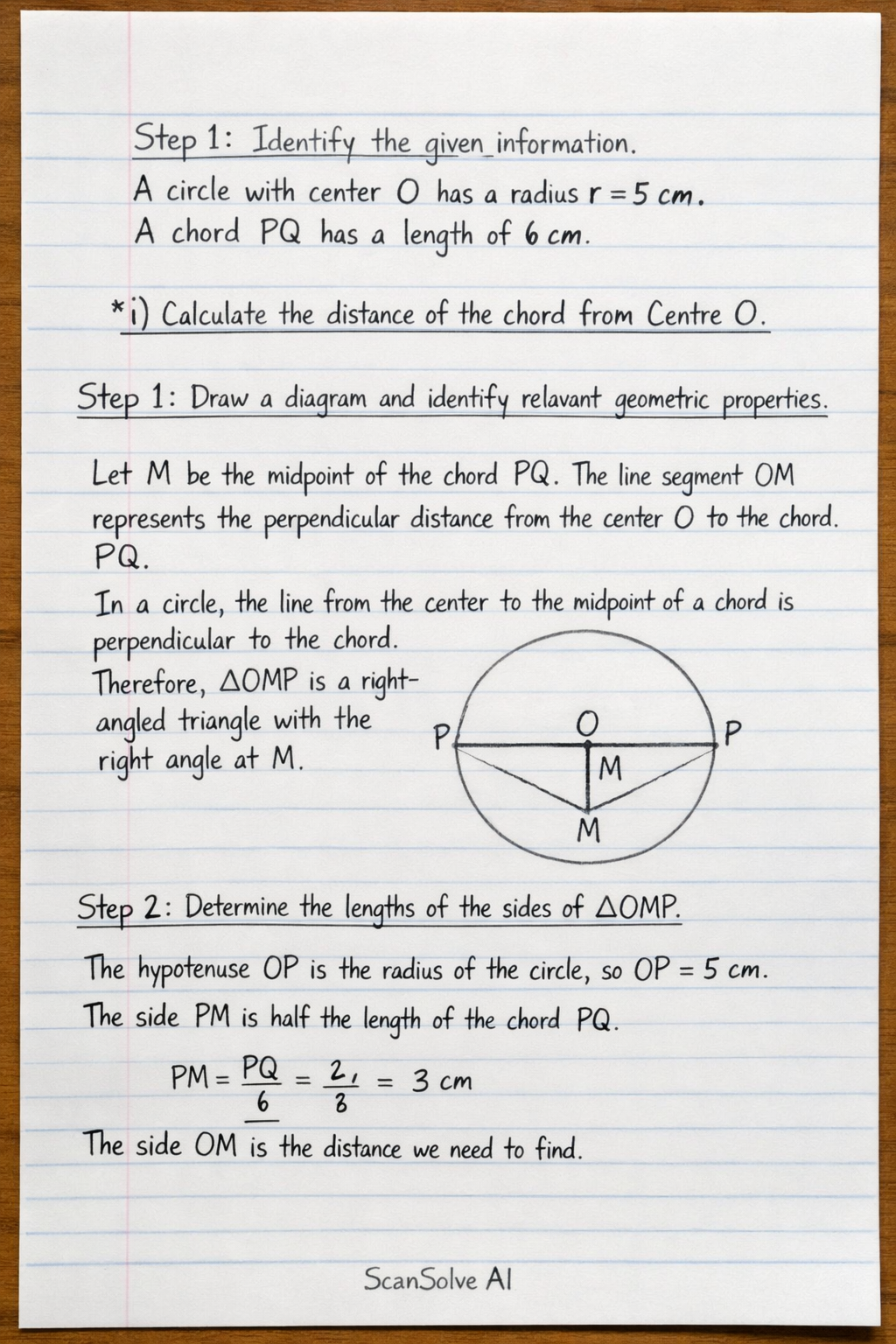
Draw a diagram and identify relevant geometric properties.
Let be the midpoint of the chord . The line segment represents the perpendicular distance from the center to the chord .
In a circle, the line from the center to the midpoint of a chord is perpendicular to the chord. Therefore, is a right-angled triangle with the right angle at .Determine the lengths of the sides of .
The hypotenuse is the radius of the circle, so cm.
The side is half the length of the chord .The side is the distance we need to find.
Apply the Pythagorean theorem.
In :
Substitute the known values:
The distance of the chord from the center is .
Part ii
Calculate Angle POQ.
Relate to .
The angle is the angle subtended by the chord at the center .
Since bisects , we have .
Let .Use trigonometry in to find .
In the right-angled triangle :
We know cm (hypotenuse), cm (opposite to ), and cm (adjacent to ).
We can use the sine function:Using a calculator:
Calculate .
Rounding to one decimal place:
The angle is .
Try one yourself
A new problem that tests the same skill.
Still stuck on this one?
Ask a follow-up, and the answer starts from this question.
More Mathematics Questions
Handwritten Step-by-Step Solution
Get this as a handwritten image on WhatsApp — like a tutor wrote it for you.
Try on WhatsApp