
We read your photo as:
A coin is tossed 100 times, and the relative frequency of heads is 0.6. If 40 of the first 50 tosses were heads, how many tails were in the remaining 50 tosses?
ScanSolve AI Answer
Step-by-step solution
6 stepsHere's how to approach question 28:
Determine the total number of spins.
The problem states there are initial spins and then an extra number of spins. Add these two quantities to find the total number of spins.
Calculate the total number of Heads after all spins.
You are given the relative frequency of Heads after the total number of spins. Multiply this relative frequency by the total number of spins (from Step 1) to find the total count of Heads.
Calculate the total number of Tails after all spins.
Subtract the total number of Heads (from Step 2) from the total number of spins (from Step 1) to find the total count of Tails.
Find the number of Heads in the extra spins.
Subtract the initial number of Heads (given in the table for the first set of spins) from the total number of Heads (from Step 2).
Find the number of Tails in the extra spins.
Subtract the initial number of Tails (given in the table for the first set of spins) from the total number of Tails (from Step 3).
Form the ratio.
Write the number of Heads from the extra spins (from Step 4) followed by a colon, then the number of Tails from the extra spins (from Step 5).
Still stuck on this one?
Ask a follow-up, and the answer starts from this question.
More Mathematics Questions
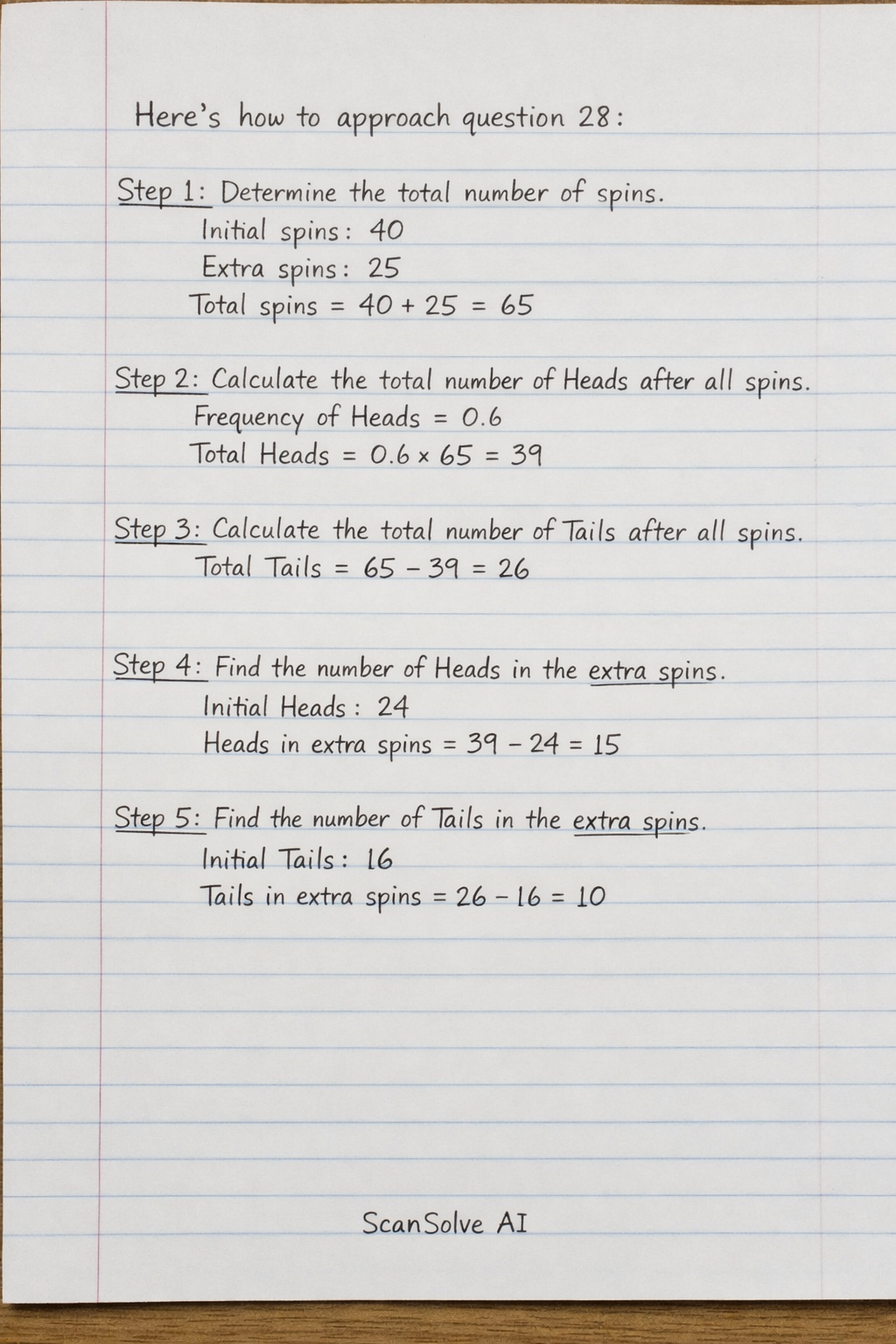
Handwritten Step-by-Step Solution
Get this as a handwritten image on WhatsApp — like a tutor wrote it for you.
Try on WhatsApp