
We read your photo as:
If two fair coins are tossed, what is the probability of getting at least one head?
ScanSolve AI Answer
Answer
Step-by-step solution
7 stepsHere are the solutions to the problems:
Part 11· 4 steps
Determine the total number of possible outcomes.
Bola chose a number between 1 and 300, inclusive.
Total number of outcomes = 300.Determine the number of favorable outcomes (numbers divisible by 4).
To find how many numbers between 1 and 300 are divisible by 4, divide 300 by 4.
Number of favorable outcomes = .Calculate the probability.
Simplify the probability.
The correct option is B.
Part 12· 3 steps
Identify the probabilities of each event.
Let be the probability Mr. Kunle passes = .
Let be the probability Mr. Boye passes = .Calculate the probability that neither passes.
The probability Mr. Kunle fails is .
The probability Mr. Boye fails is .
Assuming the events are independent, the probability that neither passes is .Calculate the probability that at least one of them passes.
The probability that at least one passes is the complement of neither passing.
The correct option is A (or C).
Try one yourself
A new problem that tests the same skill.
Still stuck on this one?
Ask a follow-up, and the answer starts from this question.
More Mathematics Questions
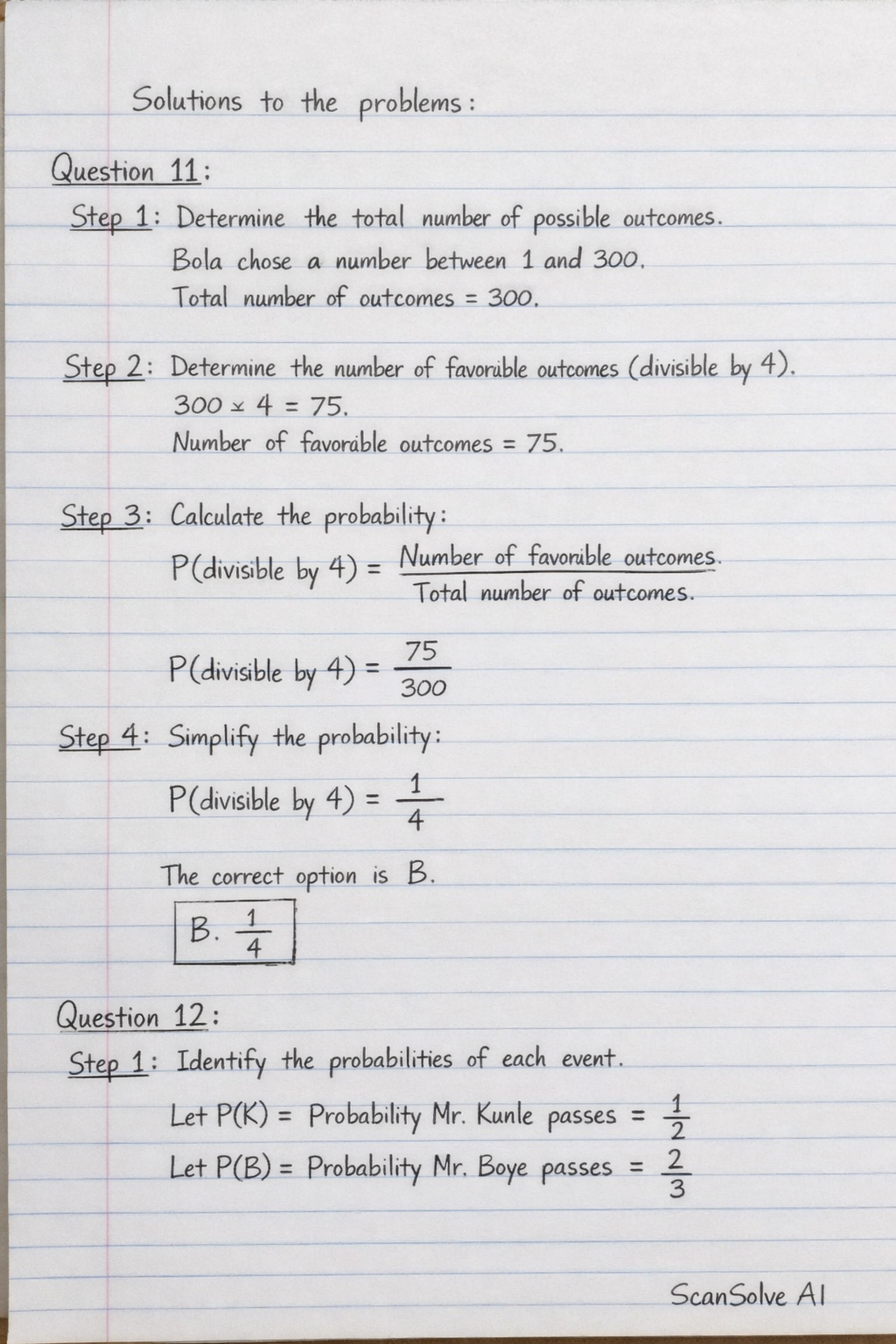
Handwritten Step-by-Step Solution
Get this as a handwritten image on WhatsApp — like a tutor wrote it for you.
Try on WhatsApp