We read your photo as:

A cricket stadium is called an "Oval" due to its unique shape. Use the diagram below to answer the questions that follow. 1.1 Calculate the area of the pitch. 1.2 Calculate the area of the oval to two decimals. 1.3 Calculate the area of the grass only.

Mathematics

ScanSolve AI Answer

Step-by-step solution

5 steps
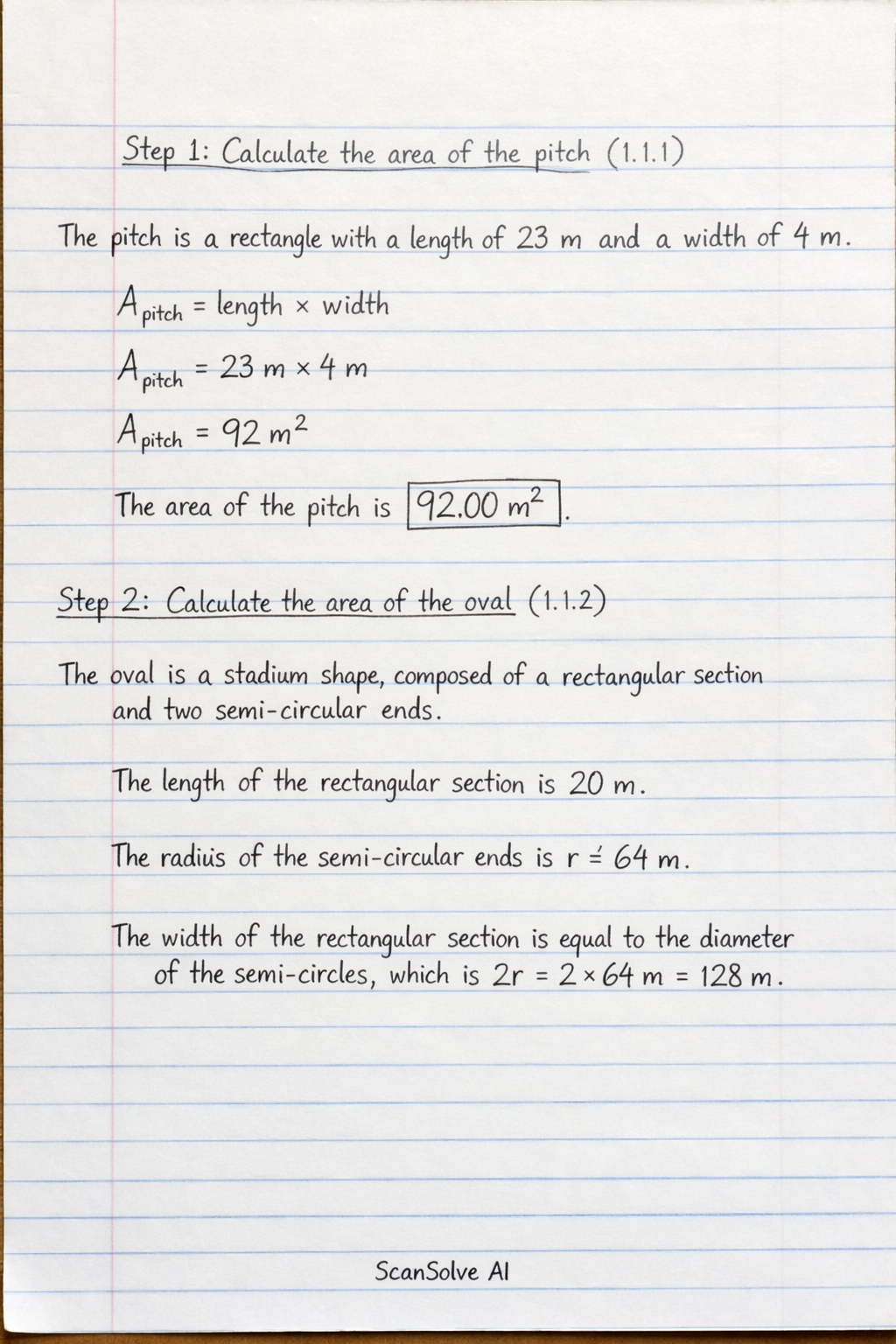
  1. Calculate the area of the pitch (1.1.1)

    The pitch is a rectangle with a length of 23 m23 \text{ m} and a width of 4 m4 \text{ m}.

    Apitch=length×widthA_{pitch} = \text{length} \times \text{width} Apitch=23 m×4 mA_{pitch} = 23 \text{ m} \times 4 \text{ m} Apitch=92 m2A_{pitch} = 92 \text{ m}^2

    The area of the pitch is 92.00 m2\boxed{\text{92.00 m}^2}.

  2. Calculate the area of the oval (1.1.2)

    The oval is a stadium shape, composed of a rectangular section and two semi-circular ends.
    The length of the rectangular section is 20 m20 \text{ m}.
    The radius of the semi-circular ends is r=64 mr = 64 \text{ m}.
    The width of the rectangular section is equal to the diameter of the semi-circles, which is 2r=2×64 m=128 m2r = 2 \times 64 \text{ m} = 128 \text{ m}.

    Area of the rectangular part of the oval:

    Arect_oval=20 m×128 m=2560 m2A_{rect\_oval} = 20 \text{ m} \times 128 \text{ m} = 2560 \text{ m}^2

    Area of the two semi-circular ends (which form one full circle):

    Acircle=πr2A_{circle} = \pi r^2 Acircle=π×(64 m)2A_{circle} = \pi \times (64 \text{ m})^2 Acircle=π×4096 m2≈12867.9635 m2A_{circle} = \pi \times 4096 \text{ m}^2 \approx 12867.9635 \text{ m}^2

    Total area of the oval:

    Aoval=Arect_oval+AcircleA_{oval} = A_{rect\_oval} + A_{circle} Aoval=2560 m2+12867.9635 m2A_{oval} = 2560 \text{ m}^2 + 12867.9635 \text{ m}^2 Aoval=15427.9635 m2A_{oval} = 15427.9635 \text{ m}^2

    Rounding to two decimal places:
    The area of the oval is 15427.96 m2\boxed{\text{15427.96 m}^2}.

  3. Calculate the area of the grass only (1.1.3)

    The area of the grass is the area of the oval minus the area of the pitch.

    Agrass=Aoval−ApitchA_{grass} = A_{oval} - A_{pitch} Agrass=15427.9635 m2−92 m2A_{grass} = 15427.9635 \text{ m}^2 - 92 \text{ m}^2 Agrass=15335.9635 m2A_{grass} = 15335.9635 \text{ m}^2

    Rounding to two decimal places:
    The area of the grass only is 15335.96 m2\boxed{\text{15335.96 m}^2}.

  4. Calculate the average number of seats in one block (1.2.1)

    The stadium has a capacity of 28000 seats arranged in 8 blocks.

    Seats per block=Total capacityNumber of blocks\text{Seats per block} = \frac{\text{Total capacity}}{\text{Number of blocks}} Seats per block=28000 seats8 blocks\text{Seats per block} = \frac{28000 \text{ seats}}{8 \text{ blocks}} Seats per block=3500 seats/block\text{Seats per block} = 3500 \text{ seats/block}

    On average, there are 3500 seats\boxed{\text{3500 seats}} in one block.

  5. Verify the caretaker's claim about the number of rows (1.2.2)

    Each row of seats needs a height of 700 mm700 \text{ mm}. The stadium height is 30 m30 \text{ m}. The caretaker claims there are 43 rows.
    First, convert the height per row to meters:

    700 mm=0.7 m700 \text{ mm} = 0.7 \text{ m}

    Calculate the total height required for 43 rows:

    Total height for 43 rows=43×0.7 m\text{Total height for 43 rows} = 43 \times 0.7 \text{ m} Total height for 43 rows=30.1 m\text{Total height for 43 rows} = 30.1 \text{ m}

    Compare this to the stadium height:
    The calculated height required for 43 rows is 30.1 m30.1 \text{ m}, which is greater than the stadium's height of 30 m30 \text{ m}.
    Therefore, the caretaker's claim is Incorrect\boxed{\text{Incorrect}}.

Was this helpful?

Still stuck on this one?

Ask a follow-up, and the answer starts from this question.

Got a different question?Ask your own question
Handwritten step-by-step solution preview

Handwritten Step-by-Step Solution

Get this as a handwritten image on WhatsApp — like a tutor wrote it for you.

Try on WhatsApp