

This mathematics problem involves applying core mathematical principles and formulas. Below you will find a complete step-by-step solution with detailed explanations for each step, helping you understand not just the answer but the method behind it.
ScanSolve AI Answer
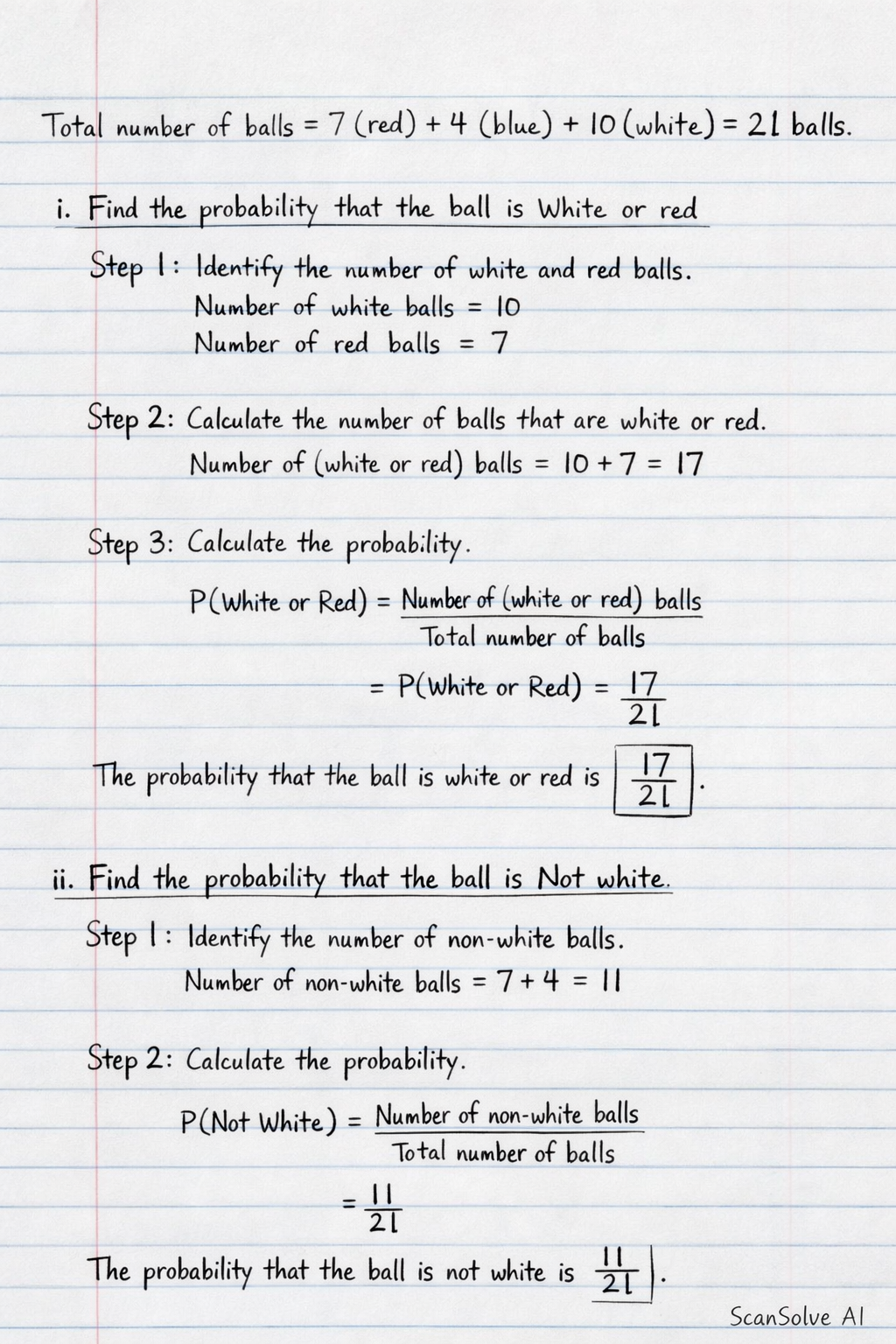
I will solve the probability questions (16.A and 16.B) as they are complete. Questions B, C, and D regarding the pyramid cannot be solved without the initial description or diagram of the pyramid, which is missing from the image. Question 16.A: A box containing 7 red balls, 4 blue balls and 10 white one. A ball is taken at random. First, calculate the total number of balls: Total number of balls = 7 (red) + 4 (blue) + 10 (white) = 21 balls. i. Find the probability that the ball is White or red Step 1: Identify the number of white and red balls. Number of white balls = 10 Number of red balls = 7 Step 2: Calculate the number of balls that are white or red. Number of (white or red) balls = 10 + 7 = 17 Step 3: Calculate the probability. P(White or Red) = Number of (white or red) ballsTotal number of balls = (17)/(21) The probability that the ball is white or red is (17)/(21). ii. Find the probability that the ball is Not white Step 1: Identify the number of non-white balls. Non-white balls are blue or red. Number of blue balls = 4 Number of red balls = 7 Number of (not white) balls = 4 + 7 = 11 Step 2: Calculate the probability. P(Not White) = Number of (not white) ballsTotal number of balls = (11)/(21) The probability that the ball is not white is (11)/(21). Question 16.B: If A B = on random experiment such that P(A) = (1)/(5) and P(B) = (1)/(3). Find the probability of the following events. The condition A B = means that events A and B are mutually exclusive. i. A or B happens Step 1: Use the formula for the probability of the union of two mutually exclusive events. For mutually exclusive events, P(A or B) = P(A B) = P(A) + P(B). Step 2: Substitute the given probabilities and calculate. P(A B) = (1)/(5) + (1)/(3) To add the fractions, find a common denominator, which is 15. P(A B) = (1 × 3)/(5 × 3) + (1 × 5)/(3 × 5) = (3)/(15) + (5)/(15) = (3+5)/(15) = (8)/(15) The probability that A or B happens is (8)/(15). ii. A and B happens Step 1: Understand what "A and B happens" means in terms of probability. This refers to the probability of the intersection of A and B, P(A B). Step 2: Use the given information that A B = . Since the intersection of A and B is an empty set, it means the events cannot happen simultaneously. P(A B) = 0 The probability that A and B happens is 0. iii. A or B not happens Step 1: Understand what "A or B not happens" means. This refers to the complement of the event "A or B happens", which is P((A B)'). Step 2: Use the complement rule: P(E') = 1 - P(E). P((A B)') = 1 - P(A B) Step 3: Substitute the value of P(A B) from part 16.B.i. P((A B)') = 1 - (8)/(15) P((A B)') = (15)/(15) - (8)/(15) = (15-8)/(15) = (7)/(15) The probability that A or B not happens is (7)/(15).