
A dice is thrown one .find the probably of getting a number divided by 3
Mathematics
ScanSolve AI Answer
Answer
Step-by-step solution
3 stepsWhen a fair die is thrown once, the possible outcomes are the numbers 1, 2, 3, 4, 5, and 6.
Determine the total number of possible outcomes.
The total number of outcomes when throwing a single die is 6.
Determine the number of favorable outcomes.
We are looking for numbers divisible by 3. From the possible outcomes , the numbers divisible by 3 are 3 and 6.
So, there are 2 favorable outcomes.Calculate the probability.
The probability of an event is given by the formula:
The probability of getting a number divisible by 3 is:
Was this helpful?
Try one yourself
A new problem that tests the same skill.
Still stuck on this one?
Ask a follow-up, and the answer starts from this question.
Got a different question?Ask your own question
More Mathematics Questions
QProblem: A six-sided die is thrown once. Find the probability of getting a number which is a…QWhat is the probability of rolling a 3 on a die (plural, dice)?QTwo fair dice are thrown. Find the probability of obtaining a sum of 7 or 11.QA die is rolled. Calculate the probability that it will give (a) a five (b) a score less than 3 (c)…QDie is rolled and a coin is tossed. 2. Find the probability of an even number of a head. 3. Find the…
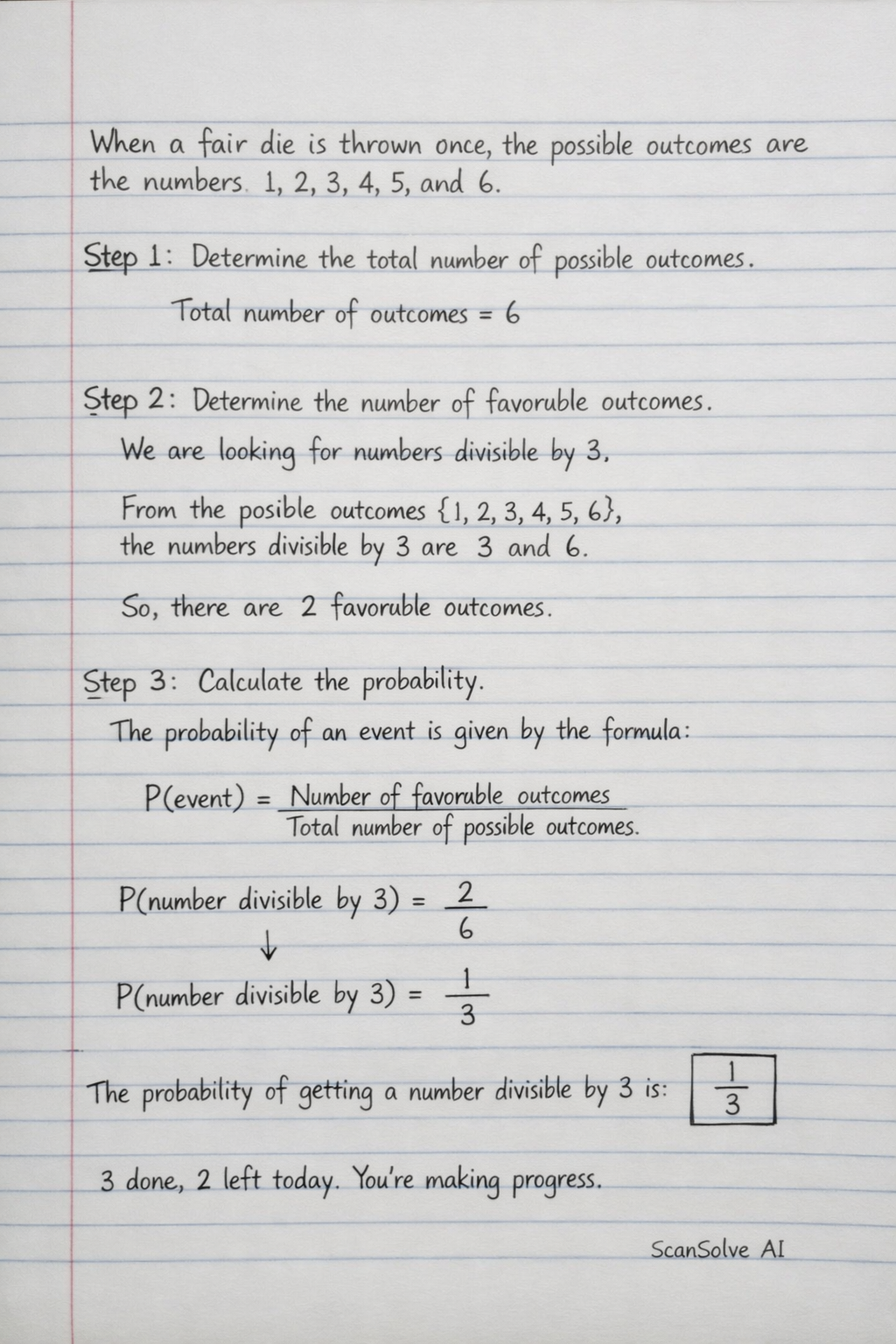
Handwritten Step-by-Step Solution
Get this as a handwritten image on WhatsApp — like a tutor wrote it for you.
Try on WhatsApp