
We read your photo as:
Two fair dice are thrown. Find the probability of obtaining a sum of 7 or 11.
ScanSolve AI Answer
Step-by-step solution
9 stepsHere are the solutions to the problems:
6. Probability of obtaining a sum of 7 or 11
Determine the total number of possible outcomes when two fair dice are thrown.
Each die has 6 faces, so the total number of outcomes is .
List the outcomes that result in a sum of 7.
The pairs are .
There are 6 outcomes that sum to 7.
The probability of getting a sum of 7 is .List the outcomes that result in a sum of 11.
The pairs are .
There are 2 outcomes that sum to 11.
The probability of getting a sum of 11 is .Since the events are mutually exclusive (a sum cannot be both 7 and 11 simultaneously), add their probabilities to find the probability of obtaining a sum of 7 or 11.
Simplify the probability.
The probability of obtaining a sum of 7 or 11 is .
7. (a) Find the position vector of P
Identify the given position vectors and the ratio.
The position vector of point F is .
The position vector of point G is .
Point P divides FG in the ratio . This means and .Use the section formula for internal division.
If a point P divides the line segment joining points F and G with position vectors and respectively, in the ratio , then the position vector of P, , is given by:
Substitute the given values into the formula.
Simplify the expression.
The position vector of P is .
Still stuck on this one?
Ask a follow-up, and the answer starts from this question.
More Mathematics Questions
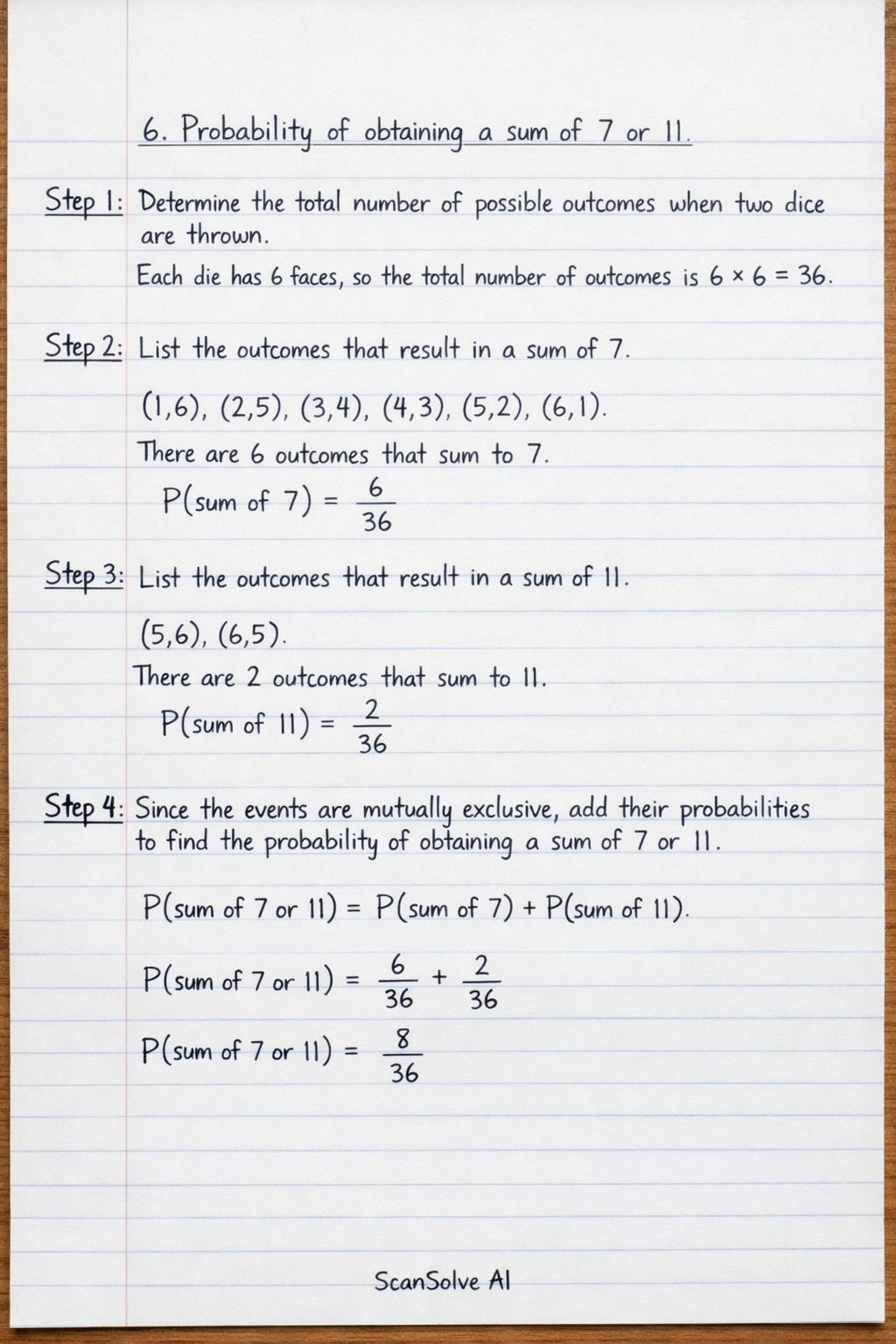
Handwritten Step-by-Step Solution
Get this as a handwritten image on WhatsApp — like a tutor wrote it for you.
Try on WhatsApp