
We read your photo as:
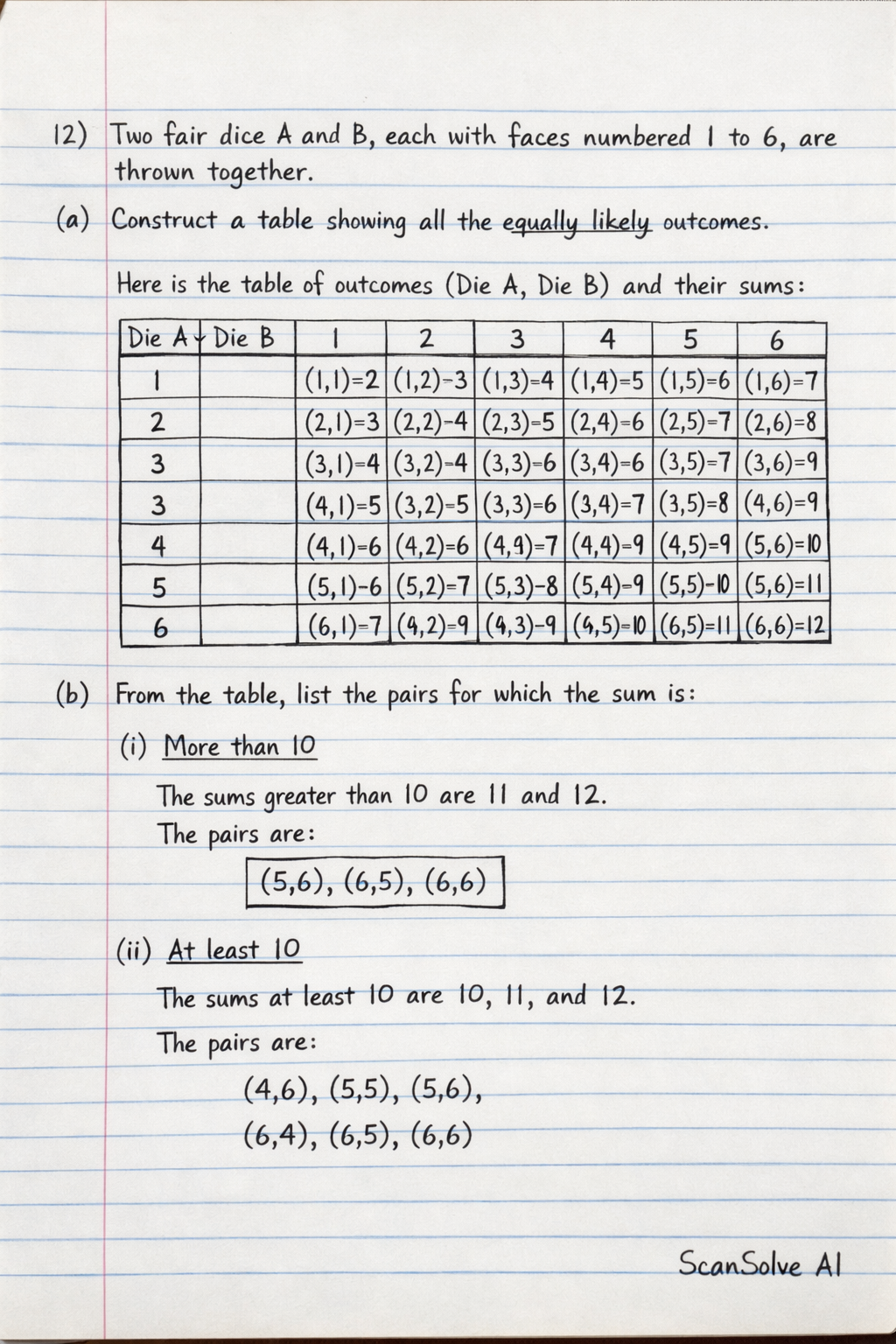
Two fair dice A and B, each with faces numbered 1 to 6, are thrown together. a) Construct a table showing all outcomes. b) List pairs summing to more than 10, and at least 10. c) Find probability sum
ScanSolve AI Answer
Answers
4 partsStep-by-step solution
6 steps12) Two fair dice A and B, each with faces numbered 1 to 6, are thrown together.
Part a
Construct a table showing all the equally likely outcomes.
The table below shows the outcomes as (Die A, Die B) and their sum.
Part b(i)(5,6), (6,5), (6,6)
More than 10
From your table list the pair of numbers on the two dice for which the sum is
The sums greater than 10 are 11 and 12.
The pairs are:
Part b(ii)(4,6), (5,5), (6,4), (5,6), (6,5), (6,6)
At least 10
The sums at least 10 are 10, 11, and 12.
The pairs are:
Part c(i)
More than 10
Find the probability that the sum of the numbers on the two dice is
Identify the number of outcomes where the sum is more than 10.
From part b) i), there are 3 such outcomes: (5,6), (6,5), (6,6).
The total number of possible outcomes is .
Calculate the probability.
The probability is .
Part c(ii)
At least 10
Identify the number of outcomes where the sum is at least 10.
From part b) ii), there are 6 such outcomes: (4,6), (5,5), (6,4), (5,6), (6,5), (6,6).
The total number of possible outcomes is 36.
Calculate the probability.
The probability is .
Try one yourself
A new problem that tests the same skill.
Still stuck on this one?
Ask a follow-up, and the answer starts from this question.
More Mathematics Questions
Handwritten Step-by-Step Solution
Get this as a handwritten image on WhatsApp — like a tutor wrote it for you.
Try on WhatsApp