
We read your photo as:
What is the probability of rolling a sum of nine on the first throw and a sum of six on the second throw of two fair dice?
ScanSolve AI Answer
Answer
Step-by-step solution
4 stepsHere's how to solve this probability problem.
Determine the total number of possible outcomes when two fair dice are thrown.
When two fair dice are thrown, each die has 6 possible outcomes. The total number of possible outcomes is .
Calculate the probability of obtaining a sum of nine in the first throw.
The combinations that result in a sum of nine are:
, , ,
There are 4 favorable outcomes for a sum of nine.
The probability of getting a sum of nine, , is:Calculate the probability of obtaining a sum of six in the second throw.
The combinations that result in a sum of six are:
, , , ,
There are 5 favorable outcomes for a sum of six.
The probability of getting a sum of six, , is:Calculate the probability of both independent events occurring.
Since the two throws are independent events, the probability of both events happening is the product of their individual probabilities:
The probability of obtaining a sum of nine in the first throw and a sum of six in the second throw is .
Try one yourself
A new problem that tests the same skill.
Still stuck on this one?
Ask a follow-up, and the answer starts from this question.
More Mathematics Questions
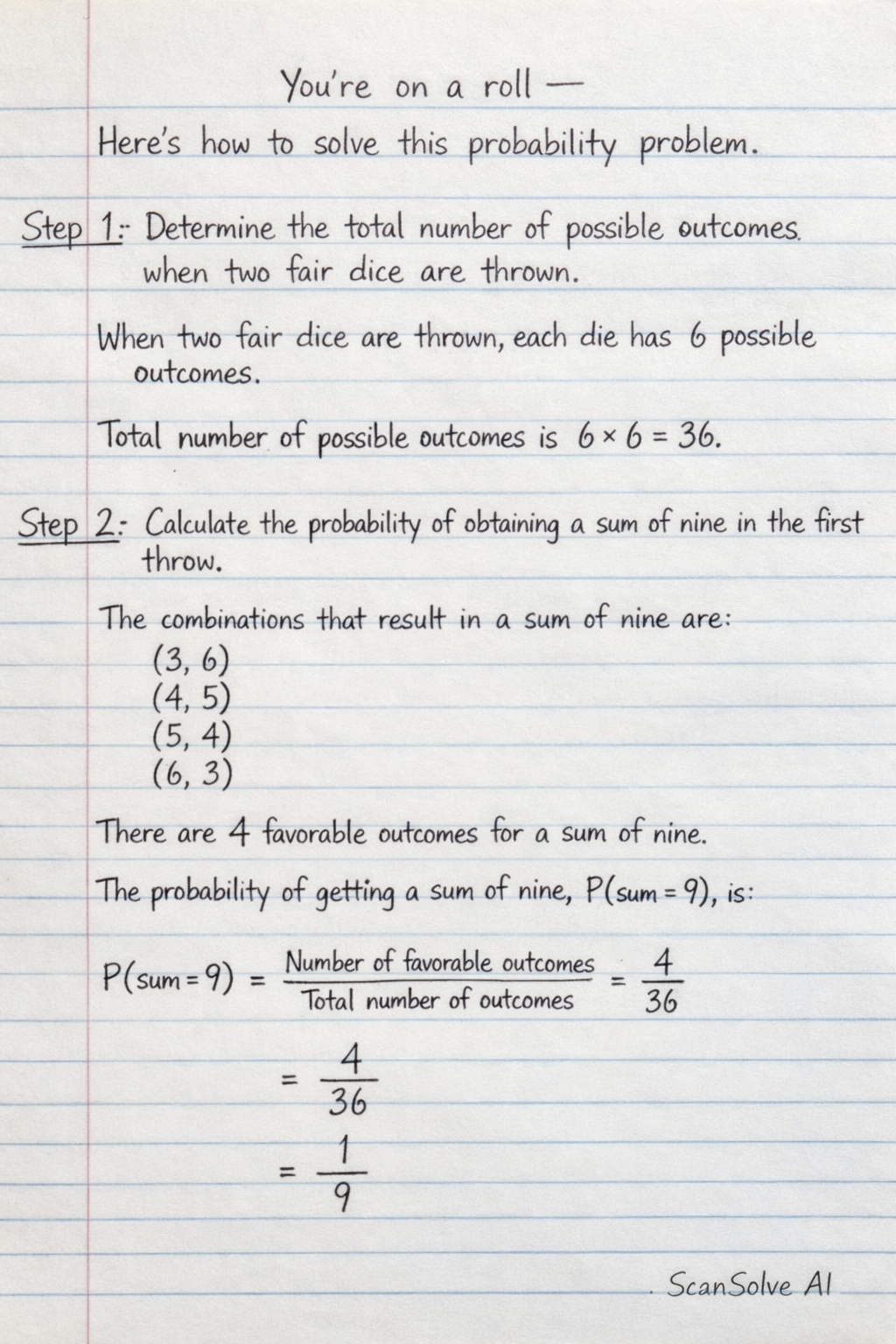
Handwritten Step-by-Step Solution
Get this as a handwritten image on WhatsApp — like a tutor wrote it for you.
Try on WhatsApp