
We read your photo as:
A dice was rolled multiple times. The results of the rolls are summarized by the counts of each outcome, N1, N2, N3, N4, N5, N6. Use the following clues to determine the number of times each outcome o
ScanSolve AI Answer
Answer
Step-by-step solution
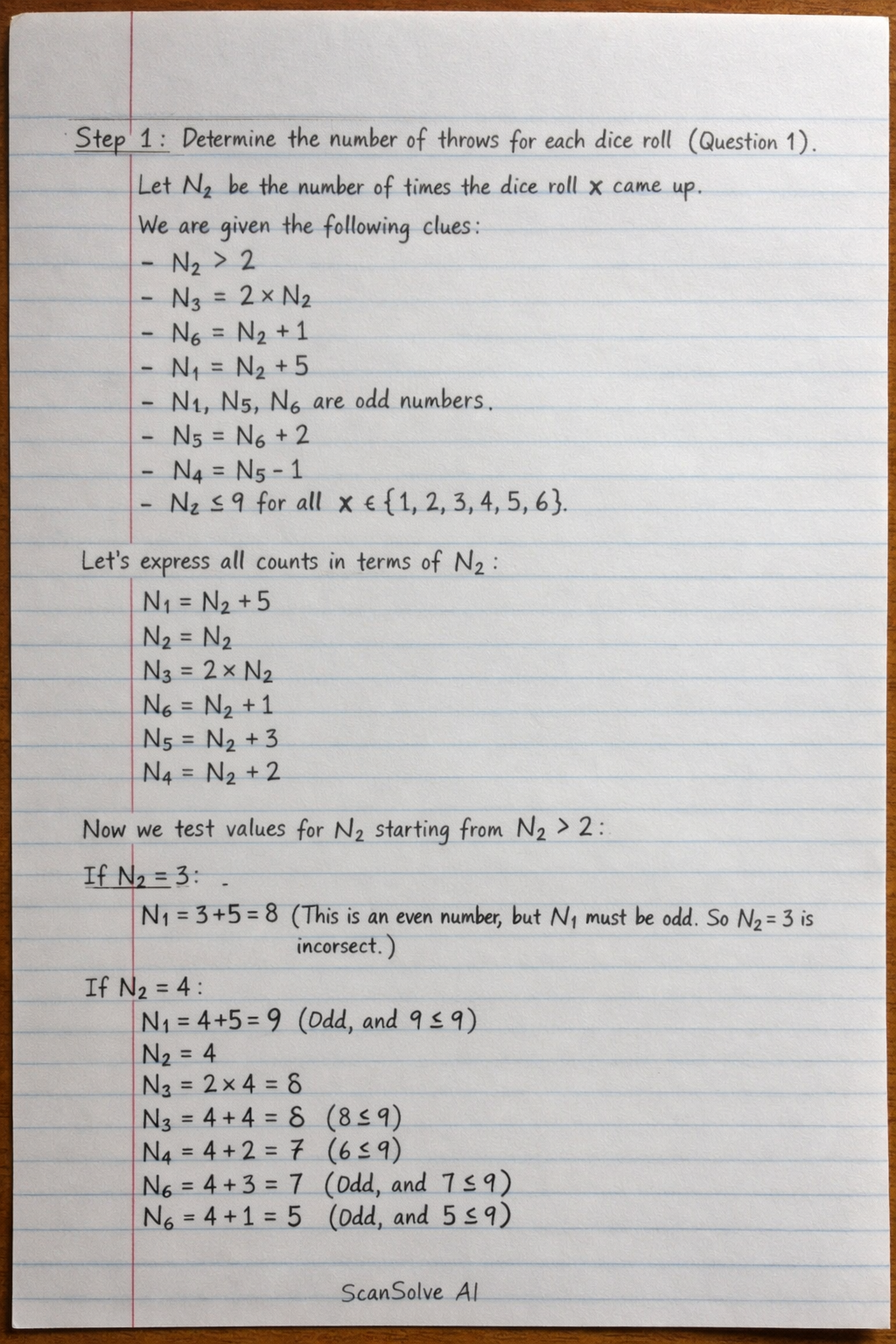
2 stepsDetermine the number of throws for each dice roll (Question 1).
Let be the number of times the dice roll came up.
We are given the following clues:- , , are odd numbers.
- for all .
Let's express all counts in terms of :
Now we test values for starting from :
If :
(This is an even number, but must be odd. So is incorrect.)If :
(Odd, and )
()
()
()
(Odd, and )
(Odd, and )All conditions are met for .
- (more than two times) ✅
- (twice as many as ) ✅
- (one more than ) ✅
- (five more than ) ✅
- , , (all odd) ✅
- (two more than ) ✅
- (one less than ) ✅
- All counts are ✅
The number of throws for each dice roll are:
- For 1 dot:
- For 2 dots:
- For 3 dots:
- For 4 dots:
- For 5 dots:
- For 6 dots:
Fill in the table:
Number of dots 1 2 3 4 5 6 Number of throws 9 4 8 6 7 5 Complete the bar chart (Question 2).
Based on the table from Step 1, draw bars for each number of dots up to the corresponding number of throws.
- For 1 dot: Draw a bar up to 9 on the "Number of throws" axis.
- For 2 dots: Draw a bar up to 4 on the "Number of throws" axis.
- For 3 dots: Draw a bar up to 8 on the "Number of throws" axis.
- For 4 dots: Draw a bar up to 6 on the "Number of throws" axis.
- For 5 dots: Draw a bar up to 7 on the "Number of throws" axis.
- For 6 dots: Draw a bar up to 5 on the "Number of throws" axis.
The total number of throws is the sum of all throws:
Total throws .
The box next to "Use the table to complete this bar chart of Luke's results" should contain .
Try one yourself
A new problem that tests the same skill.
Still stuck on this one?
Ask a follow-up, and the answer starts from this question.
More Mathematics Questions
Handwritten Step-by-Step Solution
Get this as a handwritten image on WhatsApp — like a tutor wrote it for you.
Try on WhatsApp