A discrete random variable X has the following probability distribution: P(X=0)=a, P(X=1)=a, P(X=2)=a, P(X=3)=b, P(X=4)=b. If P(X>=2) = 3P(X<2), find the values of a and b, and the expected value of X
|Mathematics
A discrete random variable X has the following probability distribution: P(X=0)=a, P(X=1)=a, P(X=2)=a, P(X=3)=b, P(X=4)=b. If P(X>=2) = 3P(X<2), find the values of a and b, and the expected value of X
ScanSolve AI Answer
Answer
a=81,b=165
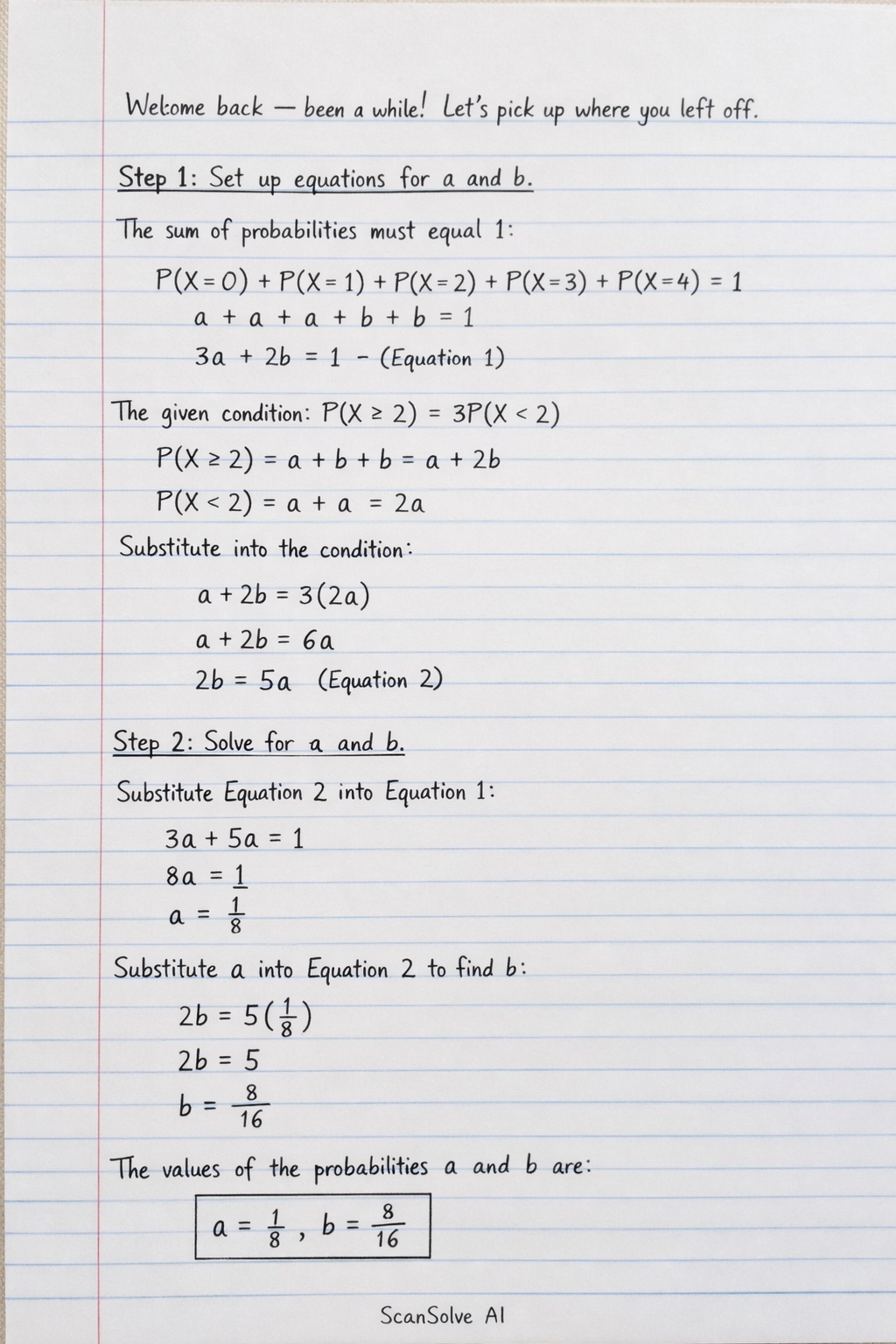
Welcome back — been a while! Let's pick up where you left off.
Here's how to solve the problem:
Step 1: Set up equations for a and b.
The sum of all probabilities in a distribution must equal 1:
P(X=0)+P(X=1)+P(X=2)+P(X=3)+P(X=4)=1a+a+a+b+b=13a+2b=1(Equation1)
The given condition is P(X≥2)=3P(X<2).
Calculate P(X≥2):
P(X≥2)=P(X=2)+P(X=3)+P(X=4)=a+b+b=a+2b
Calculate P(X<2):
P(X<2)=P(X=0)+P(X=1)=a+a=2a
Substitute these into the given condition:
a+2b=3(2a)a+2b=6a2b=5a(Equation2)
Step 2: Solve for a and b.
Substitute Equation 2 into Equation 1:
3a+(5a)=18a=1a=81
Now substitute the value of a back into Equation 2 to find b:
2b=5(81)2b=85b=165a) The values of the probabilities a and b are:a=81,b=165
Step 3: Calculate the expected value of X, E(X).
The formula for the expected value is E(X)=∑x⋅P(X=x).
E(X)=(0⋅a)+(1⋅a)+(2⋅a)+(3⋅b)+(4⋅b)E(X)=0+a+2a+3b+4bE(X)=3a+7b
Substitute the values of a=81 and b=165:
E(X)=3(81)+7(165)E(X)=83+1635E(X)=166+1635E(X)=1641b) The expected value of X is:E(X)=1641
Step 4: Calculate the standard deviation of X, σX.
First, calculate E(X2):
E(X2)=∑x2⋅P(X=x)E(X2)=(02⋅a)+(12⋅a)+(22⋅a)+(32⋅b)+(42⋅b)E(X2)=0+a+4a+9b+16bE(X2)=5a+25b
Substitute the values of a=81 and b=165:
E(X2)=5(81)+25(165)E(X2)=85+16125E(X2)=1610+16125E(X2)=16135
Next, calculate the variance, Var(X)=E(X2)−[E(X)]2:
Var(X)=16135−(1641)2Var(X)=16135−2561681Var(X)=256135⋅16−2561681Var(X)=2562160−2561681Var(X)=256479
Finally, calculate the standard deviation, σX=Var(X):
σX=256479σX=16479c) The standard deviation of X is:σX=16479
Step 5: Calculate the expected value of Y where Y=5X+3.
Using the property E(cX+d)=cE(X)+d:
E(Y)=E(5X+3)=5E(X)+3
Substitute the value of E(X)=1641:
E(Y)=5(1641)+3E(Y)=16205+3E(Y)=16205+1648E(Y)=16253d) The expected value of Y where Y=5X+3 is:E(Y)=16253
Send me the next one 📸
Was this helpful?
Need help with your own homework?
Get instant step-by-step solutions to any question. Free to start.
Welcome back — been a while! Let's pick up where you left off. Here's how to solve the problem: Step 1: Set up equations for a and b.
A discrete random variable X has the following probability distribution: P(X=0)=a, P(X=1)=a, P(X=2)=a, P(X=3)=b, P(X=4)=b. If P(X>=2) = 3P(X<2), find the values of a and b, and the expected value of X
This mathematics problem involves applying core mathematical principles and formulas. Below you will find a complete step-by-step solution with detailed explanations for each step, helping you understand not just the answer but the method behind it.
ScanSolve AI Answer
Welcome back — been a while! Let's pick up where you left off. Here's how to solve the problem: Step 1: Set up equations for a and b. The sum of all probabilities in a distribution must equal 1: P(X=0) + P(X=1) + P(X=2) + P(X=3) + P(X=4) = 1 a + a + a + b + b = 1 3a + 2b = 1 (Equation 1) The given condition is P(X ≥ 2) = 3P(X < 2). Calculate P(X ≥ 2): P(X ≥ 2) = P(X=2) + P(X=3) + P(X=4) = a + b + b = a + 2b Calculate P(X < 2): P(X < 2) = P(X=0) + P(X=1) = a + a = 2a Substitute these into the given condition: a + 2b = 3(2a) a + 2b = 6a 2b = 5a (Equation 2) Step 2: Solve for a and b. Substitute Equation 2 into Equation 1: 3a + (5a) = 1 8a = 1 a = (1)/(8) Now substitute the value of a back into Equation 2 to find b: 2b = 5 ((1)/(8)) 2b = (5)/(8) b = (5)/(16) a) The values of the probabilities a and b are: a = (1)/(8), b = (5)/(16) Step 3: Calculate the expected value of X, E(X). The formula for the expected value is E(X) = x · P(X=x). E(X) = (0 · a) + (1 · a) + (2 · a) + (3 · b) + (4 · b) E(X) = 0 + a + 2a + 3b + 4b E(X) = 3a + 7b Substitute the values of a = (1)/(8) and b = (5)/(16): E(X) = 3 ((1)/(8)) + 7 ((5)/(16)) E(X) = (3)/(8) + (35)/(16) E(X) = (6)/(16) + (35)/(16) E(X) = (41)/(16) b) The expected value of X is: E(X) = (41)/(16) Step 4: Calculate the standard deviation of X, _X. First, calculate E(X^2): E(X^2) = x^2 · P(X=x) E(X^2) = (0^2 · a) + (1^2 · a) + (2^2 · a) + (3^2 · b) + (4^2 · b) E(X^2) = 0 + a + 4a + 9b + 16b E(X^2) = 5a + 25b Substitute the values of a = (1)/(8) and b = (5)/(16): E(X^2) = 5 ((1)/(8)) + 25 ((5)/(16)) E(X^2) = (5)/(8) + (125)/(16) E(X^2) = (10)/(16) + (125)/(16) E(X^2) = (135)/(16) Next, calculate the variance, Var(X) = E(X^2) - [E(X)]^2: Var(X) = (135)/(16) - ((41)/(16))^2 Var(X) = (135)/(16) - (1681)/(256) Var(X) = (135 · 16)/(256) - (1681)/(256) Var(X) = (2160)/(256) - (1681)/(256) Var(X) = (479)/(256) Finally, calculate the standard deviation, _X = sqrt(Var(X)): _X = sqrt((479)/(256)) _X = sqrt(479)16 c) The standard deviation of X is: _X = sqrt(479)16 Step 5: Calculate the expected value of Y where Y = 5X + 3. Using the property E(cX + d) = cE(X) + d: E(Y) = E(5X + 3) = 5E(X) + 3 Substitute the value of E(X) = (41)/(16): E(Y) = 5 ((41)/(16)) + 3 E(Y) = (205)/(16) + 3 E(Y) = (205)/(16) + (48)/(16) E(Y) = (253)/(16) d) The expected value of Y where Y = 5X + 3 is: E(Y) = (253)/(16) Send me the next one 📸