a) Find the binomial expansion of sqrt(1-8x), |x| < (1)/(8), in ascending powers of x up to and including the term in x3, simplifying each term. b) Show that, when x = (1)/(100), the exact value of sq
|Mathematics
a) Find the binomial expansion of sqrt(1-8x), |x| < (1)/(8), in ascending powers of x up to and including the term in x3, simplifying each term. b) Show that, when x = (1)/(100), the exact value of sq
ScanSolve AI Answer
Answer
1−4x−8x2−32x3
You're on a roll — here are the solutions to question 2.
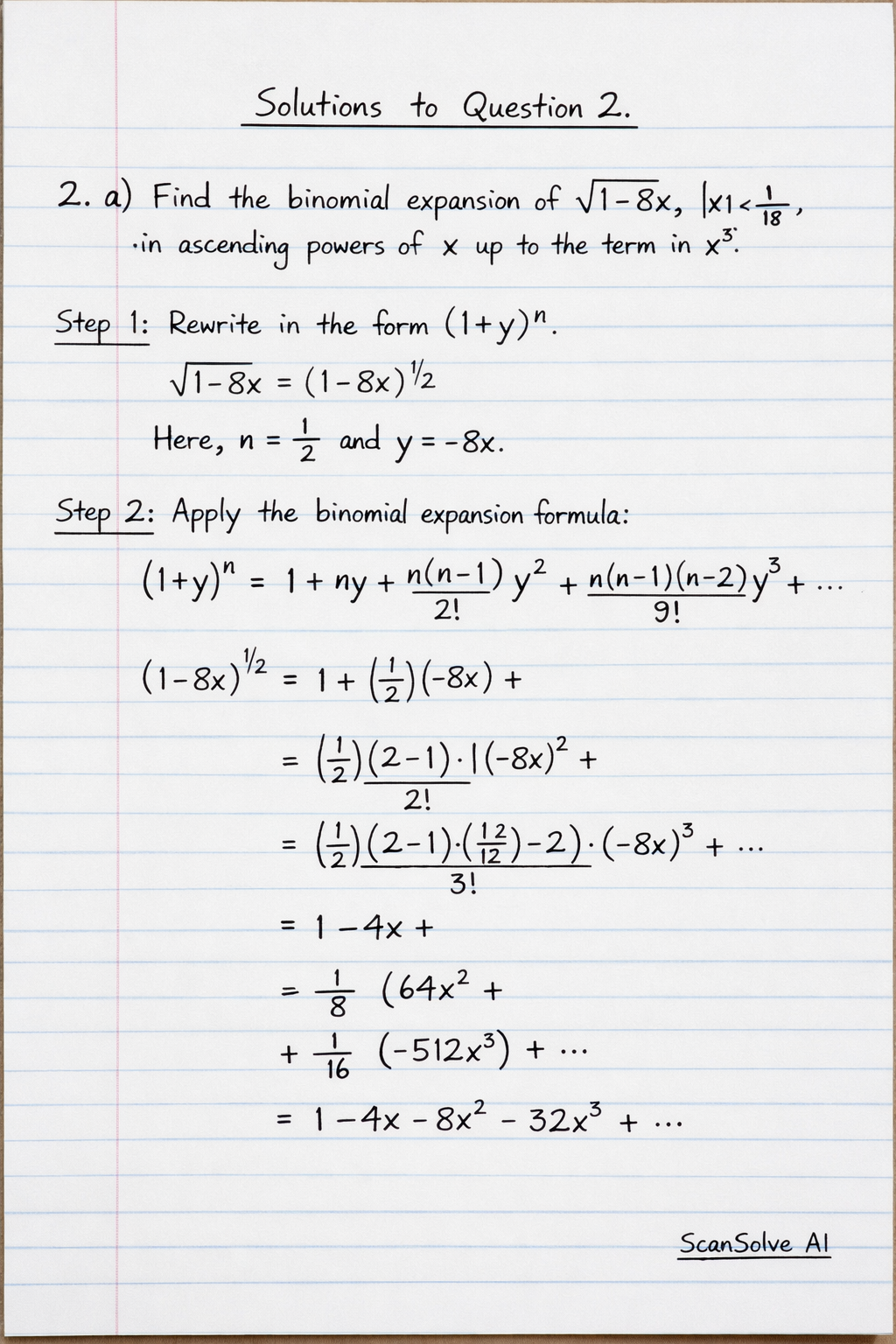
2. a) Find the binomial expansion of 1−8x, ∣x∣<81, in ascending powers of x up to and including the term in x3, simplifying each term.
Step 1: Rewrite the expression in the form (1+y)n.
1−8x=(1−8x)21
Here, n=21 and y=−8x.
Step 2: Apply the binomial expansion formula (1+y)n=1+ny+2!n(n−1)y2+3!n(n−1)(n−2)y3+….
(1−8x)21=1+(21)(−8x)+2!21(21−1)(−8x)2+3!21(21−1)(21−2)(−8x)3+…
Step 3: Simplify each term.
=1+(21)(−8x)+221(−21)(64x2)+621(−21)(−23)(−512x3)+…=1−4x+2−41(64x2)+683(−512x3)+…=1−4x−81(64x2)+483(−512x3)+…=1−4x−8x2−32x3+…
The binomial expansion is 1−4x−8x2−32x3.
b) Show that, when x=1001, the exact value of 1−8x is 523.
Step 1: Substitute x=1001 into the expression 1−8x.
1−8(1001)
Step 2: Simplify the expression.
=1−1008=1−252=2525−252=2523=2523=523
This shows that the exact value of 1−8x is 523.
c) Substitute x=1001 into the expansion in part (a) and hence obtain an approximation to 23. Give your answer to 5 decimal places.
Step 1: Substitute x=1001=0.01 into the expansion from part (a): 1−4x−8x2−32x3.
1−8x≈1−4(0.01)−8(0.01)2−32(0.01)3
Step 2: Calculate the value.
=1−0.04−8(0.0001)−32(0.000001)=1−0.04−0.0008−0.000032=0.96−0.0008−0.000032=0.9592−0.000032=0.959168
Step 3: Use the result from part (b) to find an approximation for 23.
We know 523≈0.959168.
23≈5×0.95916823≈4.79584
Step 4: Round the answer to 5 decimal places.
23≈4.79584
The approximation to 23 is 4.79584.
d) Given that (2+x)5+(2−x)5=A+Bx2+Cx4, find the constants A, B and C.
Step 1: Expand (2+x)5 using the binomial theorem (a+b)n=∑k=0n(kn)an−kbk.
(2+x)5=(05)25x0+(15)24x1+(25)23x2+(35)22x3+(45)21x4+(55)20x5=1(32)(1)+5(16)x+10(8)x2+10(4)x3+5(2)x4+1(1)x5=32+80x+80x2+40x3+10x4+x5
Step 2: Expand (2−x)5. This is similar to (2+x)5, but with alternating signs for odd powers of x.
(2−x)5=(05)25(−x)0+(15)24(−x)1+(25)23(−x)2+(35)22(−x)3+(45)21(−x)4+(55)20(−x)5=1(32)(1)+5(16)(−x)+10(8)x2+10(4)(−x3)+5(2)x4+1(1)(−x5)=32−80x+80x2−40x3+10x4−x5
Step 3: Add the two expansions.
(2+x)5+(2−x)5=(32+80x+80x2+40x3+10x4+x5)+(32−80x+80x2−40x3+10x4−x5)
Combine like terms:
=(32+32)+(80x−80x)+(80x2+80x2)+(40x3−40x3)+(10x4+10x4)+(x5−x5)=64+0x+160x2+0x3+20x4+0x5=64+160x2+20x4
Step 4: Compare this result with A+Bx2+Cx4.
By comparing the coefficients:
A=64B=160C=20
The constants are A=64,B=160,C=20.
Send me the next one 📸
Was this helpful?
Need help with your own homework?
Get instant step-by-step solutions to any question. Free to start.
You're on a roll — here are the solutions to question 2. 2.
a) Find the binomial expansion of sqrt(1-8x), |x| < (1)/(8), in ascending powers of x up to and including the term in x3, simplifying each term. b) Show that, when x = (1)/(100), the exact value of sq
This mathematics problem involves applying core mathematical principles and formulas. Below you will find a complete step-by-step solution with detailed explanations for each step, helping you understand not just the answer but the method behind it.
ScanSolve AI Answer
You're on a roll — here are the solutions to question 2. 2. a) Find the binomial expansion of sqrt(1-8x), |x| < (1)/(8), in ascending powers of x up to and including the term in x^3, simplifying each term. Step 1: Rewrite the expression in the form (1+y)^n. sqrt(1-8x) = (1-8x)^(1)/(2) Here, n = (1)/(2) and y = -8x. Step 2: Apply the binomial expansion formula (1+y)^n = 1 + ny + (n(n-1))/(2!)y^2 + (n(n-1)(n-2))/(3!)y^3 + . (1-8x)^(1)/(2) = 1 + ((1)/(2))(-8x) + (1)/(2)((1)/(2)-1)2!(-8x)^2 + (1)/(2)((1)/(2)-1)((1)/(2)-2)3!(-8x)^3 + Step 3: Simplify each term. = 1 + ((1)/(2))(-8x) + (1)/(2)(-(1)/(2))2(64x^2) + (1)/(2)(-(1)/(2))(-(3)/(2))6(-512x^3) + = 1 - 4x + (-1)/(4)2(64x^2) + (3)/(8)6(-512x^3) + = 1 - 4x - (1)/(8)(64x^2) + (3)/(48)(-512x^3) + = 1 - 4x - 8x^2 - 32x^3 + The binomial expansion is 1 - 4x - 8x^2 - 32x^3. b) Show that, when x = (1)/(100), the exact value of sqrt(1-8x) is sqrt(23)5. Step 1: Substitute x = (1)/(100) into the expression sqrt(1-8x). sqrt(1 - 8((1)/(100))) Step 2: Simplify the expression. = sqrt(1 - (8)/(100)) = sqrt(1 - (2)/(25)) = sqrt((25)/(25) - (2)/(25)) = sqrt((23)/(25)) = sqrt(23)sqrt(25) = sqrt(23)5 This shows that the exact value of sqrt(1-8x) is sqrt(23)5. c) Substitute x = (1)/(100) into the expansion in part (a) and hence obtain an approximation to sqrt(23). Give your answer to 5 decimal places. Step 1: Substitute x = (1)/(100) = 0.01 into the expansion from part (a): 1 - 4x - 8x^2 - 32x^3. sqrt(1-8x) ≈ 1 - 4(0.01) - 8(0.01)^2 - 32(0.01)^3 Step 2: Calculate the value. = 1 - 0.04 - 8(0.0001) - 32(0.000001) = 1 - 0.04 - 0.0008 - 0.000032 = 0.96 - 0.0008 - 0.000032 = 0.9592 - 0.000032 = 0.959168 Step 3: Use the result from part (b) to find an approximation for sqrt(23). We know sqrt(23)5 ≈ 0.959168. sqrt(23) ≈ 5 × 0.959168 sqrt(23) ≈ 4.79584 Step 4: Round the answer to 5 decimal places. sqrt(23) ≈ 4.79584 The approximation to sqrt(23) is 4.79584. d) Given that (2+x)^5 + (2-x)^5 = A + Bx^2 + Cx^4, find the constants A, B and C. Step 1: Expand (2+x)^5 using the binomial theorem (a+b)^n = _k=0^n nk a^n-k b^k. (2+x)^5 = 502^5x^0 + 512^4x^1 + 522^3x^2 + 532^2x^3 + 542^1x^4 + 552^0x^5 = 1(32)(1) + 5(16)x + 10(8)x^2 + 10(4)x^3 + 5(2)x^4 + 1(1)x^5 = 32 + 80x + 80x^2 + 40x^3 + 10x^4 + x^5 Step 2: Expand (2-x)^5. This is similar to (2+x)^5, but with alternating signs for odd powers of x. (2-x)^5 = 502^5(-x)^0 + 512^4(-x)^1 + 522^3(-x)^2 + 532^2(-x)^3 + 542^1(-x)^4 + 552^0(-x)^5 = 1(32)(1) + 5(16)(-x) + 10(8)x^2 + 10(4)(-x^3) + 5(2)x^4 + 1(1)(-x^5) = 32 - 80x + 80x^2 - 40x^3 + 10x^4 - x^5 Step 3: Add the two expansions. (2+x)^5 + (2-x)^5 = (32 + 80x + 80x^2 + 40x^3 + 10x^4 + x^5) + (32 - 80x + 80x^2 - 40x^3 + 10x^4 - x^5) Combine like terms: = (32+32) + (80x-80x) + (80x^2+80x^2) + (40x^3-40x^3) + (10x^4+10x^4) + (x^5-x^5) = 64 + 0x + 160x^2 + 0x^3 + 20x^4 + 0x^5 = 64 + 160x^2 + 20x^4 Step 4: Compare this result with A + Bx^2 + Cx^4. By comparing the coefficients: A = 64 B = 160 C = 20 The constants are A=64, B=160, C=20. Send me the next one 📸